The Stanford Center on Longevity focuses on the changes, challenges and opportunities of a rapidly aging population.
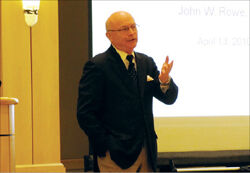
As the inaugural speaker for the center’s Distinguished Lecture Series, John W. Rowe, M.D., an expert on health-care economics and healthy aging, dispelled myths about aging and offered solutions for problems in a society where the elderly far outnumber the youth. Rowe, former CEO of Aetna Inc., discussed “Myths and Realities of an Aging Society” April 13 at the Arrillaga Alumni Center at Stanford University.
Rowe addressed the importance of confronting the concerns of an aging society and finding solutions to consequent problems, stressing collaboration with policymakers and industry leaders to tackle inevitable problems.
“We have difficulty creating a sense of urgency with policymakers,” he said, “because their views of an aging society are encapsulated in the concentric series of almost impenetrable myths.”
One myth Rowe dismantled: Old age equals diminished capacity. This may have been true in the past, but “aging has changed in America,” he said, adding that being 65 now is much better than being 65 in the 19th century.
“Imagine a society with more walkers than strollers,” Rowe said. “That’s an aging society.”
Rowe explained the sea change in America’s aging demographic.
“People over 60 outnumber the people under 15. … China will be there in 2040, (the U.S.) will be there in 24 months.”
Three factors have converged to produce an aging society, according to Rowe.
• A dramatic increase in life expectancy. The average lifespan in the United States has increased by 30 years in the past century.
• A significant increase in active life expectancy. Disabilities and signs of aging that at one time occurred earlier in life are now manifesting much later. Rowe cited as an example an anecdote about medical students at Stanford who tried to guess the age of Whistler’s mother in the iconic painting from 1871. The students all guessed 85-plus, but Mrs. Whistler was only in her 60s at the time. Rowe said that’s what 65 looked like in the 19th century, illustrating a pattern of aging that is quite different today.
• The baby-boom generation. The post-World War II baby bubble now composes nearly 25 percent of the current population.
Rowe offered a counterpoint to demographic forecasts issued by the U.S. Census Bureau and the Social Security Administration, claiming that the agencies’ projections on the nation’s aging society were incorrect.
“We thought they were wrong,” Rowe said of the forecasts. “What the Census Bureau and Social Security Administration have assumed, for whatever reason, is that going forward, the additional increase in life expectancy will be less, and less and less.”
Rowe disagreed with what he called this “theory of diminishing returns.”
“We reason that there is no reason to assume this will happen,” he said.
Two factors could contribute to an increased life expectancy: biomedical advances in the prevention, diagnosis and treatment of disease; and changing the rate of aging, including various approaches that could “change the rate at which an organism ages,” Rowe said.
“If either of these occurs, or both to some degree, we would have a different situation than the government is telling us we are going to have,” he said.
The discrepancy is severe. The Social Security Administration projects that by 2050, 81 million people will be over 65; other sources forecast 100 million to 108 million seniors.
“We don’t have as much time as we thought we had to make the changes in America that we need to make,” Rowe said.
Rowe stressed the importance of maintaining a long-term perspective, involving the private sector and ensuring that policymakers have the equivalent of an environmental impact report to assess the possible consequences of policies on an aging society.