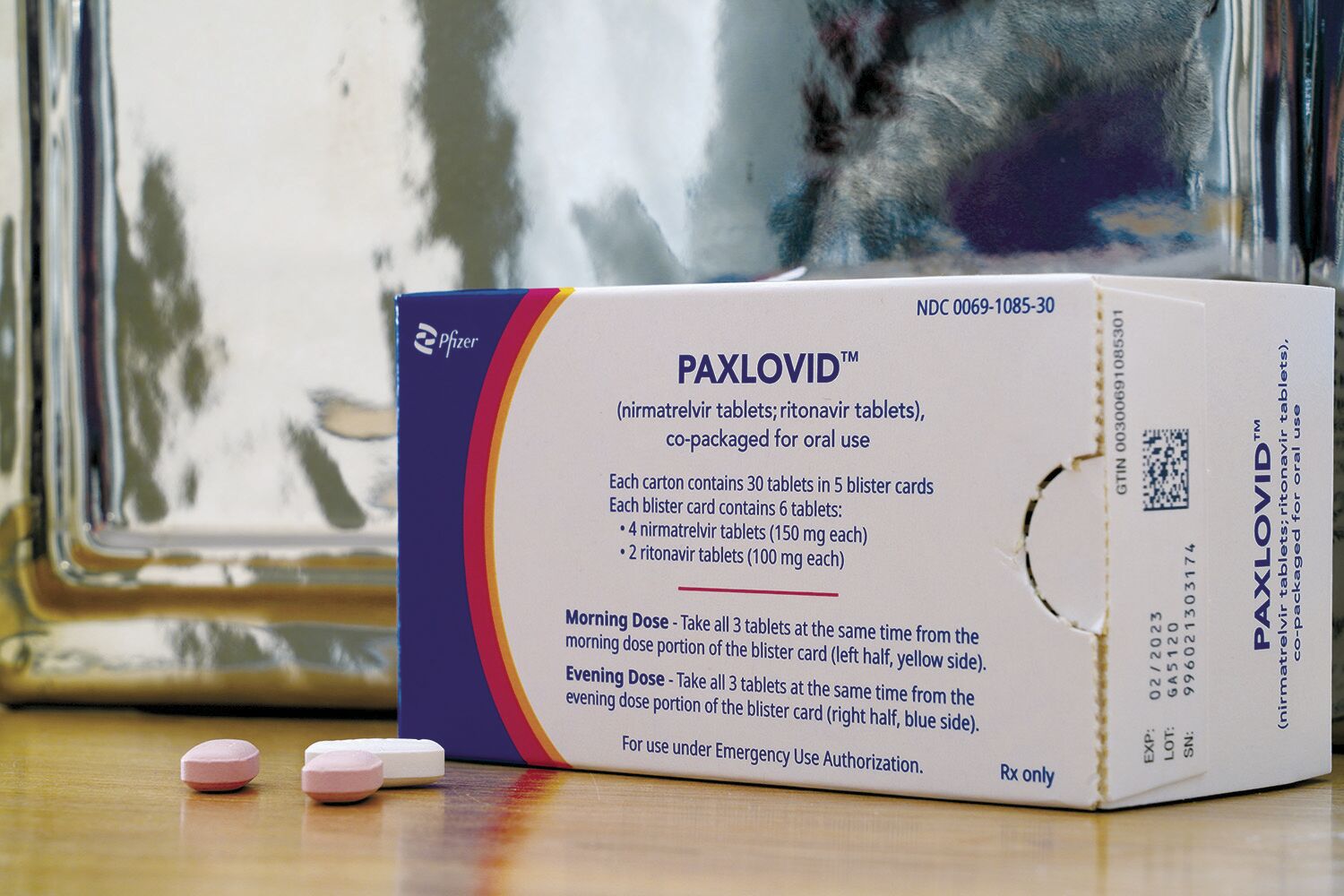
When Pfizer’s antiviral COVID-19 treatment, Paxlovid, first deployed earlier this year, local hospitals had a very limited supply for their highest-risk cases. That has changed – pharmacies throughout the region are now well stocked with Paxlovid.
The U.S. Centers for Disease Control and Prevention have issued relatively sweeping eligibility guidelines including anyone over age 60 or with one of the risk factors that once defined expanding vaccine eligibility during the scarcity of spring 2021, ranging from a body mass index over 25 to high blood pressure, cancer or immunosuppressive disorders.
Who should take Paxlovid?
But does that mean every eligible American – a sizable percentage of the population – can and should take Paxlovid every time they catch COVID? That’s a question patients and doctors are navigating in real time as they observe the results of novel treatments for a quickly changing virus.
The Paxlovid guidance is written broadly to provide guidance rather than a rigid set of criteria, according to Dr. Daniel Shin, an infectious disease specialist at El Camino Health who practices out of the hospital in Mountain View. He notes that there are other, unlisted conditions that would also clearly make a candidate eligible for Paxlovid treatment. Those patients can receive treatment. And younger, vaccinated adults with an eligible risk factor that does not appear as predictive of hospitalization or death may not need to take Paxlovid at all.
Shin said he and all doctors in the U.S. have been developing their own judgment based on what they see – which patients have gotten very sick, and which have died.
“There’s not really a recipe where you can say every person has to be on it,” Shin said. “You’re supposed to interpret those guidelines in the setting of each patient individually. … If you give me an example 45-year-old with high blood pressure, if they’re not vaccinated, I might say give them Paxlovid; if they’re vaccinated with three shots, I’d say, ‘Yeah, probably hold off.’”
Paxlovid is available only by prescription, and can be prescribed by a general practitioner or a licensed provider at one of the area’s test-to-treat pharmacy clinics. But the first decision-maker is the patient, when he or she develops symptoms and chooses whether to rapid test and when or if to consult a doctor for medical advice. Paxlovid must be administered within the first five days of symptom onset to work effectively, long before the severity of disease is obvious for most people.
Appointment?
A phone call may do
CVS pharmacies predominate among local test-to-treat options, the federal program launched by President Joe Biden to facilitate Paxlovid access. But a recent search by a Town Crier reporter turned up no appointment availability within an hour’s drive of Los Altos and Mountain View.
Dr. Ahmad Kamal, director of health-care preparedness for Santa Clara County, explained that the idea of combining all-in-one location – where people can rapid test and receive treatment quickly – requires those hard-to-get pharmacy appointments for individualized assessment because of Paxlovid’s significant drug interactions. He said that for well-insured and “well-doctored” local residents, those with access to a primary-care physician, the easiest way to access the medication is through their regular
provider.
“Every licensed health-care provider in the state is eligible to prescribe Paxlovid,” he said.
The prescription can come from anywhere, and once you have it should be easy to fill.
“Once someone has a prescription, they can pick it up at any pharmacy,” Kamal said.
Even medical practices that appear overbooked for in-person or virtual appointments can swiftly write prescriptions if they already know an existing patient, according to Shin. The crucial information – your medication list and medical history – is already established if you’re talking to your regular provider, whether it’s a primary-care doctor, geriatrician or oncologist. Unless you’re so sick that you need to have your oxygen levels and vital signs checked, an in-person visit may be totally unnecessary, he added.
“This decision doesn’t require an in-person visit and it doesn’t require a video visit,” Shin said. “If they send an online message or a phone call and said, ‘My test is positive, I’m at home, should I start Paxlovid or not?’ I usually just call the patient back, look at their chart and say ‘no’ or ‘yes, you should start it,’ and I prescribe it. It takes about 30 seconds.”
If the clock is ticking on the five-day window to start treatment and a patient can’t get seen at a local CVS walk-in clinic or get through to their primary-care physician, doctors at the region’s urgent-care clinics are also able to assess patients and write a prescription via either in-person or video visits. They will need a medical history and list of medications currently being taken.
Why take the antiviral?
Some patients may be intimidated by time constraints or lack of clarity as to their eligibility – but others are declining the drug when offered it.
“Most of the patients who want it and are willing to take it are receiving prescriptions, and they’re not having problems with supply at the retail pharmacies,” Shin said. “They’re able to get it – (but) not everyone wants to take it.”
He said he’s spoken to some patients who don’t want to have to stop other medications for five days (Paxlovid has a significant number of drug interactions). Others have read about rebound symptoms and thus wonder what the point is; others erroneously assume that because their COVID symptoms are mild, they don’t merit treatment.
Shin said he doesn’t prescribe Paxlovid to relieve your symptoms – he does it to decrease the likelihood you’ll end up in the hospital a few weeks later.
“This drug is really to decrease the progression of disease to hospitalization. It’s really to treat something that they’re not experiencing right now – that’s probably the most difficult message,” he said. “I try to explain to (patients) that the real benefit in this drug is to prevent you from getting worse and ending up in the ICU. … Before Paxlovid, and before vaccination, there were plenty of patients who through the natural course of disease would get sick, would feel better after five or six days, and about four days after that started getting severely short of breath. And that’s when they came to the emergency room, on day 11.”