In 2015, Los Altos’ Bill Brennan, president and CEO of Credo, was visiting potential customers in Tokyo, Japan, when a woman who was walking ahead of him collapsed without warning. Stunned, Brennan stopped and tried to help, holding her but feeling powerless to do more. Despite paramedics arriving swiftly, they could not revive her, and she died of cardiac arrest.
The weight of that moment deeply impacted Brennan, moving him to act. Within a week of returning to California, he completed a cardiopulmonary resuscitation (CPR) certification course, determined never to feel helpless again.
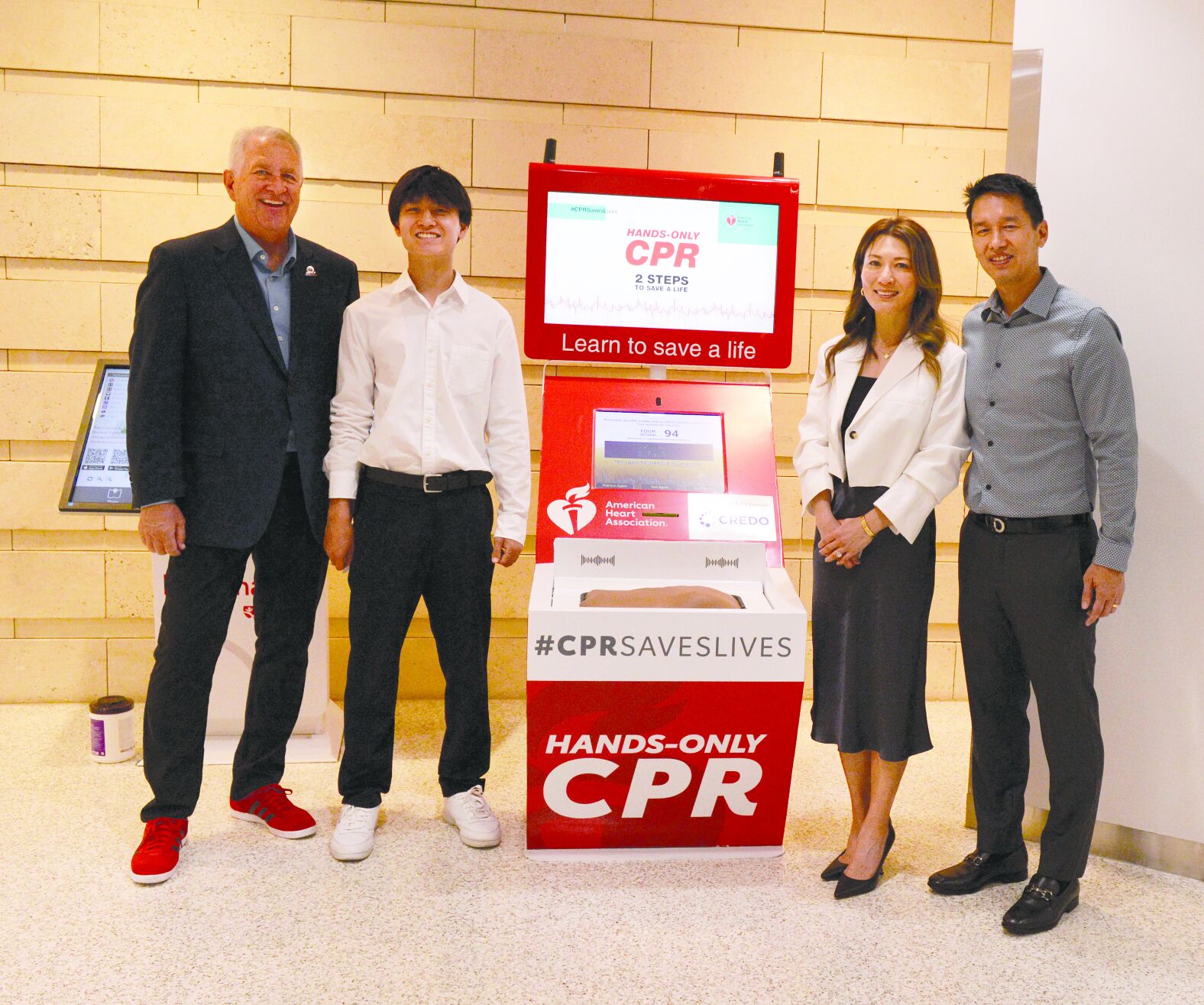
The tragedy also inspired Bill and his wife Laurie Brennan to help others learn the life-saving skill. Now, with Silicon Valley technology company Credo, the Brennan family is sponsoring a hands-only CPR training kiosk provided by the American Heart Association (AHA), the third installed in California. The kiosk is located on the first floor at Lucile Packard Children’s Hospital Stanford in Palo Alto.
“Hands-only CPR is simple to learn and can be quickly taught to almost anyone, empowering them to save a life,” Brennan said. “We have learned that even imperfect CPR is better than none at all.”
Every year, more than 350,000 cardiac arrests occur outside of a hospital, and more than 20% occur in public places. The hands-only CPR kiosk will help empower people to learn and practice CPR skills and understand how they can immediately help a person who has experienced a cardiac emergency.
To date, the hands-only CPR kiosks have been used to train more than 600,000 people.
Los Altos resident and Homestead High School student Ryan Chian was also at the recent kiosk launch and ribbon cutting. He shared his own moving survivor story about collapsing from cardiac arrest on a local basketball court and being saved by two lifeguards who performed CPR on him.
Chian is also an AHA student volunteer as a member of the Youth Leadership Council.
The kiosk features a touch screen with a video that provides an overview of hands-only CPR, followed by a practice session and a 30-second test using a manikin, or a rubber torso. The kiosk then gives feedback about the depth and rate of compressions and proper hand placement – factors that influence the effectiveness of CPR. The training can be done in about five minutes in English or Spanish with closed captioning.
“Cardiac arrest remains a leading cause of death in the United States, and survival depends on immediately receiving CPR from someone nearby,” said Liza Mudd, American Heart Association Bay Area SVP executive director. She said while certified CPR training will always be best, the kiosk can still help people save lives.
Approximately 90% of all cardiac arrest victims die, often because bystanders don’t know how to start CPR or they’re afraid they’ll do something wrong, according to the American Red Cross.
“Bystander CPR, especially if administered immediately, can double or triple a cardiac arrest victim’s chance of survival, which is why the hands-only CPR education available at the kiosk is so valuable,” said Justin Lee, M.D., board member for the American Heart Association Greater Bay Area.
There are two simple steps for hands-only CPR. Call 911 if you see a person collapse, then push hard and fast in the center of the chest to the beat of a song that has at minimum 100 beats per minute, such as Adele’s “Rolling in the Deep” or the Bee Gees’ “Stayin’ Alive.” For children and infants, CPR also requires breaths. For more on CPR with breaths, visit heart.org/nation.
For more information on the hands-only CPR campaign and to learn how to save a life, visit heart.org/handsonlycpr.