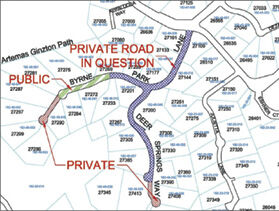
It wasn’t until 2008, when residents of Deer Springs Way and Byrne Park Lane sought to bring Comcast into their homes, that they learned they lived along private – not public – roads.
Among them was Deer Springs Way resident Nataya Boonmark.
“Of course I thought it was public,” Boonmark told a Los Altos Hills City Council ad hoc committee assembled June 22 to discuss the issue.
“We find it very frustrating for you,” said Mayor Courtenay C. Corrigan. “I’m very empathetic. But it’s not the city’s responsibility to put a disclosure packet together in with your real estate documents.”
The distinction between private and public roads is an expensive one. Comcast isn’t required to provide cable and Internet along private roads. During city council meetings, locals have complained about company representatives allegedly quoting them upwards of $5,000 to extend basic services to their homes.
But Comcast contends such numbers are inflated.
“The amounts that Comcast quoted per home ranged from $1,700 to $3,300 depending on the location and distance,” said Bryan Byrd, director of communications for Comcast’s California region.
Making do
For now, some are making do. At homework time, parents dispatch children to Starbucks to use the coffee shops’ complimentary Wi-Fi.
But it shouldn’t be this way, protests Deer Springs Way resident Colin Knight. As spokesman for 30 homeowners living on the contested roads, Knight has invested countless hours compiling documents he claims prove the two are public, meaning the city should accept responsibility for general maintenance and the installation of Comcast services. His efforts prompted the formation of a private roads ad hoc committee comprising Corrigan and Councilman Gary Waldeck, charged with investigating.
California Streets and Highway Code Section 1806 governs the reclassification of a private road to public. Section (b) requires an official resolution generated by council vote. Through section (c), the state permits a designated representative to accept roads on a city’s behalf.
Deer Springs Way and Byrne Park Lane are part of the Parkside Estates subdivision, developed in 1969. Knight contends that the roads were always intended to be public and references tract maps, Planning Commission documents, subdivision agreements, final subdivision reports and town communications with utility companies to support his claim.
Knight believes that the mayor at the time rendered the roads public by signing a subdivision agreement accepting dedications on behalf of the city council.
This predated December 1974, when the town began relying on resolutions for acceptance of roads, he continued, and that’s why no one can unearth a physical resolution as proof. He says the fact that scores of Los Altos Hills streets were made public without dedication resolutions before 1974 proves his point.
“Either the town was using another procedure (we contend 1806 (c)), or the town acted in violation of state law,” Knight wrote in an email to the Town Crier. “The town has made no effort to explain the discrepancy.”
Council response
According to Waldeck and Corrigan, there is no Los Altos Hills ordinance allowing for the designation of a representative to accept roads under section (c), and therefore, only section (b), reliance on council-approved resolutions, applies.
They refuted Knight’s claims that resolutions weren’t used prior to 1974 and stated that absent definitive documentation of resolutions for Deer Springs Way and Byrne Park Lane, the council must follow the applicable law.
“We’re not going to go back and rewrite history,” Waldeck said. “We’re going to use what we know as the rule of law today to make that determination. That’s the only thing we can do. History, right or wrong, is history. We can’t change it.”
Knight and his neighbors have until the September city council meeting to choose one of two avenues: continuing to dig up documents to support their claims or convincing the council to officially adopt a resolution accepting the roads as public. The latter option could be accomplished by appealing directly to the council or by first collaborating with city engineers to bring the roads up to standards, thereby improving the odds of council approval.
City staff has provided 18 recommended standards for private road improvements, a list designed to garner council acceptance. Suggestions include increasing right-of-way easements and improving drainage systems. But the council may choose to waive or add any standards.
“The council has the final decision and in some cases may say, ‘We’re going to take this street despite all of its shortcomings, despite the fact that it’s too narrow, despite the fact that it doesn’t have all the paving depth that it needs to comply with every one of these – we’re willing to accept it,’” Corrigan said.
Conservative estimates indicate a $280,000 price tag to update Byrne Park Lane alone, but who ultimately funds the repairs is yet to be determined. One possibility includes the town offering to match residents’ funds.
“We are willing to find a million ways to help you guys get this problem solved,” Corrigan said. “But if you want to keep fighting the fight, that’s one thing. If you’re ready to say, ‘OK, the fight’s over, let’s solve the problem, our sleeves are rolled up.”