If you look closely at the trees in your yard and see holes in the leaves, congratulations! That’s one sign of a successful landscape, according to Doug Tallamy, chairman of the department of entomology and wildlife ecology at the University of Delaware at Newark.
Tallamy is the author of the book “Bringing Nature Home: How You Can Sustain Wildlife with Native Plants” (Timber Press, 2009).
Having holey leaves means the tree is passing on its energy, through insects, to other living things, Tallamy said. It means your landscape is part of the local food web, rather than a collection of highly decorative but biologically inert statues. One or two statues is fine; a garden full of them portends doom.
In the Bay Area, it’s possible to grow some of the most beautiful plants from every corner of the world. But because 90 percent of plant-eating insects have an evolutionary relationship with specific host plants – monarch butterflies eating only milkweeds, for instance – the plants that are imported from other parts of the world are unpalatable to the incredible diversity of native insects.
Native plants support a diverse and stable food web that runs our ecosystems, providing the ecological services that sustain us all. When host-specific insects cannot find enough sustenance, their numbers decline; in turn, the 96 percent of terrestrial birds who rely on insects to raise their young are also imperiled.
“Birds are the canaries in the coal mine,” Tallamy said.
The 2016 “State of the Birds” report concluded that one-third of all North American bird species need “urgent conservation action” and that all habitats are threatened.
In an interview, Tallamy said a world without insects is a world without biodiversity, and quoting eminent biologist E.O. Wilson, a world without biodiversity is a world without humans.
Because suburban and urban development have replaced and fragmented natural areas, Tallamy said each bit of landscape, no matter how small, can help re-establish biological corridors. The plants you choose will “make all the difference,” he added.
His research team has identified the “best plants to support the most life where you live.” They learned that 5 percent of the native plants in a given area constitute foraging hubs, providing 75 percent of the food.
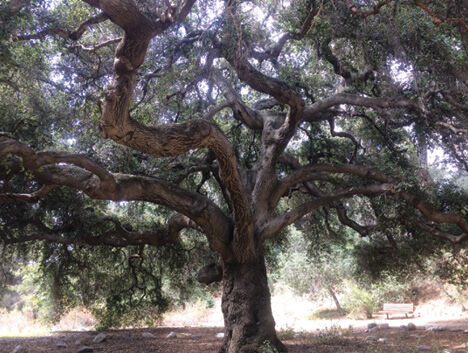
For Los Altos, the top 10 “foraging hub” plants are native species of oak, willow, cherry, cottonwood, pine, alder, maple, ceanothus, Douglas fir and rose. Even a garden that was 100 percent native would not support biodiversity if it did not contain some of the most important plants, Tallamy said.
To find the beta version of the NativePlantFinder, Google “nwf native plants location” and enter your ZIP code. Its preliminary list does not yet include all of the species identified. It ranks the plants by genus for each county in the U.S., based on the number of species of butterflies and moths that use this genus as a caterpillar host plant (a good marker of its bird-feeding ability, because fat, juicy caterpillars are an important food for raising baby birds). In addition, the website displays photos of the top 15 caterpillars or adults for each genus.
Tanya Kucak gardens organically. Email her at [email protected]. l