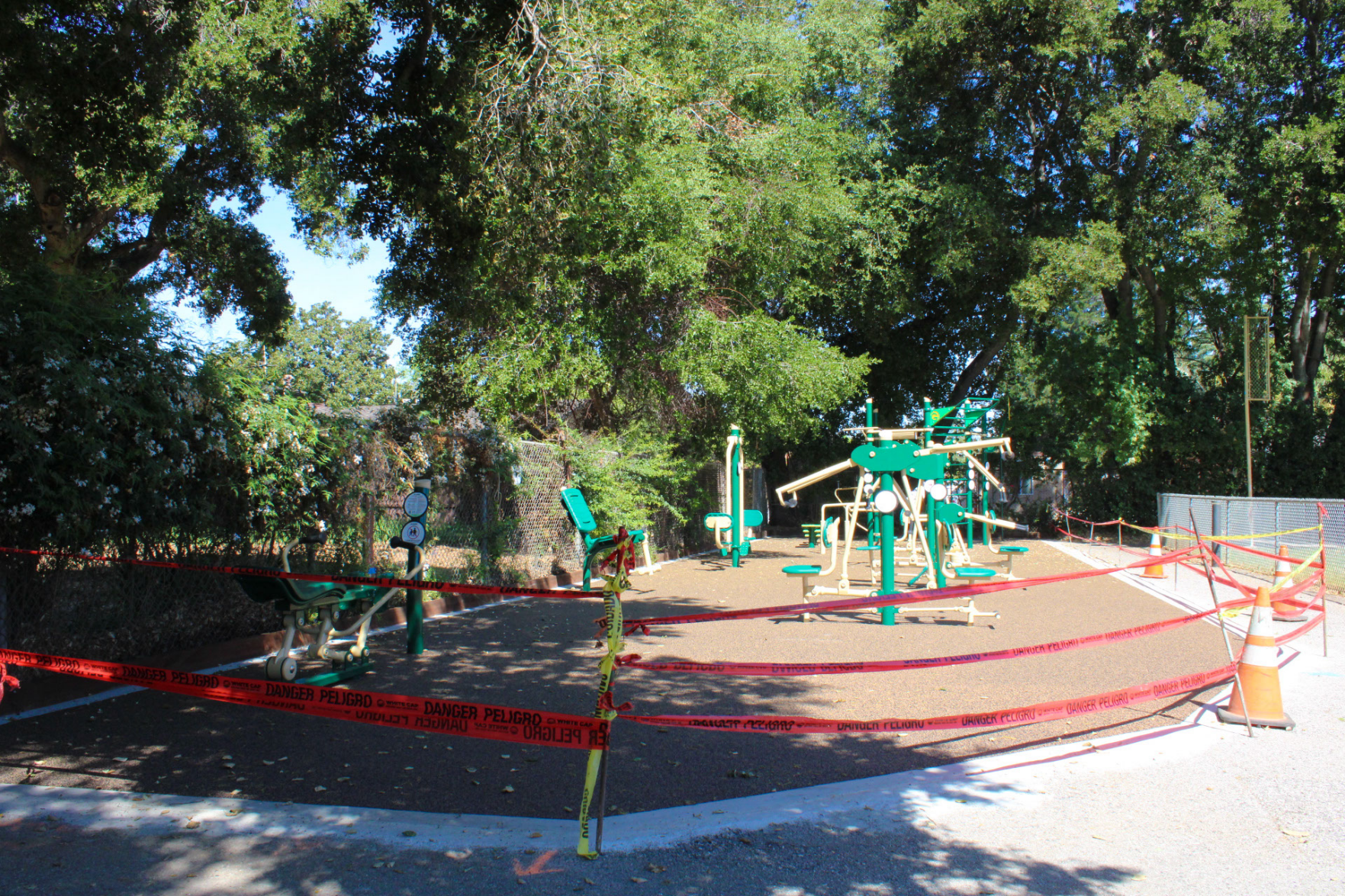
Some Los Altos residents are concerned about the use of potentially toxic synthetic surfaces at city parks after controversial material was used last week in the renovation of the exercise zone at Hillview Park.
The Los Altos City Council approved the renovations of Hillview Park’s exercise equipment last year. Laura Fay, a Los Altos resident of more than 30 years, environmental advocate and retired tech executive, was in Hillview Park when construction personnel, wearing respiratory and full-body protection, began preparing and pouring surface material.
What caught her eye when she passed the site was the polyurethane-based binder that was being poured, with big red letters spelling “Danger.”
“There is strong evidence over time that these things leak and do expose the community,” Fay said.
The specific binder used, binder BFLV-5, was manufactured by RYVEC Inc., a company based in Anaheim, Calif. According to the RYVEC website, BFLV-5 “… is a catalyzed fast-reacting binder intended for use in conjunction with SBR crumb rubber, EPDM or buffings in the top and bottom portions of Pour-In-Place playgrounds, and other sporting applications.”
SBR crumb rubber is granulated rubber usually produced from scrap materials, including tires. It’s most often found in athletic turf infill and poured-in-place playgrounds. Ethylene Propylene Diene Monomer (EPDM) is a synthetic rubber used for its industrial (including roofing) benefits.
Also listed on the binder tub were the following precautions:
• Causes skin irritation and potential allergic skin reactions
• Causes eye irritation
• Harmful if inhaled and causes damage to organs (respiratory system) with prolonged, repeated exposure
• May cause breathing problems, respiratory irritation, or asthma and allergy symptoms
Fay said the use of potentially harmful materials in locations Los Altos residents frequent was concerning, especially because she said her research into rubber and plastic often used in playgrounds and other outdoor spaces revealed some adverse effects.
“They all include forever chemicals, which, over time, are known to leach into the environment, leach into our storm drains, expose humans and pets to not good stuff,” she said. “Many of the chemicals have been associated with a variety of human illnesses.”
Forever chemicals, potentially harmful Per- and Polyfluoroalkyl Substances (PFAS), are manmade chemicals that do not easily break down, according to the US Environmental Protection Agency.
Future concerns
Fay was especially concerned because the same materials may be used again in the city.
The city of Los Altos Jan. 27 approved playground renovations at Grant and Shoup parks. The renovation agreement, made between the city and Alabama-based PlayCore – which provides turnkey outdoor play and recreation facilities – will not exceed $444,098.99 for Grant Park and $536,845.04 for Shoup Park renovations, contingency up to 15% for both projects.
“I understand residents care about the materials used in our parks and public spaces, especially when questions are raised about safety. It is important that this discussion be grounded in accurate information,” said Los Altos City Manager Gabriel Engeland. “Available government research to date has not found evidence that the rubber playground and field materials it has studied pose a health hazard in normal use.”
According to the U.S. Environmental Protection Agency, a study found organic chemicals and others, like polycyclic aromatic hydrocarbons (PAHs), methyl isobutyl ketone, benzothiazole and 4-tertbutyl phenol were “somewhat higher” in playground areas with recycled crumb rubber.
PAHs, often resulting from the incomplete burning of coal, oil, or organic substances like tobacco and charbroiled meat, are linked with cancer and developmental and reproductive issues, according to the Centers for Disease Control and Prevention’s (CDC) Agency for Toxic Substances and Disease Registry (ATSDR). Methyl isobutyl ketone can often cause eye, skin, respiratory and liver/kidney issues, according to the CDC’s National Institute for Occupational Safety and Health. Benzothiazole can cause respiratory issues and is a potential carcinogen, according to the National Institutes of Health, and 4-tertbutyl phenol can cause eye and skin irritation, according to Thermo Fisher Scientific.
However, the findings also “… support the conclusion that although chemicals are present (as expected) in the tire crumb rubber and exposures can occur, they are likely limited.”
Exposure also does not mean someone will definitely become sick – according to the ATSDR, it depends on the type of chemical and the amount, length of time and how frequently someone was exposed to it.
Engeland said the city chose to pursue the materials it did for accessibility and safety.
“The city’s focus is to make this amenity safer and more accessible. The previous surface, engineered wood fiber, did not provide adequate fall protection or true accessibility,” he said. “The replacement ground cover was selected to better cushion falls, and reduce the risk of injuries such as sprains, fractures, broken bones, and head injuries, while providing accessible space for residents with disabilities.”
While Fay is concerned about the chemicals, she’s also concerned about the heat index. As summers grow hotter overall, Fay is concerned the lack of shade paired with rubber surfaces could raise temperatures in parks, limiting children’s play.
“If it’s 80 F outside, then you know, concrete may be in the hundreds, engineered wood fiber might be in the 90 to 100s,” she said. “Concrete might be higher than that, but pour-in-place rubber is more like 140 F.”
Currently, the city’s Parks, Arts, Recreation, and Cultural Commission is working with the city’s contractors for the Shoup and Grant park renovations.
“We will continue reviewing surfacing options with safety, accessibility and environmental considerations all in mind,” Engeland said. “The Parks, Arts, Recreation, and Cultural Commission has been asked to review options for future park installations that balance each of those priorities.”