

Note: This article has been altered since initial publication to add greater historical context
As the public comment period on Halsey House’s draft Environmental Impact Report (EIR) ends, some community members question the accuracy of the report and the methodology behind it.
The draft EIR paints an incomplete picture by failing to explore options outside of demolition, said Catherine Nunes and Maria Bautista, two representatives of the Preservation Action League of Los Altos (PALLA).
“It’s on demolition alone, and that’s not what this deserves,” Nunes said. “We deserve a lot better than this process.”
The draft EIR ultimately concluded that Halsey House held too much historical value to demolish. However, Nunes and Bautista still feel that the way it was structured and presented to the public shows some glaring issues with the way that the city of Los Altos is operating in regards to the property as a whole.
In similar situations, demolition is typically considered as a last resort, once restoration and reuse are deemed to not be viable options. In these instances, Bautista said that a parallel draft EIR focused on adaptive reuse has been published alongside the draft EIR which deals with demolition.
Nunes and Bautista said that the city of Los Altos has not published any evidence which shows that these options are not viable. The final EIR, which combines the draft with public comments, has not yet been published. The city of Los Altos declined to comment until the final EIR has been published.
“The issue right now is that we are undergoing a process that has gotten started prematurely,” Bautista said. “The resolution that City Council passed in 2023 was to look at adaptive reuse or demolition, and we feel that the city has moved forward with a project that is demolition with objectives geared toward demolition.”
Nunes said that this undermines the history behind Halsey House, as well as its interconnectedness with Redwood Grove and the place that the property holds within the hearts of Los Altans.
Halsey House was first constructed in 1923 by Emma Wright Halsey and Theodore Vail Halsey. While redwood trees are native to the area, Nunes said that the Halseys cultivated much of what is now Redwood Grove alongside the family’s gardener, Omori.
“The Halseys are the reason Redwood Grove exists. They are one unified, inextricable historic and cultural resource for us,” Nunes said.
Omori was one of several Japanese-American gardening staff who lived and worked at Halsey House, Redwood Grove, and other estates in the area. Nunes stressed the importance of remembering the impact that these individuals and families had on Los Altos’ history, especially considering the hardships they faced following Japanese internment during WWII.
“The more evidence of them that we remove from our environment, the less we acknowledge them,” Nunes said. “And Los Altos has done a very poor job at keeping the physical evidence of some of the hard stories.”
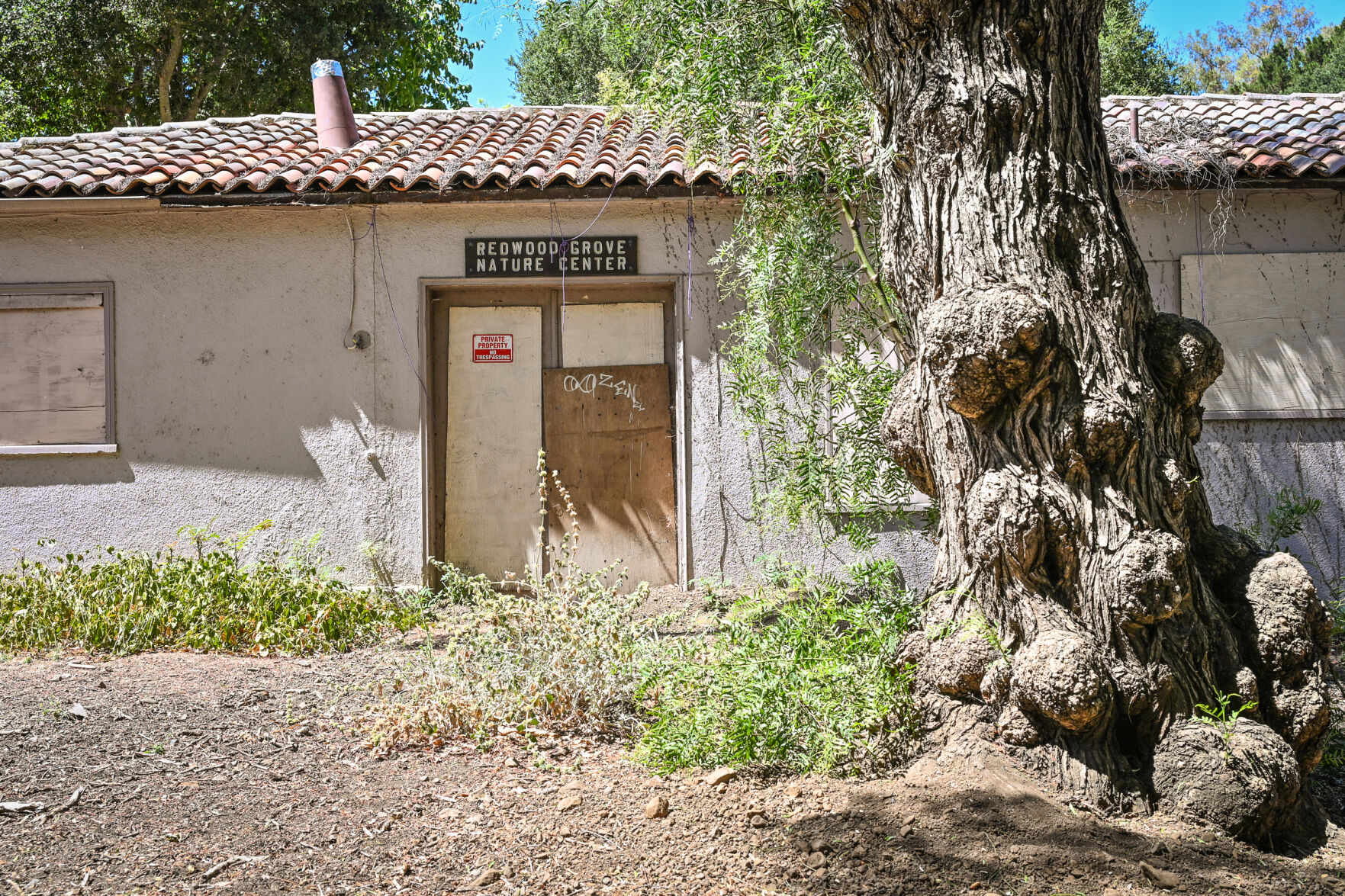
The house and surrounding property were purchased by the city of Los Altos in 1974, after which the house became an informational centre to serve the Redwood Grove Nature Preserve and public park.
During this time, the house and surrounding natural environment served a crucial role in educating the children of Los Altos on local history, including the practices and traditions of the Ohlone people and the lives of the Halsey family, Bautista said.
“It was a very, very popular summer camp, especially for young children,” Bautista said. “Generations of Los Altans spent their first summers at summer camp at Redwood Grove, and for many kids it was the first time that they slept away from home.”
Bautista stressed the impact that this camp, alongside its director at the time, Keith Gutierrez, had on the children of Los Altos.
“There was a stewardship element that we don’t have in the city now,” Nunes added. “He was there as a presence. He was a naturalist and he was connected to the Ohlone, to the history.”
The property has been a designated historical landmark since 1981. But, the building itself has been shuttered since 2008 and left in a state of disrepair. Nunes noted that, legally speaking, Halsey House and Redwood Grove Nature Preserve are recognized as the same landmark.
“I think that’s really vital because a lot of people want to say, ‘Oh, we’re just going to take the house out,’ but they’re a connected and unified space,” Nunes said. “It maintains its connection with the environment … and all the history that’s associated with it.”
Nunes also noted a distinction between historical integrity and structural integrity. While the building is not structurally sound, Nunes pointed to a 2021 historic resource evaluation conducted by Page and Turnbull which determined that the house maintained high historic integrity due to these connections.
“Its decline over time is a part of the story here. Initially, it was an absolute gem of our city” Nunes said. “Each year it gets worse and that is not a reflection of the community’s priorities. That’s just a fact of poor stewardship by our city. … That doesn’t mean that it can’t be returned to glory, it’s an absolutely unique community asset.”





