

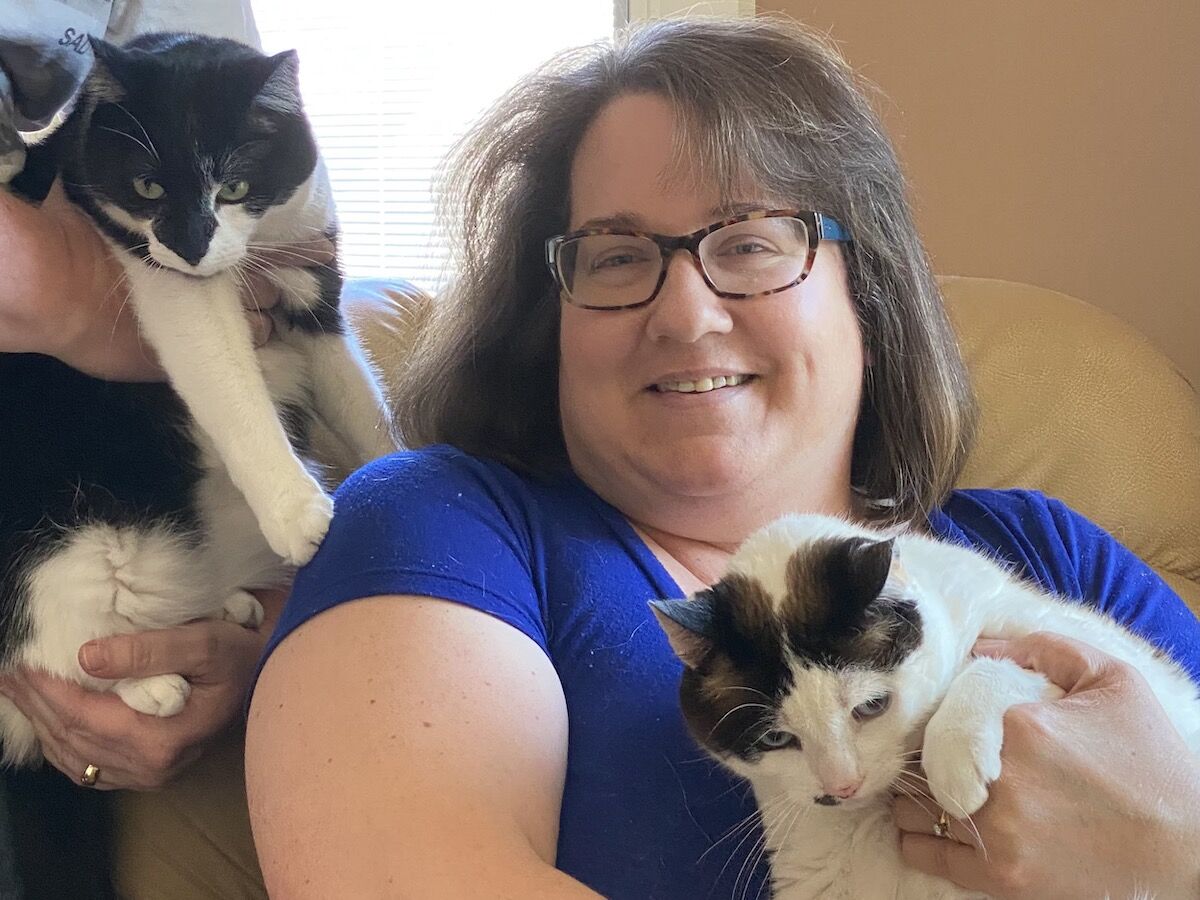
In hindsight, Kim Henrie recognizes the red flags: The person (or people) behind the websites never provided a name in email correspondence, their sites contained spelling errors and they declined to accept payment via credit card.
“Yeah, I should have known better,” Henrie said, describing an alleged scam she says bilked her out of $770.
About a month ago, the Mountain View resident started looking for a companion for her two adult cats, Becca and Gracie, she told the Town Crier last week. She desired a ragdoll, a feline breed known for striking blue eyes and color-point tips, and she selected 11-week-old “Frank” from rockinredragdolls.com, the virtual face of a what claimed to be a North Carolina-based business.
Henrie estimates she exchanged approximately 10 emails with someone purporting to represent rockinredragdolls.com before she ultimately used Zelle, a digital payment app, to send the unknown person $770, including $700 for the cat and $70 for shipping the cat across the country.
“The next day, they said, ‘OK, great. Your cat’s going to come to you,’” she said. “But then they asked for $900 more because there was a problem and the cat needed another vaccination and a special, temperature-controlled crate. And then: ‘We would refund you the $900 once you got the cat and we take the crate back from you.’ And that’s when I knew for sure that this was a scam.”
Awaiting a refund
Henrie immediately called her bank following the request for additional money. She said a representative told her the bank would attempt to get her money back but that she shouldn’t expect restitution.
Scammers are known to use peer-to-peer payment services like Zelle and Venmo because transactions take place quickly and are difficult to cancel once they commence, according to the Better Business Bureau. And unlike a credit card issued by a traditional financial institution, these payment methods do not guarantee reimbursement for fraud.
Both the Zelle and Venmo websites warn users against sending money to people they don’t know and trust.
Once Henrie realized she’d been duped, she filed a claim with the Federal Trade Commission and emailed the Mountain View Police Department to inquire whether a police report is warranted. She said she is awaiting a response from the MVPD.
The rockinredragdolls.com website disappeared last week, but Henrie said the same information and feline profiles are featured on coastragdolls.com.
On May 11, when the Town Crier sent an inquiry about Henrie’s transaction to two email addresses featured on the coastragdolls.com website, a response arrived just six minutes later.
“She paid for a kitten, yes!!” the email read. “But the kitten will be deliver (sic) to her tomorrow, we are still working on the paperwork and we always have to visit our vet before we can register for delivery, she just want (sic) everything to be done in her own ways, I am sorry we have policy, we do not run a scam here and if she is not comfortable with the deal, we can refund her immediately.”
The sender, who did not provide a name, did not respond to a subsequent email from the Town Crier. Henrie said the person who took her money has not refunded it.
Pet scams on the rise
Online pet breeder scams are part of a lucrative but illegal enterprise growing at an alarming rate, particularly as the COVID-19 pandemic has increased humans’ desire for four-legged companionship, the BBB reports.
Back in 2017, a BBB study found at least 80% of the sponsored advertising links that appear in internet search results for pets may be fraudulent. Many of the scammers are based in West Africa and Cameroon, but they have been known to use connections within the U.S. to perpetrate their crimes.
“In addition to creating phony websites to advertise the animals, the thieves similarly will develop bogus websites that appear to be legitimate transport companies,” the study stated.
The Humane Society of the United States provides a free guide for identifying responsible and reputable dog breeders. Although a similar document does not exist for felines (purebred cats represent just 5% of all cats in the country), many of the same principles apply to identifying a legitimate cat breeder, according to Danielle Bays, senior analyst of cat protection and policy for the nonprofit organization.
Responsible breeders specialize in just a single or a few breeds, they breed sparingly and they promptly provide veterinary records upon request, the guide says. They only keep animals in spacious, clean homes and only sell animals to people they have met in person.
“I’ve learned that you just need to have the cat in your hands physically before you pay for it because any reputable breeder or rescue group or whatever is going to do that,” Henrie said. “They’re not going to be elusive like mine was.”
Beyond spelling errors and dodgy correspondence, the websites Henrie consulted before paying for Frank feature other suspicious characteristics.
A reverse Google image search of photos published on coastragdolls.com revealed some photos – or at least slight variations of them – are also used on another ragdoll kitten site, familyragdollcat.com. On coastragdolls.com, for example, a photo of a kitten with a white nose and white socks sitting on a couch is described in accompanying text as “Kate,” an 11-week-old female. On familyragdollcat.com, the text that accompanies the exact same photo indicates the subject is “Cloe,” a 10-week-old female. Photos of a predominantly white kitten perched atop a binder also link the two sites. On coastragdolls.com, the cat is described as 11-week-old “Vicky,” a male. What appears to be the same cat is pictured on familyragdollcat.comin a slightly different pose upon the same binder and dubbed “Frank,” 10 weeks.
On May 12, the Town Crier sent an email inquiring about the photos to an address featured on the familyragdollcat.com website, but no response arrived as of the publication’s Monday morning print deadline.
While Henrie has accepted the fact that she’ll likely never see her money again, there is a silver lining to her story – at least one for some yet-to-be-identified, formerly stray feline.
“We’re not looking for a purebred anymore,” she said. “We’re going to go with a rescue group.”
To review the Humane Society’s dog breeder guide, visit humanesociety.org/sites/default/files/docs/find-responsible-dog-breeder.pdf.





