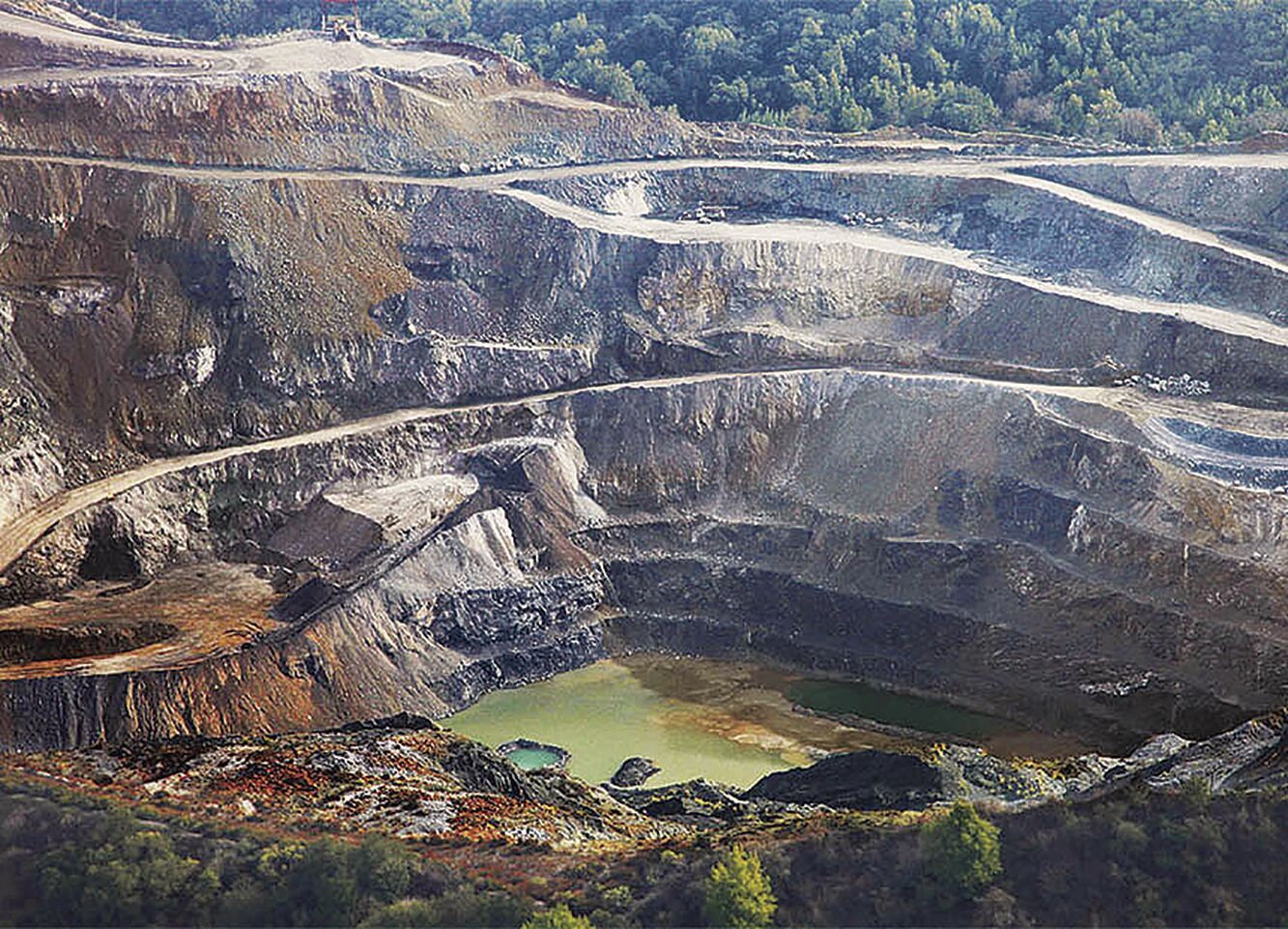
It may be premature to celebrate the closure of the Lehigh cement plant.
The 3,500-acre property in the foothills above Los Altos has “a long goodbye” ahead of itself, said Santa Clara County Supervisor Joe Simitian in a community update at the Los Altos Council Chambers last week.
“This is not next week, next month, next year – this is not even next decade,” Simitian said. “This is a very long goodbye.”
In August, the Santa Clara County Board of Supervisors approved a legally binding agreement between the county and the owners of the Lehigh cement plant and quarry to permanently shutter the plant, an effort that Simitian said “took a century.”
“The cement plant itself has operated for more than 80 years, cheek by jowl with the quarry pit, which has actually been in operation for more than 100 years,” he said. “So, when people say, ‘Hey, good news on Lehigh,’ I smile and say, ‘It only took us a century, but we finally got an outcome that makes sense for the community and, frankly, for the folks at Lehigh.’”
Laborious process

Now that county has shut down the plant and stopped the quarry activity, the question of how to restore and reclaim the land remains – a question that Simitian will not be able to see through after he terms out in November 2024.
Lehigh must now create a Reclamation Plan Amendment laying out what it intends to do with the property. The Board of Supervisors usually takes two to three years to approve this type of application, Simitian said. In the remaining 15 months Simitian is on the board, he said he intends to put in place a process for review of the Reclamation Plan Amendment “in a way that ensures that there’s a meaningful and rigorous opportunity for the community to weigh in.”
“Lehigh will understandably press to monetize their asset to the greatest degree possible,” he said. “That process will then generate a lively discussion in the community and at the Board of Supervisors about what is and isn’t appropriate. And that’s the part that’s to be determined.”
Lehigh currently intends to develop a portion of its Cupertino property into housing. It also plans to finish crushing existing rock into aggregate to sell and continue to be a distribution center for cement made off-site. Likely the most contentious part of the plan is to fill the quarry with clean fill.
“You start to look at the size of that hole, and I’m not exaggerating when I say it is literally hundreds of thousands of trips over not just years, but probably decades to fill that hole,” Simitian said.
Why does the hole have to be filled? The short answer is pollutants.
“I actually asked at one point, ‘Is there some value, for example, in not filling the hole and using it as a reservoir?’” Simitian said. “And the folks at Valley Water said, ‘No, it doesn’t work for a variety of reasons.’”
Long-running issue

What to do with the Lehigh quarry will likely be a long, heated debate in the future, but how did it get to this point?
In 2013, Simitian returned to the Board of Supervisors, and a new staff member in his office said, “What’s this Lehigh thing?” recalled Simitian.
“I started to chuckle because I said, ‘It’s going to be with us from the first day we open the office door to the last day when we turn out the lights and walk out of the building. It’s one of those issues that just is always with you and always there,’” Simitian said.
Simitian noticed there was very little county oversight of Lehigh, so he began to implement small measures that ended up playing a larger role later on. He facilitated the sharing of information among the dozen regulatory agencies overseeing Lehigh, held annual meetings in Cupertino for the regulators to meet with the public and held monthly accountability calls with Lehigh, “quite candidly to communicate, ‘We’re not going away. We’re paying attention,’” he said.
In 2019, Lehigh submitted a Reclamation Plan Amendment to expand its mining operations and take down the hillside at the top of the quarry. Taking down the hillside was startling, because decades ago, Lehigh had conveyed to the county an easement protecting that hillside. So, Simitian rallied the Midpeninsula Regional Open Space District, city leaders and labor leaders frustrated with the operation of the facility there to protect the existing easement and the hillside.
“Don’t chop the top,” became the movement’s motto.
“I joke it’s the only time in my life I’ve ever been able to put together a press conference where we had the Sierra Club standing next to the Teamsters Union,” Simitian said.
This was where Simitian’s efforts to increase communication about Lehigh played an important role.
“Everybody was supportive because we understood what the issue was,” said Los Altos City Councilmember Neysa Fligor. “We had annual updates, so we knew what was happening. And so together we were able to join forces with a strong voice and a strong message.”
To prevent Lehigh from “chopping the top,” Simitian gave the enforcement rights of the county’s easement to the Midpeninsula Regional Open Space District, a government agency that exists to protect open space.
“Following that, I thought, ‘Let’s see what else we can do to hold folks accountable,’” he said.
So, he asked the Department of Planning and Development and the Office of the County Counsel to conduct an assessment of Lehigh’s violations over the past decade. And the results were astounding: 2,135 violations in 10 years.
That was a problem because the cement plan was covered by a use permit, and one of the conditions of the use permit is that the operator, Lehigh Southwest Cement Co., shall comply with all applicable law and regulations. So, Simitian asked the county’s Planning Commission to consider the revocation or amendment of the use permit.
“And that’s when things get serious because now, we’re talking about having real legal grounds to say, ‘Not going to happen anymore,’” he said.
Lehigh changed its business operation. No longer making cement, and by proxy no longer mining the quarry, it reinvented itself as a distribution center.
But that wasn’t enough for Simitian. He wanted to make sure the cement plant was indefinitely shuttered. So, he booked a flight to Irving, Texas, where the North American headquarters of the parent company of Lehigh, Heidelberg Materials, is located.
“Because of the LGBTQ provisions in Texas state law, Texas is on a list of I can’t use county funds to travel there,” Simitian said. “So, for the record, no county funds were spent flying.”
He suggested that rather than Heidelberg having to deal with the 18-month Planning Commission process that could potentially revoke Heidelberg’s use permit, the company should just sign an agreement to permanently close the plant.
And Heidelberg agreed. Less than four months later, the papers were signed.
“It very explicitly says that in exchange for this year-and-a-half hiatus not having to go with the Planning Commission and negotiating with our staff, that the plant itself can never be open,” Simitian said. “Even if you sell it to somebody else, they buy it knowing that there’s not going to be a plant there.”
And while it’s unclear whether Heidelberg Materials is truly committed to the restoration of the property, Simitian did say this: “I don’t think the folks in Heidelberg wake up every day and say, ‘I wonder what Joe Simitian is thinking about?’”