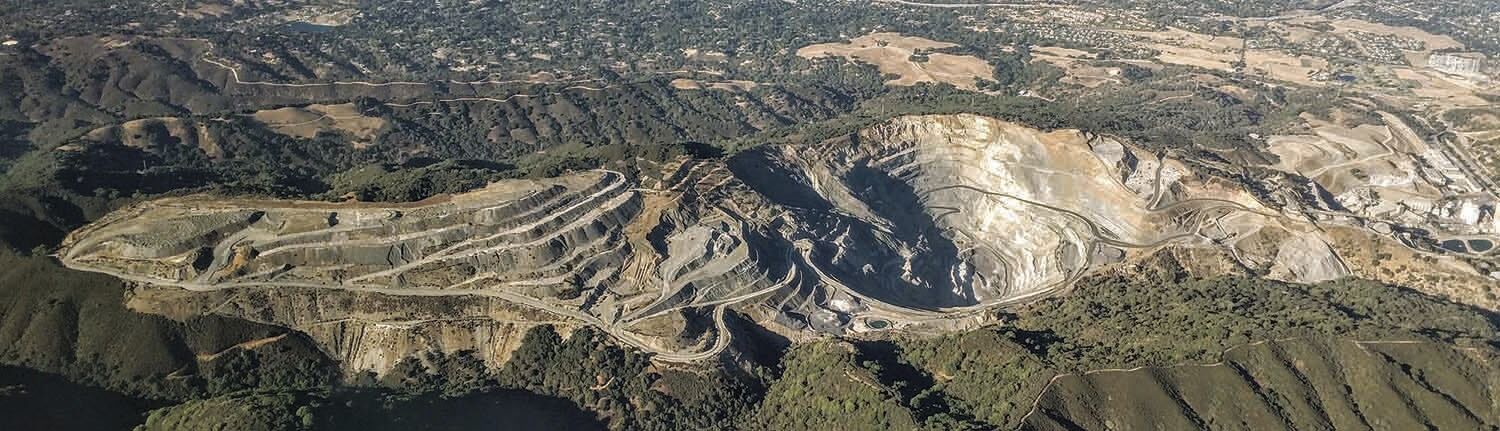
Santa Clara County Supervisor Joe Simitian and the Board of Supervisors are moving closer to ushering out cement production activity in the Cupertino foothills south of Los Altos.
Supervisors at their April 18 meeting directed legal staff to work with operator Lehigh Hanson between now and the end of June to negotiate a legally binding agreement to permanently shutter the company’s cement kiln. The kiln operated under a county use permit issued in April 1939. Lehigh Hanson officials announced in November they were shutting down kiln operations.
Simitian, who hosted his annual forum updating residents on the plant’s status April 26, said he was “gratified” when Lehigh reported it would not restart production at the cement plant. It has been offline since April 2020.
The facility’s operations have been a continuous source of concern to residents for decades due to adverse environmental impacts. In the past 10 years alone, the county estimates Lehigh has amassed more than 2,100 violations.
Simitian said he traveled to Texas recently to meet with Lehigh officials at their headquarters to encourage the company to agree to a legally binding closure agreement.
Supervisors directed the issue to the county Planning Commission to consider permit revocation or modification within 18 months if a negotiated agreement on the cement plant closure is not forthcoming within the next three months.
“I think a stand-alone agreement on shutting down the cement plant is important right now because it will take time to compile the documentation to support modifying or revoking the use permit,” Simitian said. “Lehigh has already stated its intention to close the cement kiln after an 83-year run, and if that commitment is sincere, it should be fairly straightforward to make that on-the-record commitment legally binding before folks head off to their summer vacations.”
The board also directed the county planning department to consider a negotiated agreement with Lehigh on a revised use permit, pending a binding agreement on the plant closure. Simitian said a change to the existing use permit will be “an opportunity to envision a new future for the site, and clarify the extent to which ancillary operations like storage and distribution continue to take place.”
Future uses
At Simitian’s urging, the board also directed county staff to work with the city of Cupertino to develop, by August, a set of joint planning principles to use when considering future uses for the Lehigh site.
The Lehigh site currently has two primary uses. One relates to the cement kiln and the manufacture, storage and distribution of cement, while the other involves the quarrying and processing of quarried material, some of which is transported off-site as aggregate, and some of which has historically been used on-site as feedstock for the cement kiln.
Lehigh officials announced they do not intend to quarry new material from the pit or elsewhere on-site, but they do have plans to continue processing already quarried material for sale as aggregate and plans to submit a new reclamation plan amendment later this
year.
The cement plant and quarry are both part of the Lehigh property, which encompasses 3,510 acres, 2,656 of which are in unincorporated Santa Clara County. The remaining land is within the cities of Cupertino and Palo Alto.
Green Foothills, an environmental advocacy nonprofit focusing on Santa Clara and San Mateo counties, supported Simitian’s proposal.
“It’s the right thing to do,” said Megan Fluke, executive director of Green Foothills. “The sooner we get an official, legally binding commitment from Lehigh, the sooner we can begin preparing for the restoration of this land, and the closer we’ll be to rehabilitating the land for all to enjoy.”
The county has oversight over the quarry, and activities at the facility are regulated by a Reclamation Plan approved by the Board of Supervisors in 2012, as well as by a vested-rights decision the board made in 2011.