Parking, or lack thereof, appeared to be a chief concern among participants at last week’s virtual community forum on Los Altos’ first all-affordable housing project.
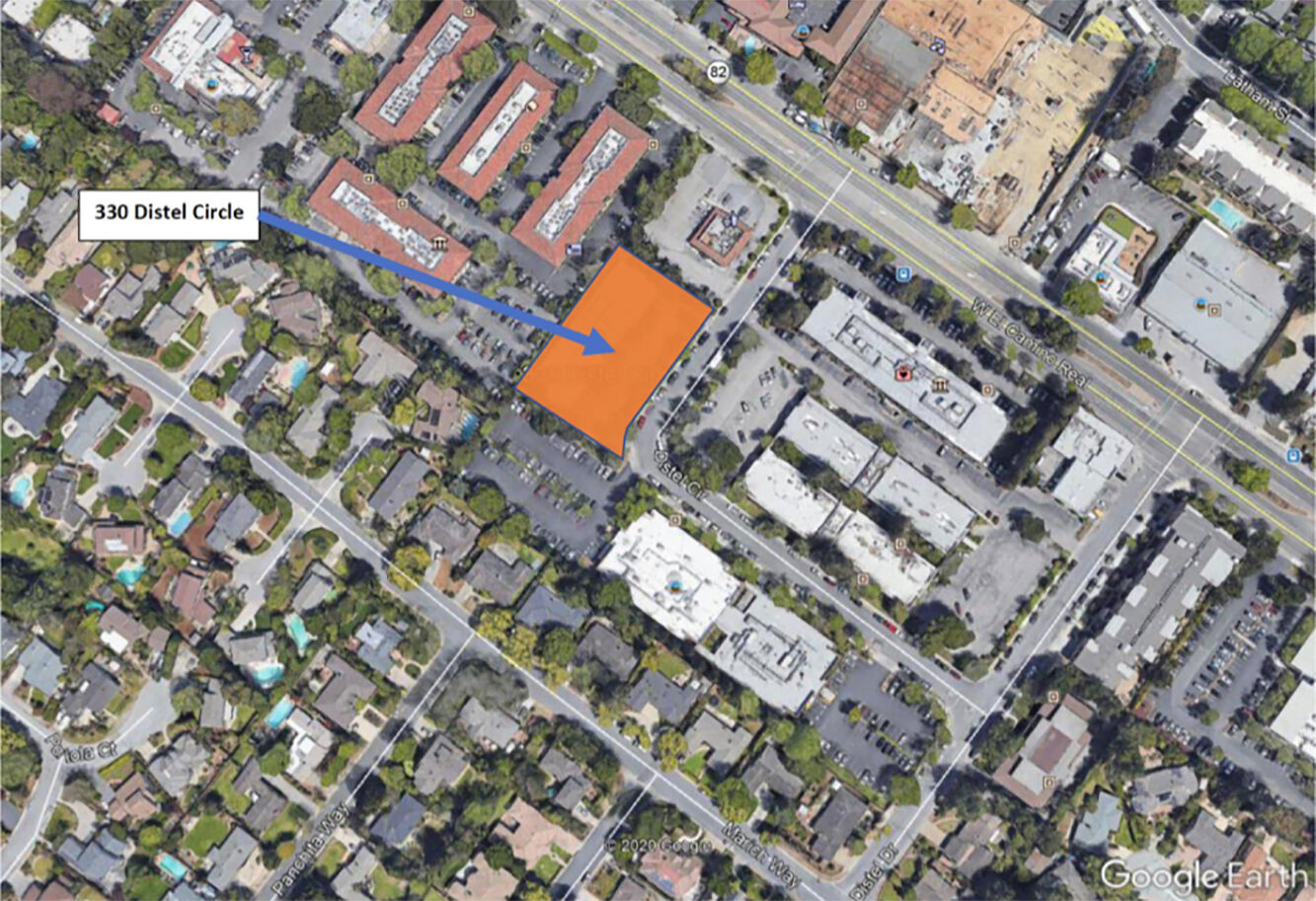
The Aug. 12 forum was one of five hosted by developer EAH Housing to gauge preliminary public input on the 90-unit project at 330 Distel Circle. While in its early stages of planning, the developer is proposing an integrated community.
Families and individuals, from those with special needs to local workers, would occupy the proposed five-story complex, with units ranging in size from studios to three-bedrooms. Those qualifying would be making 30-80% of the area’s average median income, and a one-bedroom occupant could pay in the range of $800 to $1,600 a month.
While the project drew general support from forum attendees, the 48 parking spaces proposed for the 90-unit project raised a red flag for some.
“It’s very important to look at whether we can we provide more parking,” said Roberta Phillips. “Otherwise people will be parking in residential areas. It’s something I’m hearing from people in the community.”
But Patricia Evans noted that “parking (allotted) depends on the model that’s chosen.” A project centered on families with children, she said, reduces the parking per person required.
Tenant selection
Other questions involved the selection process for tenants – a mix of county referrals and a lottery process.
Despite some residents’ preference to see the project serve as workforce housing and limited to those who work in Los Altos, Welton Jordan, EAH’s chief real estate development officer, indicated tenant selection would be wide open – from unhoused individuals to undocumented workers and Section 8 tenants.
“There is a need for workforce housing,” Jordan said. “They don’t make a lot of wages where they are employed, so this is a way to address that.”
He added that with the integrated model, “we can serve a little bit of everybody.”
Jordan said the nonprofit is prohibited by law from selecting tenants based on geography.
“We cannot guarantee everyone working here will get (housing),” he said, “but the focus (is) on the surrounding community.”
Also questioned was the nearly four-year process to bring the project to fruition – units would not be ready for leasing until 2025 – and whether there was a way to expedite the project.
On the other hand, the benefits of the project, in addition to low-cost housing, include location – with tenants in walking distance to parks, public transit and shopping.
“I actually think it’s a fantastic location in terms of amenities within walking distance,” Evans said.
Lily Ciammaichella, with the architectural firm KTGY, said early project considerations included “carving out” space for a courtyard and an entrance at the north end of the site, avoiding the curve of Distel Circle at the south end. She said her firm is taking into account details such as the impact of shadows from the five-story structure on the surrounding area.
Ciammaichella led real-time online polls with questions related to “sustainable strategies” (participants favored energy efficiency and drought-tolerant landscaping) and art elements for the project (sculptural seating and painted murals were favorites).
Tracking progress
Jordan gave a brief history of the project’s progress to this point, dating back to the county’s 2019 purchase of the property – site of the Midpeninsula Regional Open Space District headquarters. The county is building the project with funds from Measure A, the $950 million affordable housing bond passed by voters in 2016.
The county and the city of Los Altos agreed to terms in a memorandum of understanding last October, with the city waiving $4.6 million in park in-lieu and traffic impact fees. The county announced selection of EAH Housing as the developer in April.
Jordan said the project is especially appealing to Los Altos city officials looking to meet state-mandated Regional Housing Needs Assessment numbers. Los Altos must provide 580 housing units identified as “very low income” and 333 “low income” (1,958 new units total) by 2031.
Next steps include another community forum Sept. 9, followed by a Sept. 30 open house and discussion at the joint Los Altos City Council-Planning Commission study session Oct. 7. Pending a smooth public approval process, construction would be scheduled for early 2023.
Meanwhile, EAH promises plenty of community engagement to produce a quality project.
“We’re really just getting started,” Jordan said. “We are here to hear the needs.”
San Rafael-based EAH Housing (originally named Ecumenical Association for Housing) was founded in 1968. The nonprofit has developed thousands of affordable units in California and Hawaii. It runs 15 communities comprising more than 2,700 units in Santa Clara County. Units for this project are required to remain “affordable” for a minimum of 55 years.
For more information, visit eahhousing.org.