So much anticipation led to the world premiere of San Francisco Opera’s “The Monkey King” by composer Huang Ruo and librettist David Henry Hwang, a milestone production based on the first seven chapters of “Journey to the West,” hailed as one of the “four great Chinese classic novels.”
It is rare for a major American opera institution to stage a full-scale production of a foundational Asian epic, blending folk tales with mythology to create an action-hero opera exploring themes of struggle against temptation, atonement and spiritual enlightenment.
“The Monkey King” brought a significant celebration of Chinese culture to the War Memorial Opera House with activities such as calligraphy art and lion dance. Traditional Chinese supertitles were displayed vertically on both sides of the proscenium to help the multigenerational Chinese-American audience follow along the storyline; my 82-year-old mother, who was visiting from Beijing, thoroughly enjoyed the performance, and the Chinese supertitles were a huge help.
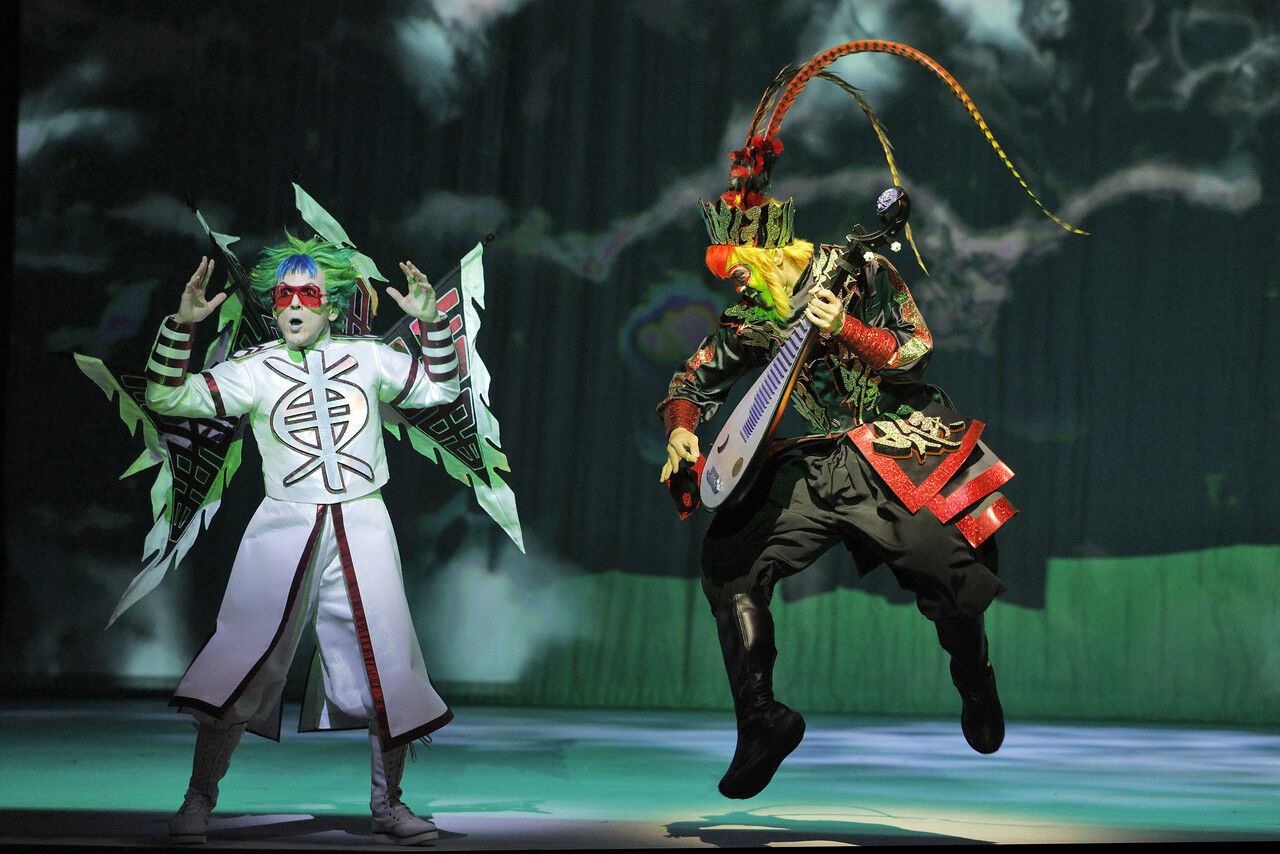
The opera featured a multidisciplinary approach in all aspects of its production. Costume design by Anita Yavich was ravishing with eclectic modern touches, including 3D printing, while deeply rooted in Chinese tradition, such as Peking opera. Chinese street and folk arts-based costumes such as ornate headpieces and robes juxtaposed with neon colored robe overlays, rainbow-color highlighted spiky or puffy hairdos and iridescent glass lenses: a sensory overload with color explosion in orange, purple, green, pink and yellow.
The stage design by Basil Twist was dazzling with many Chinese traditional elements, including street art influence, highlighted by shadow puppets alongside digital mapping projections. A whimsical stage underpinned by thousands of yards of floating and draping silk fabric created a metaphorical fantasy land: mountains were created with rising pillars of fabric to illustrate Buddha’s hand and fingers; undulating silks depicted the sea and the underwater world, along with jellyfish puppets; floating fabrics symbolized clouds and heavens. Additionally, video projections blending traditional Chinese ink painting with modern digital art helped transform the stage into shifting landscapes of mountains, oceans and skies.
Three Monkey Kings were on stage in various orders, or simultaneously, by Kang Wang (tenor), Huiwang Zhang (dancer) and the three-people puppet team (designed and directed by Basil Twist). Lyrics and voice were accompanied by Chinese Wushu (martial arts) and Peking opera-infused dance moves and whimsical and humorous puppet performances to depict the complex emotional and physical journeys of the Monkey King.
The inversion of the moral expectation has been a leading theme in the traditional storyline. The Monkey King was featured in the opera not only as a rebellious hero but also as a humorous trickster truth-teller, an antithesis, a mirror held up to the divine hypocrisy symbolized by the gods as the satirical target. Incredibly powerful and believing his position deserved in heaven, he was, however, despised by the Jade Emperor and the celestial court as an inferior monkey. The gods’ greed, vanity and complacency were demonstrated via vocal lines by the Jade Emperor and his court, including Supreme Lord Laozi, Lord Erlang, the Dragon King Ao Guang and the Crab General. A moral inversion was on full display by the Monkey’s clarity, wit and justice and the gods’ bureaucracy, excess and corruption. Costumes, orchestration, vocal writing and movement actions underscored the exaggerated extravagance of the gods in contrast to the nimble monkeys. This timeless satire strikes especially strongly today with grassroots desires and movements to disrupt the existing power structure, the government order and the institutional arrogance.
“The Monkey King’s” disruptive spirit – bold, uncontainable, boundary-breaking – resonated refreshingly through a cross-cultural storytelling by San Francisco Opera’s production. It was a powerful cultural outreach to a multigenerational yet contemporary audience via a “visual tsunami,” a fantastical collage of classical Chinese imagery, contemporary digital projection, Western operatic spectacle and mythic fantasy compressed into an electrifying kaleidoscope.
For more information, visit sfopera.com.
Duanni Hurd is a Town Crier columnist covering arts, culture and lifestyle. Find her coverage of arts and performing arts on Instagram @duanniduanni.