Life is always an unpredictable journey but war and power accelerate the disaster one may already feel on the inside.
This theme relates to Sergei Rachmaninoff, a Russian composer and pianist who found his way to the United States in the middle of World War I at a time of instability in Russia. Born to Russian nobility, Rachmaninoff had a privileged life but was sent off to boarding school at a young age. His love of piano grew at the boarding school and from there he sought to be a famous musician. He toured around Russia in his young adulthood, but as the Red Army stormed the cities, he and his family no longer felt safe.
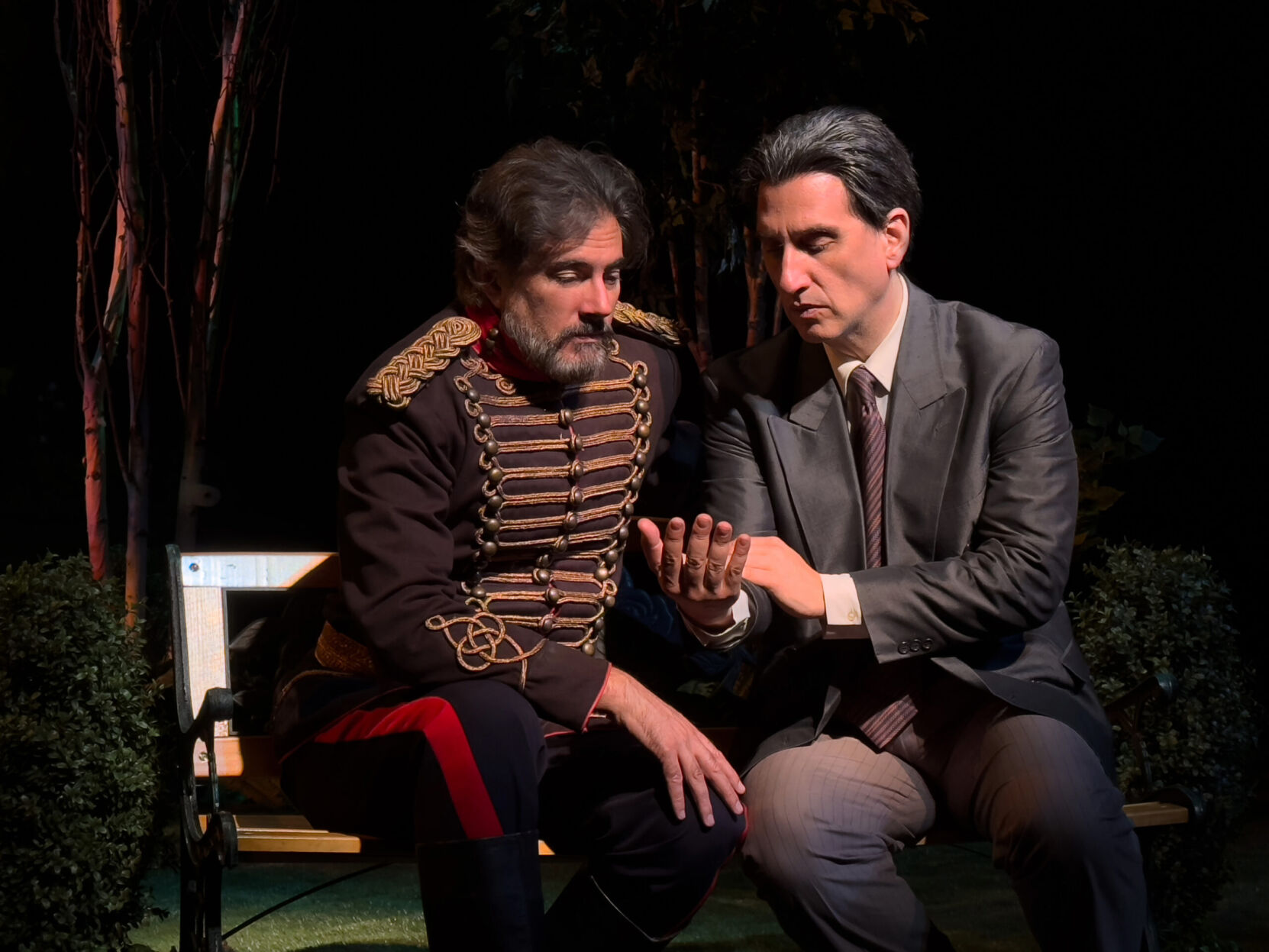
Hershey Felder, a pianist and actor who wrote “Rachmaninoff and the Tsar’” and plays the composer in his own show, said he was drawn to write a story of the composer because of his complicated history. Rachmaninoff in the story is nearing his death and hallucinates a conversation with the last Russian Czar Nicholas II (Jonathan Silvestri). Felder said he usually performs on stage alone in monologue, but this play allowed him to explore the depths of both the characters. Felder said both of the characters had a complicated relationship with each other and that the Czar reminded him of his past life.
“I think it’s a story that is timely,” Felder said. “It’s a story that is interesting, because here we are a little over 100 years later and there’s all kinds of things going on similar in the world, very, very complicated stuff. And this is the story of a dated time, so there’s that side of it that we can reflect on. It also how art can get through complex times.”
Felder goes above and beyond on stage. He is a great drama alongside Silvestri as he tries to understand the demise of the Russia he once loved. To explain his life, Felder performs pieces across Rachmaninoff’s music as a tool of escape and a form of communication. Rachmaninof in the play explains he is a man of few words and turns to music so he could be closer to God.
Both actors question what is left of their legacy and if they will be remembered. They create a commentary on the politics leading up to World War II and how they could have done things differently. Although Rachmaninoff had a fortunate life until the day he died, his life was not in his control and was instead plagued by the exploitation of dangerous leaders.
To learn more and to buy tickets, visit theatreworks.org/mainstage/rachmaninoff-tsar.