Pruning is logical and simple, according to author and fruit-tree specialist Ann Ralph.
“You don’t need a bunch of fancy rules,” she said, quoting nurseryman Ed Laivo.
Ralph discussed growing small fruit trees at March’s San Francisco Flower & Garden Show.
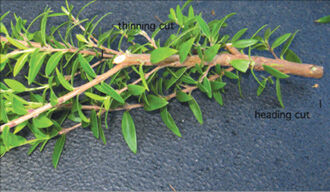
It helps to understand the two types of pruning cuts and the consequences of making them.
Heading cuts remove part of a limb, which results in bushy growth near the cut. The cut should be “near a node so that it can heal nicely,” Ralph noted.
Thinning cuts “remove the entire branch at the point of origin,” which “creates space and redirects growth,” she said. Most cuts should be thinning cuts.
Although she focuses on deciduous fruit trees, Ralph shared some simple, commonsense rules that apply to pruning in general.
• Rule No 1: If you don’t know what to do, cut some stuff out.
“Use your native intelligence,” Ralph said, adding that you should observe the tree and “ask what’s bugging you about it.”
Because you can’t undo a pruning cut, she suggested that beginners get some blue masking tape and place it where they want to make cuts, then stand back and reassess. Typically, you want to remove dead, diseased, dying and damaged branches, as well as suckers and selected crossing branches and water sprouts (twigs that grow straight up from a normal branch).
“Prune to reveal the shape of the tree,” Ralph said.
• Rule No. 2: Prune to keep the zone of equilibrium within reach.
On fruit trees, “upright growth is never fruitful,” according to Ralph. The zone of equilibrium is the fruit-producing area of the tree. She enthusiastically promotes the idea of growing backyard fruit trees that are kept small with strategic pruning. The goal is to keep the tree small enough so that you don’t need a ladder to maintain it. She prunes twice a year. Primary pruning occurs June 21, even if the tree has fruit on it.
Because trees store nutrients in their leaves in the summer, this summer pruning helps stunt the tree by removing resources before they are stored in the roots. Winter pruning might seem easier because the leaves are gone, but it’s less effective if you want to keep a tree small, and it’s not good for trees such as apricot that are particularly sensitive to waterborne diseases.
In January, Ralph’s touchup winter pruning takes 15 minutes total for the seven small trees in her garden. It pays to keep fruit trees small. Even a fruit tree that’s 12 feet high “will have lots of wormy and inferior fruit” because you can’t get in there to thin the fruit, she said.
• Rule No. 3: Make aesthetic decisions.
Aesthetics is more important than thinking about thinning cuts or apical dominance or fruiting spurs, Ralph noted.
“Different pruners make different decisions,” she said.
A pruner Ralph knows who specializes in Japanese maples opens the canopy so that a bird could fly through the tree without its wings hitting the branches. An open canopy reduces the chance of disease.
• Rule No. 4: Pruners learn by pruning.
“The tree will teach you more than the internet can, than I can, than my book can,” Ralph said.
Ralph is the author of “Grow a Little Fruit Tree: Simple Pruning Techniques for Small-Space, Easy-Harvest Fruit Trees (Storey Publishing, 2014). She also offers workshops in the East Bay.
Tanya Kucak gardens organically. Email her at [email protected].