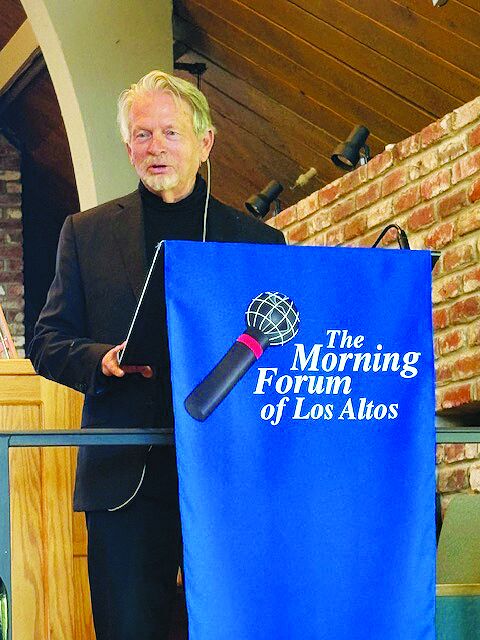
On May 6, Professor Robert Hartwell returned to The Morning Forum of Los Altos for the third time. Using clips from famous orchestras and opera companies, the speaker conveyed the brilliance of the two major works Mozart wrote in 1791, his final year of life.
Hartwell also used colorful animated notation to allow his audience to visualize the complexity of Mozart’s music while they were hearing it. Hartwell holds a doctorate in music education from Columbia University, and as Professor of Music and Department Chair at Foothill College specializes in welcoming the uninitiated into the world of classical music. His classes at Foothill College on music history and music of multicultural America are among the school’s most popular.
Hartwell co-authored “Great Composers and Music Masterpieces of Western Civilization,” a three-volume textbook on the history of Western musicians. He is also a staff lecturer at the Institute for the Study of Western Civilization and a pre-performance speaker for the San Francisco Opera.
What was unique about Mozart, Hartwell explained, was his musical versatility. While most composers specialize in one form, Mozart’s genius allowed him to write magnificent symphonies, concertos, chamber music and especially operas. By the time Mozart was 12, he had written 12 of his 22 operas. “All of his mature works,” Hartwell added, “are masterpieces.”
Mozart’s last opera, “The Magic Flute,” unlike most operas which were written for royalty, was written for the masses. Influenced by egalitarian principles of the Freemasons, Mozart created a “magic, fairy tale opera” which contains something for everyone: animals for the children, simple, catchy tunes for “the regular folks” and sophisticated arias for the opera aficionados. To demonstrate the appeal of this opera, Hartwell showed a clip of Nathan Gunn playing the role of Papageno in Julie Taymor’s famous production at the Metropolitan Opera.
The most famous aria from “The Magic Flute,” “The Queen of the Night,” is, Hartwell said, with its high notes and speed, “a high wire act, a tour de force for any soprano.”
“The Magic Flute” was Mozart’s greatest operatic success – a great relief to Mozart and his wife since they had been strapped for money – and sold out every night. Unfortunately, Mozart died two months later, so it was also his last complete work.
The second work that Hartwell highlighted was Mozart’s “Requiem Mass,” which is surrounded by unsubstantiated rumors, two of which Hartwell believes may be true. One was that Mozart imagined he was writing his own requiem, certainly plausible given that he had been experiencing feverish states while writing it.
A second legend was that a messenger came to Mozart offering a generous sum for the composer to write a requiem mass on two conditions: both the benefactor and the composer needed to remain anonymous.
Evidence discovered years later indicates that this may have also been true. In Vienna at the time, a wealthy count, a music lover, had lost his beloved young wife and wanted people to believe that he had written the requiem for her. In need of more money, Mozart agreed to write it, even though he was busy finishing “The Magic Flute.”
Since he died before he could finish “The Requiem,” his wife, desperate for funds, hired other composers with similar handwriting to complete it. By studying the scores, handwriting experts have ascertained that Mozart wrote the first third, but scholars have never been sure who wrote the other parts.
Hartwell attributed many of Mozart’s emotional and physical problems, which may have contributed to his early death, to Leopold Mozart’s terrible exploitation of his daughter and talented son. An accomplished musician and teacher, Leopold paraded them around Europe at a time when diseases were rampant. When his son was unable to perform because of one or another ailment, Leopold worried not about his son’s health but the lost income.
While Hartwell praised Milos Foreman’s film “Amadeus” as brilliant, he also said that it perpetuates a lot of myths that have always surrounded Mozart. Actor Tom Hulce’s “idiotic laugh” reinforces the idea that Mozart had some kind of mental disability that is often associated with the term “savant.” But the composer’s letters, Hartwell said, indicate that “he was smarter and more sensitive than the film implies.”
Hartwell used a clip from one of the film’s most haunting scenes – Mozart’s body being dropped into a pauper’s grave with no mourners – to illustrate both the beauty of “The Requiem” and a major myth perpetuated by the film. The scene implies that at the end of his life Mozart was a friendless pauper. In fact, Hartwell explained, most Viennese were buried this way as concern about public health had led Emperor Joseph II to decree that cemeteries be moved outside of city limits, where mourners could not attend.
When Mozart died, Joseph Hayden, another great composer of the time, said, “posterity will not see such a talent for a hundred years.” Hartwell added, “I would say 200 years.”
Morning Forum of Los Altos is a membership lecture series held Tuesdays at the Los Altos United Methodist Church. For more information, visit morningforum.org.