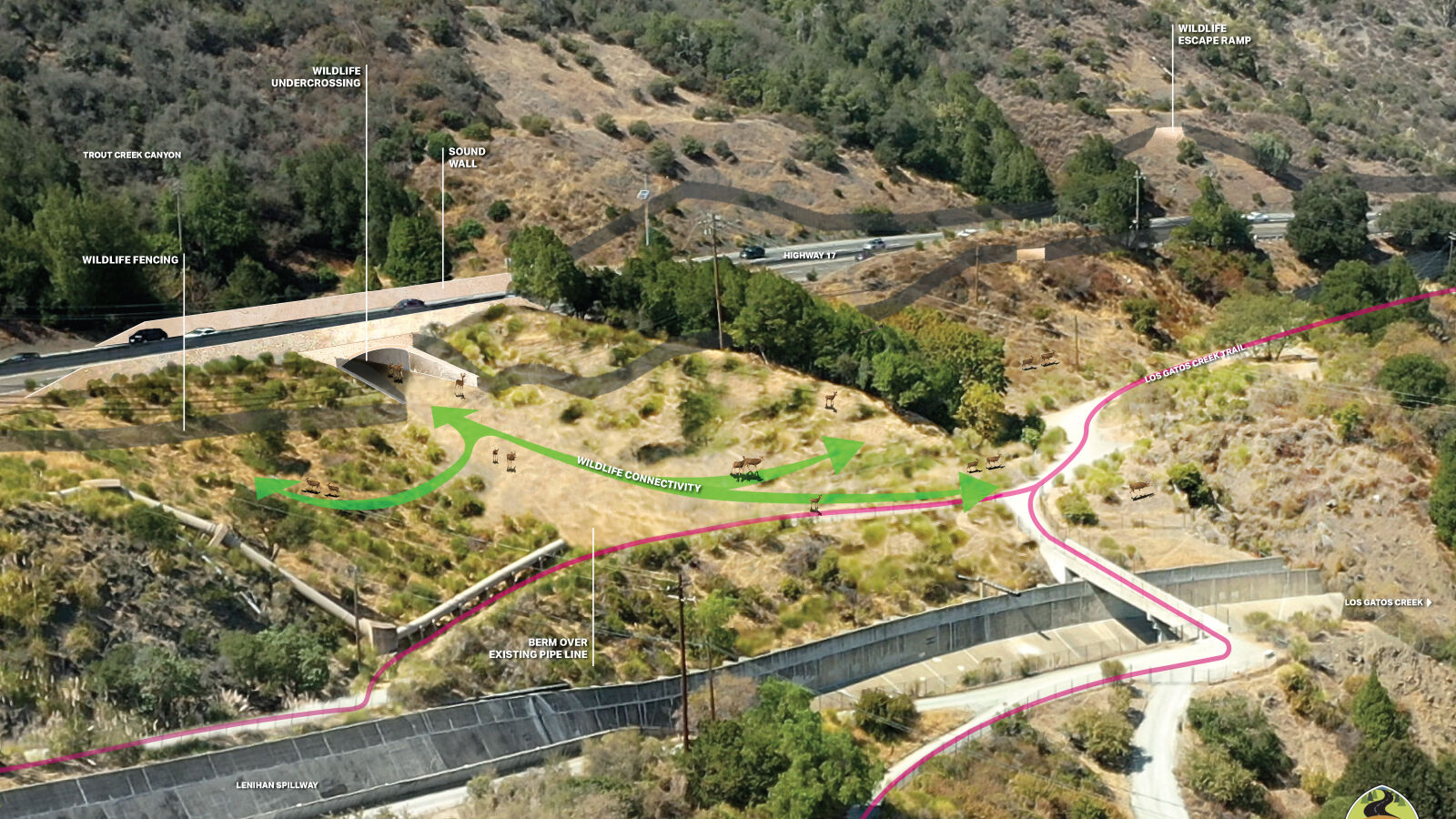
Inspired by community concerns about the lack of safe passage for animals crossing Highway 17, Los Altos-based Midpeninsula Regional Open Space District has launched a multi-year project to build a wildlife undercrossing and a recreational trail overcrossing.
Planned for the Santa Cruz Mountains, construction is set to be completed by 2027, according to Midpen officials, and will link more than 30,000 acres of protected public lands.
“We’re interested in not just getting wildlife across, but also regional trail connections,” said Julie Andersen, Midpen wildlife program manager. “This is a gap in the Bay Ridge Trail, a 550-mile loop around the San Francisco Bay, and we’d like to close that gap and provide better connectivity for our recreational users.”
The project will also connect the Bay Area Ridge Trail to regional ones, such as the Los Gatos Creek Trail, Andersen added.
Highway 17 winds across a steep, curving landscape and, in many places, is elevated on a viaduct. That makes it difficult for wildlife to go underneath, because there is no way to connect, or because animals could jump off the edge and be killed, Andersen said.
Specifically, south of Los Gatos, there is an earthen berm where one can see across the arm of Lexington Reservoir. Wildlife needs to go over and, with poor visibility, cross four lanes of a busy highway and a concrete divider, Andersen noted.
“The things that we’ve done to make the highway safe for people to get across a very challenging landscape have made it harder for wildlife to get across a challenging landscape,” she said.
Nearly all wildlife species on either side of Highway 17 are affected, but the target species benefiting from the project are mountain lions and deer. Smaller animals such as raccoons, foxes, bobcats, coyotes, newts and turtles may also see positive results, Andersen said.
Design phase
Midpen is currently in the preliminary design and environmental review phase. Senior planner and project manager Jared Hart said Midpen will release a public report in the fall, open for feedback.
Midpen will then move on to final design before beginning construction; that’s when project partner Santa Clara Valley Transportation Authority will take a leadership role, Hart added. Other partners include Caltrans, Santa Clara County and the San Jose Water Company.
Full funding of the construction is still needed, according to Hart, but he said Midpen is pursuing additional grants.
“A lot of our legislators, both past and current and hopefully in the future, have been great partners and advocates for the project,” Andersen said. “Often, they help in securing and identifying funding for us to pursue.”
Area residents can help the project move forward by providing support to the Midpen Board of Directors, as well as their local, state and federal representatives. With more support, Midpen can secure additional funding, Hart said.
Additionally, local residents can sign up on the project webpage to receive updates and stay informed. With the 30-day review period of the environmental review document, Hart said residents have an opportunity to leave comments. Midpen may also hold a public meeting with the board of directors.
“Not only did the public help us start this project by advocating for and helping us secure funding, they’ve also helped shape the design as it moves forward,” Andersen said. “It’s really important to us that we’re using those taxpayer funds wisely and being responsive to not only the wildlife, but the constituent interests in the project.”
Andersen said she is excited to break ground on the project and see some of the first wildlife images of which animals are using the crossing.
“As a wildlife biologist, I’ve seen a large movement and connectivity grow, not just within our state, but within our country,” she said. “There’s a lot more funding available for wildlife connectivity, and that is a testament to people speaking up and being the voice for wildlife.”
To sign up for updates on the project and for more information, visit tinyurl.com/bdh7ecpm.