Our security can seem like it is disappearing as our community and our inner circle fall for the destructive discourse and actions that we fear. Although it could seem like our world is crumbling, it is important for us to stay true to who we are and to stand up for causes that no one else will participate in.
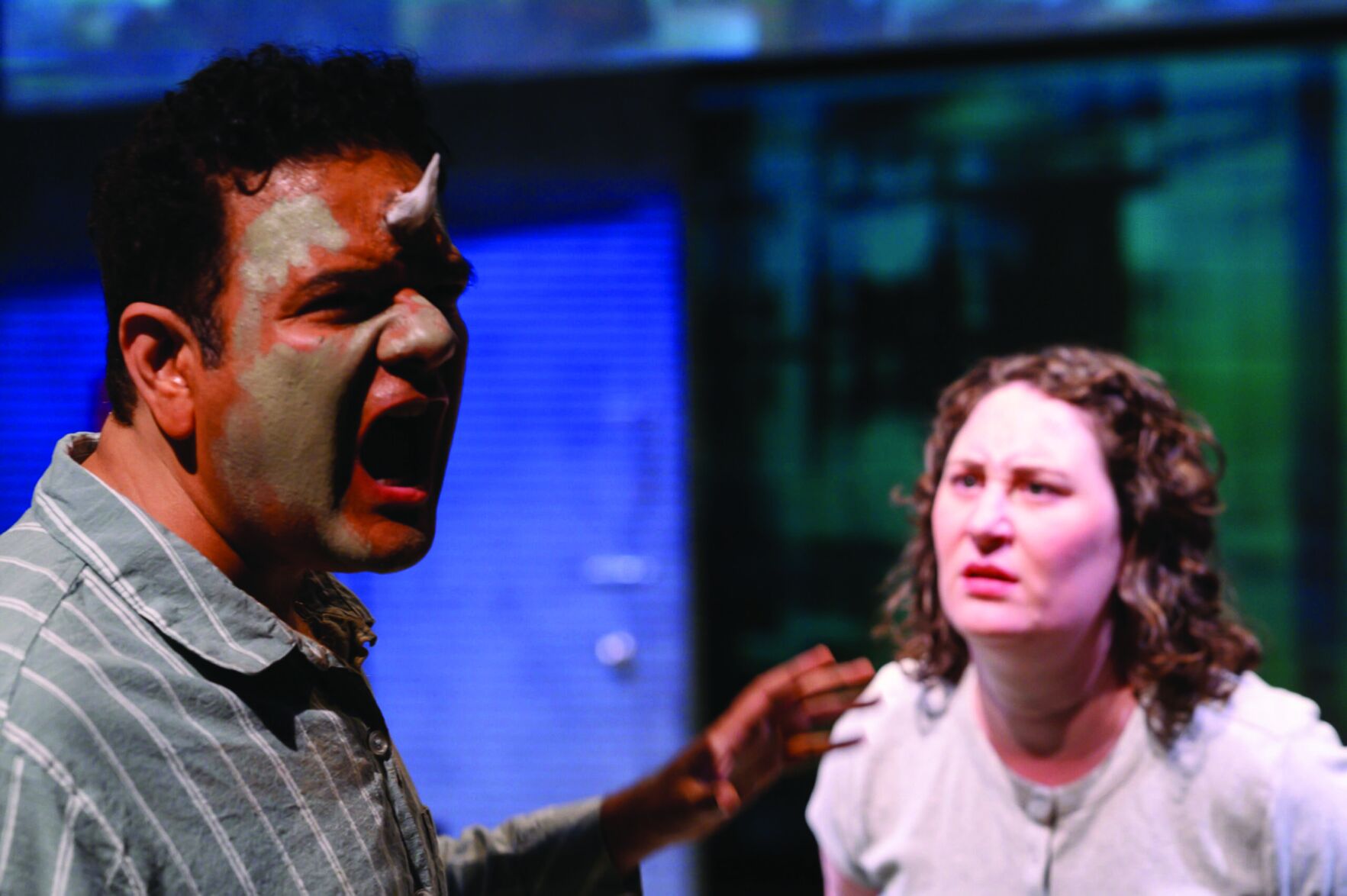
Foothill College Theatre Arts is presents Romanian Playwright Eugene Ionesco’s 1959 absurdist comedy play “Rhinoceros” this month to tell the story of people falling for the the trap of propaganda. Ionesco alludes to the fascist party in the play by suggesting that the characters who turn into rhinoceros are the people who accept the information that comes before them. Ionesco hoped the play would remind audiences not to believe everything at face value and not to follow harmful agendas.
Bruce McLeod, the director of “Rhinoceros,” modernizes the story to set in our world through the technology, pop culture references and professions they mention in the dialogue. McLeod said in the introduction to the play that every society is susceptible to totalitarianism. He said he is drawn to stories that have characters wary of the greater context of their world.
The play opens in an undisclosed city as many patrons go about their business on a Sunday afternoon, such as buying food at the market, eating at a cafe and catching up with friends over a drink. Berenger (Caitie Clancey), the protagonist and first character we meet, has a hard time adjusting to her daily life. She drinks heavily and feels too anxious about her own issues to care about what is going on around her. Her friend John (Lian Malla) meets up with her and calls her out on how she dresses and her indifference to doing better for herself.
As the friends and other patrons have their conversations, a rhinoceros is seen storming the street, confusing everyone in their ordinary day. The patrons try to make sense of it and try to understand how it is possible, but Berenger is the only one not to engage in conversation about it. Although an out-of-ordinary experience just happened, Berenger continues to ignore the unusual encounter and seems to struggle with why people care so much.
Throughout the play, one will see that Berenger continues to avoid the social norms and the typical behavior that are expected of her friends and colleagues at work. She refuses to conform to the ideas people want her to believe in and would rather be her own person.
Her individuality is expressed even more when the rhinoceros begin to show up in larger numbers. What started as one strange encounter with the beasts turns into a common figure in the media. She is afraid that she will turn into a rhinoceros and she begins to lock herself away.
This play shows the downfall of humanity and how common it is for people to be tricked by the alleged benefits of new ideas. The rhinoceros was once perceived as an unusual sighting but was soon viewed as a misunderstood animal that people needed time to understand. Many did not want to be left behind if they did not turn into a rhinoceros fast enough and others soon changed their viewpoints once they saw themselves as the minority.
The play is set to run until June 8. For more information, visit foothill.edu/theatre/rhino.html.