While spelling and grammar remain the same, the way children are learning the rules of writing is undergoing rapid change.
On Jan. 14, Springer Elementary School held a public demonstration of Read, Write & Type! (RWT), an innovative software program designed to combine the skills of reading and writing with typing and computer proficiency.
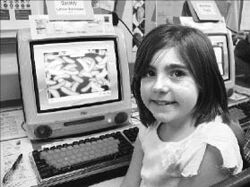
“This game is superfun,” said Kyle Pease, a second-grader from Mountain View. Following the current trend in learning software, basic lessons are disguised in more palatable forms of entertainment.
In 1994, students in the Los Altos School District began to learn to read and write using computers as part of a grant from the John S. and James L. Knight Foundation, which supported the development of computer-based teaching programs. Fourteen years later, the program continues with the awaited release of RWT.
The Springer students prattled away at their keyboards, absorbed in exercises that ranged from matching homonyms to popping balloons containing rule-breaking “outlaw” words.
By setting reading lessons on the computer, Los Altos teachers killed two birds with one stone, bundling the necessary skill of typing with the more essential art of literacy.
But the software is not all fun and games, said program designer Dr. Jeannine Herron.
“Studies conducted in 2003 show that only 31 percent of college graduates (10.5 million individuals) qualify as ‘Proficient Readers.’ That’s a decrease of 9 percent from 1992, when the number was 40 percent.”
Quoting a Yale University study, Herron suggested that the decrease may be due to problems arising during a student’s early years in the classroom.
In an environment where right-brain activities (logic and analysis) are taught alongside left-brain functions (creative and emotional skills), children may struggle with language due to employment of the wrong hemisphere for a given task.
“The (young) mind is like a refrigerator waiting for the food,” said Herron. “So it’s important to nail the left hemisphere right away.”
The software aims to set the mind on the right track at an early age, possibly even mitigating the effects of dyslexia at later stages of a child’s development. With its 20 songs, numerous games and colorful animated characters, RWT attempts to accomplish proficiency in the most innocuous way possible.
“If I can read and type the words,” sang a two-legged keyboard, “then I can read and spell them.” With a click the screen morphed into another window, commencing a song about the “silent e.”
Silent vowels are no challenge to Cassidy Larson-Barcelona, a second-grader at Springer who has discovered J.K. Rowling. An avid user of RWT, the program has helped her speed through the Harry Potter series, which she now fights over with her mother. “My mom is a Harry Potter hog!” she complained, grinning. “I always have to steal it back from her. No! No! No!”