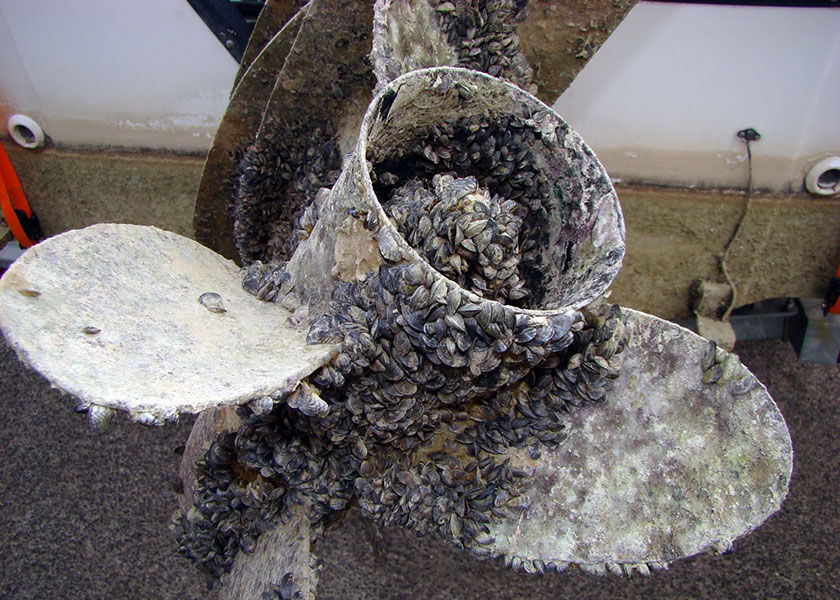
Labor Day is one of the most popular occasions to hit the water for late summer fun. However, the presence of invasive golden mussels in California waters means certain boating regulations have been updated.
Golden mussels are an invasive bivalve species that pose significant risk to California’s aquatic ecosystems and underwater infrastructure, said Krysten Kellum, a public information officer for the California Department of Fish and Wildlife.
“They can attach to virtually any surface, boat, water infrastructure, aquatic vegetation, hard surfaces, soft surfaces,” Kellum said. “We’re making a huge effort right now to educate the public, let everybody know that we need to keep those mussels away.”
Kellum added that beyond the ecological damage caused by the introduction of new species, golden mussels can damage irrigation and floodgate systems.
Golden mussels were first found in California in 2024 at the Port of Stockton, which is connected to the San Joaquin River Delta. While this species of mussel has not been found outside the delta, they still pose a risk that necessitates certain precautions, Kellum said.
While adult mussels are about one to two inches long, diamond-shaped and yellow-brown colored, mussel larvae, or veligers, are microscopic and must travel through water, Kellum added. Additionally, adult mussels are able to detach in order to move with mussel flow.
“That’s how they are spreading throughout the delta and water connected to the delta,” Kellum said. “They don’t have legs and they can’t move upstream, but people could facilitate golden mussels moving.”
Santa Clara County Park Ranger Supervisor Mike Tobin said that the parks department, in collaboration with Valley Water, launched the “Don’t move a mussel” campaign to address these concerns.
They work alongside the Watercraft Inspection and Decontamination (WID) program, which includes a vessel and inspection tracking database, Tobin said. WID contains a list of bodies of water that are “quagga free,” or free of invasive mussel species.
All boats that have previously operated in waterways not on this list must undergo inspection and a 30-day quarantine before they are able to be used in Santa Clara County waterways. Currently, vessels banded in WID safe waters do not need to be reinspected prior to entering Santa Clara County waters.
Tobin outlined some key steps boat owners should take prior to inspection.
“What we recommend is that people wash their hull thoroughly, rinse interior compartments of the boat, then dry them, and then flush the motor for two minutes,” Tobin said. “Then, drain your motor bilge, livewell and then dry everything for at least five days. Any boat coming in has to be dry before going through inspection.”
Tobin said that boat owners should inspect dry surfaces by hand since veligers are too small to be detected visually.
“They feel like sandpaper,” Tobin said.
Vessel inspections also use trained dogs to identify the presence of invasive mussels, said Park Program Coordinator Audrey Diaz.
“We encourage everyone to come with their boat again clean, drained and dry,” Diaz said.
Diaz noted that beginning Sept. 14, all vessels operating in Santa Clara County waters must be inspected, quarantined and banded in Santa Clara County.
Diaz encouraged all Santa Clara County boat owners to undergo inspection now in order to avoid delays. Additionally, the parks department will be hosting a virtual town hall meeting in order to go over any updated regulations. Diaz said that the date for this virtual town hall has not yet been determined.
For more information, see tinyurl.com/Santa-Clara-Mussels.