The heart is an amazing muscle, beating between 55 and 85 times per minute for most heathy adults, according to Harvard Health – and more than 2.5 billion times during an average lifetime.
But things can go wrong. Heart attacks, cardiac arrest and heart failure each affect hundreds of thousands of Americans every year.
The Cedars-Sinai blog (cedars-sinai.org/blog/heart-attack-cardiac-arrest-and-heart-failure.html) describes the differences between various heart ailments. In a nutshell, a heart attack happens when blood flow to the heart is obstructed, often by a blood clot or plaque in the arteries. Emergency surgery is required to remove the blockage and restore the blood flow.
Heart failure is usually a more chronic condition (though it can come on suddenly) in which the heart muscle is weak and can’t pump as much blood as the body needs. Heart failure can also cause an irregular heartbeat (arrhythmia) that can lead to cardiac arrest.
Cardiac arrest, as explained by the American Heart Association (heart.org), happens when an electrical failure in the heart causes an irregular heartbeat. The heart can’t pump blood to the brain, lungs and other organs. This causes a person to lose consciousness and a pulse. The person can die if they don’t receive help within minutes.
According to the Sudden Cardiac Arrest Foundation, there are more than 356,000 cases of out-of-hospital cardiac arrest in the U.S. each year – with almost 90% of them fatal. Another almost 300,000 cases happen while hospitalized.
A survivor’s story
One man’s experience with full cardiac arrest – and full recovery – led him to a new mission in life: urging people to learn CPR.
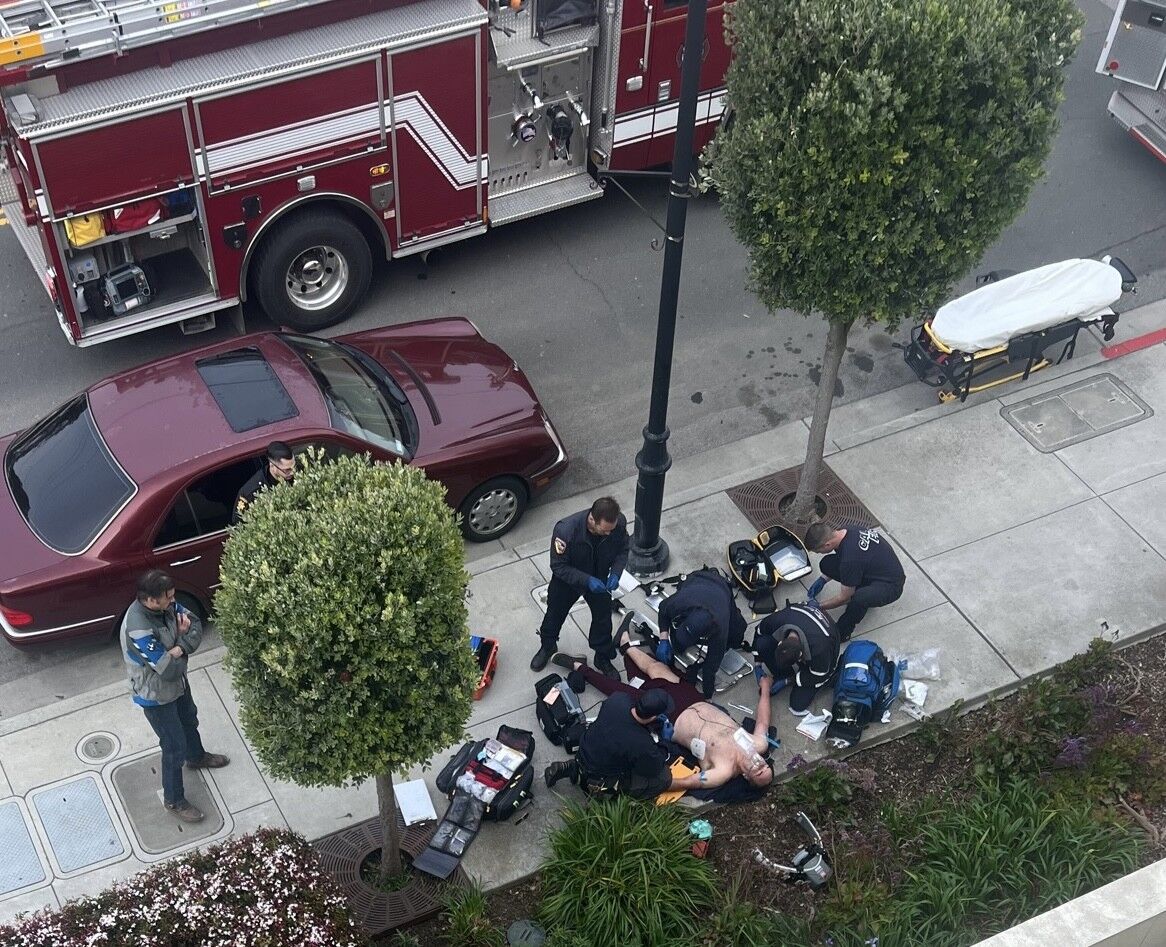
In 2023, Matthew Burrows, a Los Altos native who had moved to Half Moon Bay, said he had been experiencing shortness of breath for a few weeks – “a classic symptom,” he said. Putting off seeing a doctor about his symptoms, he decided a healthier lifestyle was in order and was trying to eat better and exercise more. He was doing the latter one fateful Monday (“which I believe is statistically the highest day for heart attacks,” Burrows said) – walking down Half Moon Bay’s Main Street – until his heart suddenly stopped beating and he fell to the ground at age 67.
Fortunately for Burrows, Peter Williams, the man who would save his life, was riding his motorcycle down Main Street and noticed a small crowd around a man lying on the ground. Williams said he normally took Highway 1 home, bypassing Main Street. But on this particular Monday, he chose Main.
“By the time Peter got there, I was probably there a good 10 minutes,” Burrows said. “Anyone who’d been trained in CPR would have taken action, but there was seemingly no one trained in CPR.
“Just to stop and take action takes a lot of courage,” Burrows continued. “Because it’s easy to say you’re trained, but it’s a big deal. He had been trained, he’d been a ski instructor. He said that when he was doing CPR on me, I would start to come out of it and (drift) back, so it was tough. He didn’t know whether to keep going – it was tough for him to judge. But I hope he feels proud of his heroic action.
“I am also incredibly grateful for the Coastside Fire Department paramedics and emergency ambulance team,” he said. “Without them – and Peter – I wouldn’t be here today.”
When the paramedics arrived, they used a defibrillator on him. Burrows remembers nothing of the fall or the rescue and has just a vague recollection of his long ambulance ride to the hospital.
“That’s the (downside) of living on the Coastside – there’s no emergency room,” he said. “So I recall going in and out (of consciousness) to the hospital on a very chaotic 40-minute or whatever it was drive over 92 to Mills Hospital in Burlingame.”
After a few days in the hospital, during which he had two stents put in, he was sent home, with his sister Julie there to help him.
As for the recovery process, Burrows said it was “remarkably ‘on-your-ownish.’ They want you to get moving and do what you can. So I set out to walk as much as I could and just get healthier. Over the next year or so, I lost about 40 pounds and was walking quite a bit.”
After an initial aggressive course of blood thinners, he settled into taking “the drugs that I never took but should have been taking” for high blood pressure, as well as statin pills and half an aspirin as a blood thinner.
Burrows’ advice for preventing the situation he found himself in that day on Main Street includes the following.
“Number one, leading up to it, is lifestyle, keep yourself fit, and if you do experience symptoms, act on them right away. Don’t expect them to go away on their own. See a cardiologist.
“And number two, even if you’re not experiencing symptoms, but are a certain age or are in a certain physical condition, you should probably know you’re at risk, either through your own lack of fitness or your family history. Go see a cardiologist.
“Definitely don’t wait,” he stressed. “Probably if I had not waited, I would have had a better outcome. I was extremely lucky to have been taken out of that whole situation by Peter.”
Burrows, who was certified in CPR shortly after the event, urges everyone to learn CPR and to be aware of defibrillators (AEDs) when out in public.
“The importance of learning CPR also, is that it’s not just the chance of running into a stranger on the street who needs it – it might be your loved ones or neighbors – and if you’re with older people, the odds are pretty good something’s going to happen.”
What to do
If you witness an adult experiencing cardiac arrest (procedures for children and infants are slightly different), the American Heart Association recommends the following: Check for responsiveness; shout for help; call 911; begin CPR and continue until EMS staff arrive; use an Automated External Defibrillator (AED) if possible; if two people are able to help, one should start CPR immediately while the other calls 911 and finds an AED.
CPR together with the use of an AED greatly increase survival rates. CPR is intended to pump the heart to get blood flowing and circulating to organs, while the AED sends an electric shock to the heart in an attempt to restore its normal rhythm.
Save a life – Learn CPR
The Santa Clara County Fire Department offers regular four-hour AHA Heartsaver CPR/AED courses in various locations. Classes include instruction in adult, child and infant CPR; how to use an Automated External Defibrillator (AED); how to assist someone who is choking; two-year course completion card with CPR mask and gloves kit. Classes cost $65. To view upcoming classes, visit tinyurl.com/SCCFD-CPR-AED.
The American Red Cross also offers regular training in First Aid/CPR/AED. Most classes take place in San Jose. Online options are available but require an in-person skills session for certification. Prices vary. For details, visit tinyurl.com/RedCross-CPR-AED.Safety Training Seminars, an authorized training center of the American Heart Association, offers a wide selection of classes in Palo Alto. Hybrid online/in-person First Aid/CPR/AED classes are $89. American Heart Association certification costs an extra $40.
For a schedule of classes, visit tinyurl.com/STS-CPR-PaloAlto.