

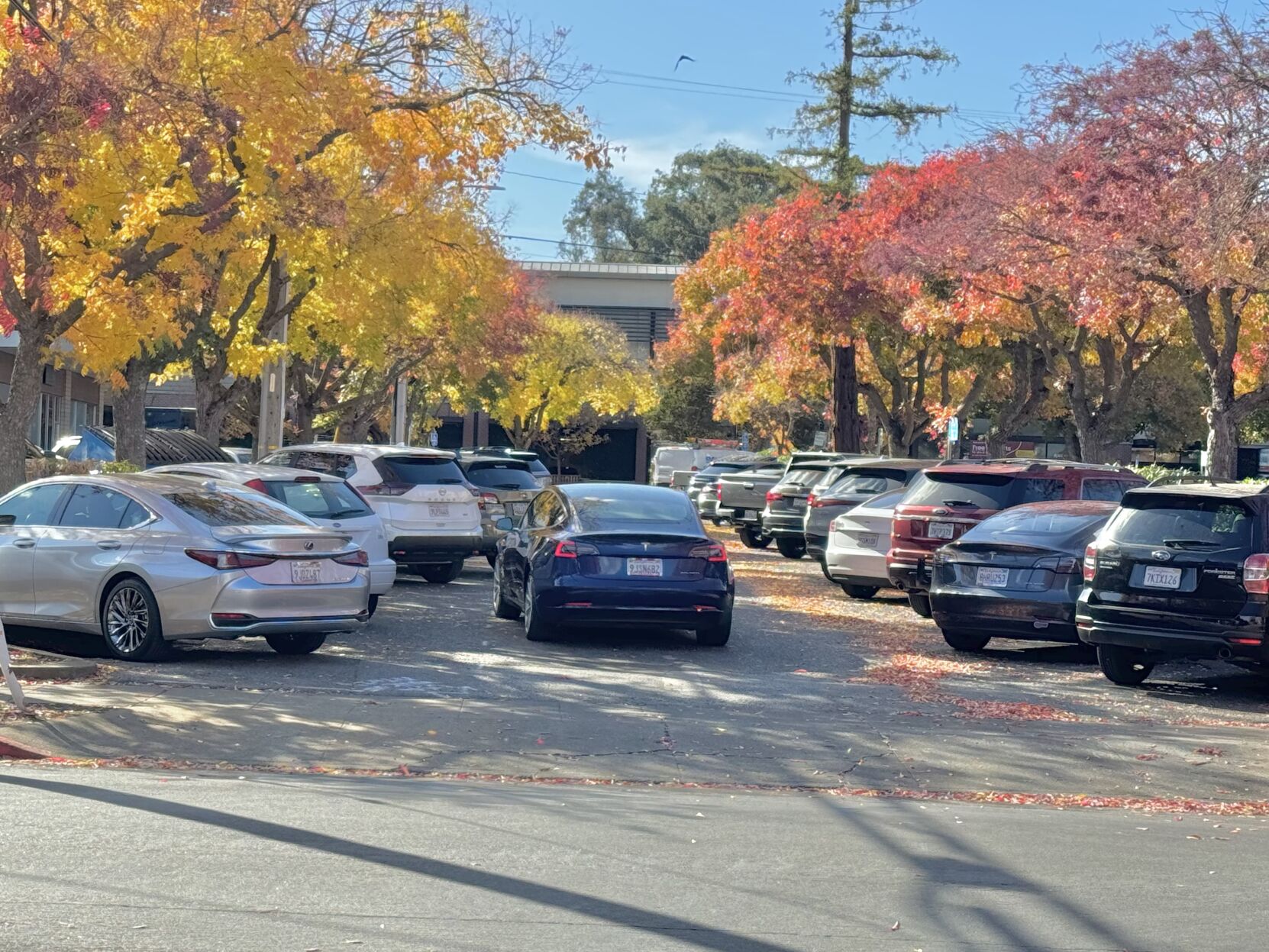
Downtown Los Altos has ample parking, but improving conditions could involve meters or use of private spaces through a business improvement district.
These are a few of the recommendations made in a new report on downtown parking strategies. City council members discussed the findings during a Nov. 12 study session.
The latest in a series of parking studies dating back decades, the presentation from W-Trans traffic management consultants found that peak usage of the 1,700 public spaces ranged between 54% and 60% – data collected during the holiday shopping season in December 2023. Peak occupancy reached a high of 71%.
Data on the 804 privately-owned spaces was far lower with peak use at 38%. The consultant’s finding also showed most vehicles parked for less than two hours and relatively few parked “long-term.”
The report suggested freeing up existing private spaces through shared parking agreements when forming a Business Improvement District (BID).
The report’s findings come as downtown Los Altos faces the potential loss of downtown parking plaza space to affordable housing development, a city park and a theater.
The assertion that people found downtown had plenty of parking took some councilmembers by surprise.
“The fact that most people that you interviewed, … thought that we had sufficient parking – anecdotally I will tell you, I get the opposite reaction,” Councilmember Neysa Fligor told Brian Canepa of W-Trans.
“I was a little surprised too, because most of the time, when we pose these questions to people, is parking easier or more difficult, more often than not, it’s more difficult,” Canepa said.
Canepa said feedback for the report came from public input gathered in February through April through online surveys, workshops and a pop-up appearance at a Los Altos First Friday event.
The report also generated surprise, concern and some negative reaction from public speakers.
Perhaps the most immediate non-starter was a recommendation to install parking meters.
“Part of the success of our downtown is, we don’t have parking meters and you do not have to park below ground,” said longtime property owner Mel Kahn. “Above ground versus underground parking are not equal.”
The report also offered findings of concern to proponents of outdoor dining.
“According to feedback from community members, there is general interest in converting outdoor dining spaces, … back to on-street parking spaces,” the report noted.
W-Trans recommended the annual cost to renew parklet permits be adjusted in the short term to reflect “the theoretical value of an on-street parking space.” The city is charging $3 per square foot annually, far lower than the $10.52 in Redwood City or the $48 in Walnut Creek.
“A lot of businesses invested in the new parklets, and to change the rates so quickly could be very shocking to them,” offered longtime downtown property owner Kim Cranston.
Anne Paulson reacted to a report recommendation that developers replace parking lost to affordable housing in the parking plazas.
“(Affordable housing) developers can’t afford to do that,” she said. “These grants are competitive and funders are just going to say, ‘Our affordable housing dollars are for affordable housing, not for parking for rich city shoppers.”
Jon Baer disagreed with the report’s assumptions about parking demand.
“We don’t really understand what the demand is, from studios, from one-bedroom units, from two bedrooms, from BMR (below market rate) units, and we really need that information to plan accordingly,” he said. “Our downtown is becoming a condo and restaurant downtown, and maybe we have a handle on what’s going on with the restaurants, but we really don’t with housing.”
A surprising high point of discussion concerned the artistic bike racks in the downtown.
Paulson said: “Cyclists hate them – I hate them. I just want a rack I can find, lean my bike against and it won’t fall over – that rack is the inverted U – accept no substitutes.”
Other recommendations, which covered short-term (0-2 years) and longer-term (2-5 years) implementation periods:
• Amend the city’s zoning code to make all downtown a single parking district and institute parking in-lieu fees within that district.
• Provide online mobility information for downtown users.
• Implement all-day visitor parking permits.
• Use Automatic License Plate Recognition (ALPR) for parking enforcement and contract with a third party to do it.
• Install wayfinding signage throughout the downtown to better direct drivers to off-street parking facilities.
Fligor suggested the city “look at things we can do in the short-term that would have a big impact,” such as the wayfinding signage. She also wanted a comprehensive plan that would allow for flexibility “but not change every year.”
Added Mayor Jonathan Weinberg: “Until we have clarity on what happens with plazas 1 and 2, and 7 and 8, we can’t really say, this is the plan, we’re sticking to it.”
City staff and the consultant plan to use feedback from last week’s study session to make changes on the parking strategy and report back to council for adoption early next year.





