

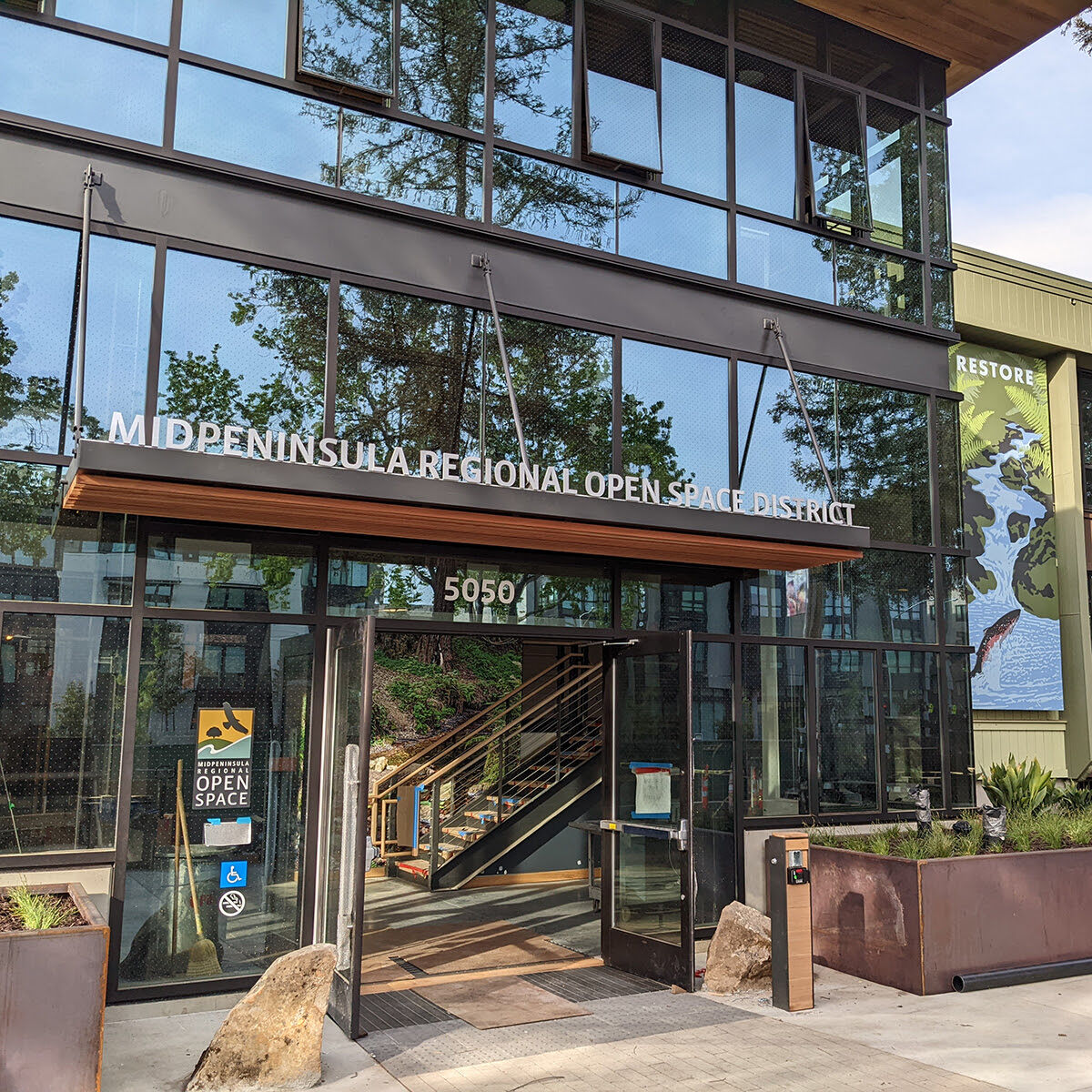
The Midpeninsula Regional Open Space District recently revealed that it reduced its greenhouse gas emissions by more than 30% in 2022 – well above its targeted goal of 20%.
Officials with Los Altos-based Midpen, which maintains more than 70,000 acres across its 27 preserves, said they aim to reduce operational emissions by 80% before 2050 to combat escalating global warming threats to the state’s ecosystems and wildlife.
“All of our facilities, except one, are using entirely renewable electricity – solar, wind and some hydropower,” said Sophie Christel, Midpen management analyst and climate change specialist. “Another really cool thing that we’ve been able to do is run some of our equipment and larger vehicles on renewable diesel. It’s a lot more convenient and it burns really clean; the carbon footprint is about a third of regular diesel. And we have fuel tanks at our field offices for our staff if they drive a diesel vehicle.”
The organization’s website reports that Midpen-related emissions come from vehicle and equipment operation, employee and visitor commute travel, and facilities activities. However, with the introduction of renewable electricity – along with the previously mentioned renewable diesel made from natural byproducts – energy efficiency has been improved without further compromising the health of the preserves. In addition, Christel said facility vehicles are gradually transitioning to electric power in preparation for California’s zero-emissions law, which mandates that by 2035 all vehicles sold in the state must be zero-emission.
“How much charging infrastructure do we need? Where is it best to put it or distribute it between our various offices? How many vehicles do we actually need of each type for the work that we do?” Christel said. “We are working on a fleet transition plan with a consultant which will give us a roadmap (in answering these questions as we) move away from fossil fuels.”
Climate change effects
Apart from providing public recreational areas and protecting California’s biosphere, open-space preserves can help combat rising temperatures. Massive amounts of carbon are stored in plants and soils, with industrial development of the areas resulting in that carbon being released into the atmosphere. Midpen, by acquiring and protecting natural spaces, can ensure the carbon stores remain inactive in the earth.
According to the organization’s website, trees and plants “in a process called
sequestration, breathe in more carbon every year, removing it from the atmosphere. Every acre of open space land absorbs on average 1 ton of carbon every year, and sequestration can be much more than that in ecosystems like redwood forests.”
By working with regional partners and experts, while providing connected oases for plants and animals to migrate, Midpen can also prepare for the many effects of climate change that are already irreversible.
“The thing to remember is that reducing our greenhouse gas emissions – while it is important to limit climate change in the future – it doesn’t affect the impacts that we’re already seeing,” Christel said. “As an agency that manages open space and natural land, we are really concerned that our ecosystems are under pressure by intensified cycles of drought and deluge; we’re also concerned about range shifts for species.”
Due to rapidly changing conditions, habitats are no longer suitable in ways they once were; examples of a range shift include a stream that may be unable to sustain a population of fish throughout the year or a pond that dries up before a species of frog can finish their reproductive cycle.
These are the types of impacts Midpen officials said they are seeing within their preserves, which includes Rancho San Antonio. The La Honda Creek Preserve Forest Project, aimed specifically at forest health and restoration, was established in response to aid the forest in being more resilient to climate stressors.
“The goal (of the project) is to protect a forest that will, in the long term, be able to develop old-growth conditions, conditions that you can really only see now in a few remote areas of the redwood forests throughout California because most of our redwood forests have been logged,” Christel said. “What we want to do is protect those (remaining) old trees and make it possible for some of the younger trees to reach that really old age; the bigger they get, the faster they grow and the more carbon they sequester every year.”
Christel added that the treatments Midpen is employing in the La Honda Creek project will help reduce the risk of fire, limit the spread of disease and invasive species in forests, and slow down the stress of drought on protected lands.
By managing increased natural disasters and proactively implementing sustainable technologies and models, Midpen aims to limit both destruction of habitat and the economic costs of reconstruction.
“We also work with a consortium of organizations in the Santa Cruz Mountains bio region, which includes most of the Peninsula – it’s called the Santa Cruz Mountains Stewardship Network,” she said. “And that’s a group of different land stewarding agencies and organizations which share data and knowledge and coordinate efforts to do this type of resilience and adaptation work that we’re talking about. Because it does have to be a regional effort; climate change doesn’t obey property lines.”





