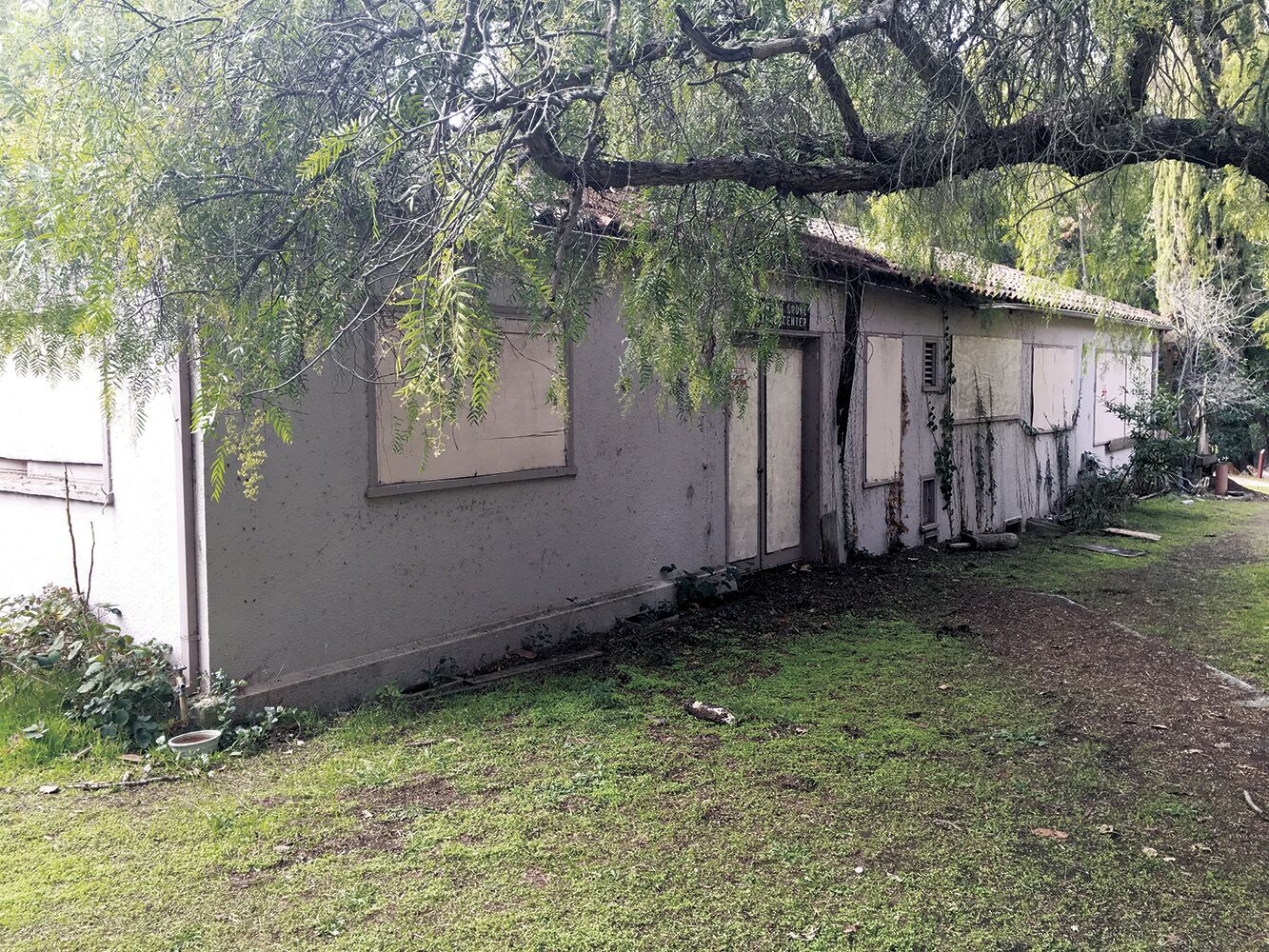
Subjected to conflicting and passionate viewpoints, the fate of the dilapidated yet historical Halsey House remains in limbo. For years, the Los Altos City Council has been wrestling with how to proceed.
Council members were still unsure during last week’s study session about the 1920s-era structure at Redwood Grove Nature Preserve. Even as they approved an analysis required under the California Environmental Quality Act (CEQA), they kept three options open: full rehabilitation, adaptive reuse, each costing $4.5 million or more, or demolition.
Built by Theodore and Emma Halsey in 1923, the city purchased the house and surrounding land in 1974 to create Redwood Grove. The Spanish colonial-style structure was designated a historical landmark in 1981. The house was used for recreational programs, but by 2008, it fell into such disrepair that it was boarded up.
The arguments for both restoring and destroying Halsey House were on full display at the April 25 study session.
“Put Halsey House out of its misery – it’s been 15 years since it’s been red-tagged,” said nearby resident Rory Van Tuyl. “The city has done nothing – get off the dime and do something about this.”
Added neighbor Tim Twerdahl: “It’s an eyesore and embarrassment to the city to have a condemned building in the middle of a nature preserve. Given the potential seismic and flood issues, the restricted access for emergency vehicles, the fact that the park is meant to be a nature preserve and not a programming space, I implore the council to delist and demolish the whole house.”
Jon Baer, a former planning commissioner and longtime supporter of Halsey House rehabilitation, countered that the house was professionally evaluated and deemed structurally sound. He added that the structure was not vulnerable to earthquakes or flooding, as demonstrated by the house escaping the latest winter storms unscathed. He added that as Halsey House is a historical landmark, the city is legally obligated to prioritize its rehabilitation.
“As an owner of a city landmark building, I’m appalled and offended by the city trying to weasel out of its responsibility when others are held accountable,” Baer said. “How does a city spend and continue to spend tens of thousands of dollars on discretionary projects ahead of an expenditure that is required by law?”
Council members spent considerable time confirming with deputy city attorney Erik Ramakrishnan which options would trigger the CEQA analysis. In the end, opting for complete rehabilitation or teardown would cover any option in between, Ramakrishnan said, though demolition would require an environmental impact report.
One option that is off the table is “mothballing,” in which basic maintenance is performed on a structure to prevent it from further deteriorating. Some council members and speakers felt the option wasted money and “kicked the can down the road.” The council in 2021 chose the mothballing option for Halsey House.
Council members approved an initial study and environmental review, if appropriate, pertaining to two primary options – demolition and adaptive reuse, which includes alternative project options yet to come forward.
Councilwoman Lynette Lee Eng sought and received assurance that full rehabilitation of Halsey House remained an option.