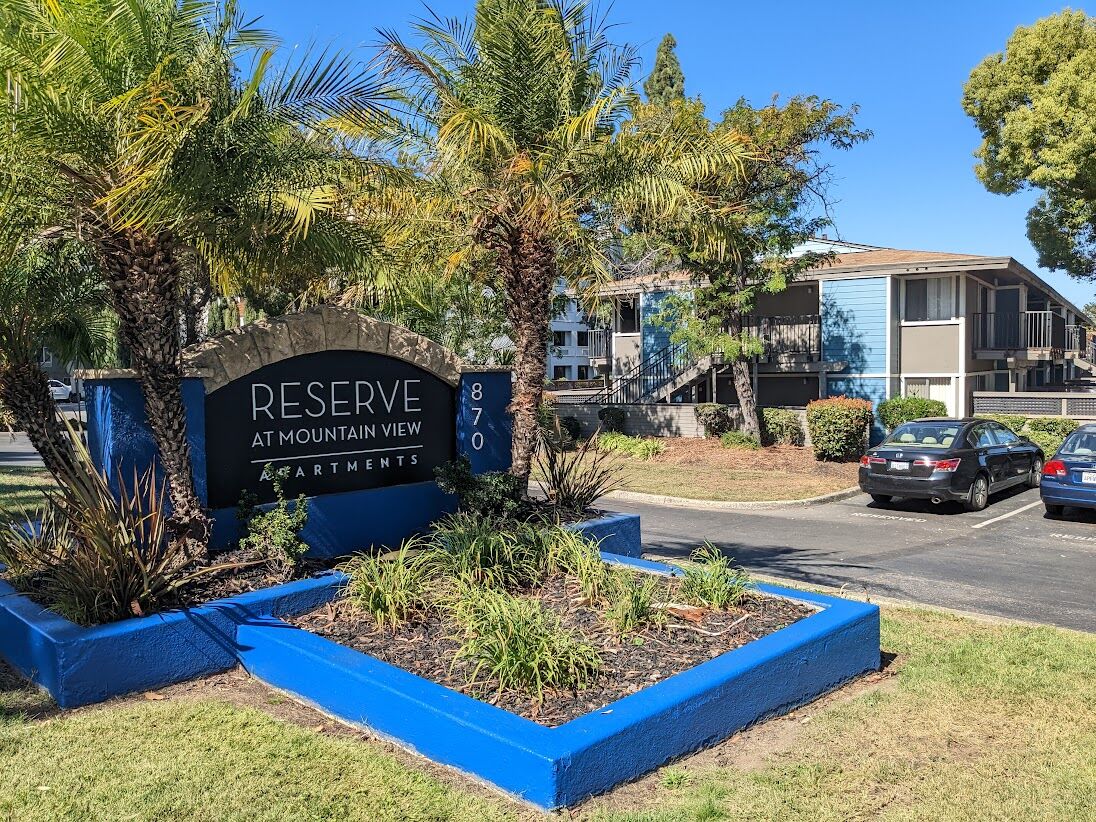
The Mountain View City Council approved a new apartment complex on El Camino Real last week that marked the first time a new rental housing affordability rule in Mountain View has been applied. Landowners replacing rental housing units built before 1995 are now required to deed-restrict an equal number of new units, to be rented at below-market rates.
The Equity Residential redevelopment project, located near Goodwill and PAMF Mountain View on the southeast side of the city, includes affordable units designated for very-low-income households, fulfilling the requirements of a recently enacted state law, Senate Bill 330, whose ramifications are only beginning to play out in Mountain View.
Enacted in 2020, SB 330 outlines rental housing unit replacement among many other rule changes intended to address California’s housing crisis. It offsets limitations on what can be developed by streamlining the approvals process for developers and pairing affordability requirements with incentives like density bonuses.
Cities have some discretion in how they deploy SB 330’s rules, and the Mountain council approved a policy last month specifying how demolished rental units that had been subjec to rent control must be replaced with affordable housing in any rental redevelopment. This applies to multifamily rental housing being replaced with rental housing units, not condo conversions or other land sales. More than half of Mountain View’s housing stock is rental units.
Because the city implemented rent control across all multifamily housing built before 1995, SB 330’s rules apply to much of its housing stock. Council members weighed two options: new rental units could be subject to rent control, or they could be deed-restricted, with rent capped at rates deemed affordable to households earning 80% of the region’s median income. The council voted unanimously to choose deed restriction.
Councilmember Margaret Abe-Koga, who supported the council vote, noted in an interview that rent control is not means tested – all renters, however affluent, benefit from capped rent increases – while the deed restriction creates affordable housing specifically designated for low- and very-low-income residents.
“I support trying to provide more affordable units for those who need it, that’s why that choice was for me the better option to take,” she said.
Compromise solution
It’s too soon to say whether SB 330 will curb or promote redevelopment interest. For small-time landowners, the new policy codified last month will make redevelopment of a modest rental property nearly impossible from a financial perspective.
“About half of our units are owned by property owners that own fewer than 10 units, the mom-and-pop property owners,” said Abe-Koga, who acknowledged the housing affordability rules come with serious costs for some landowners.
She estimated that property owners with a fourplex or eightplex would need to quadruple their number of units to recoup the cost of redevelopment, given the rent caps brought by deed restriction.
“My sense is what will happen with those smaller developments is that they probably will go to the for-sale side,” Abe-Koga said. “That’s just inevitable.”
For large developments like the Equity Residential project that just received the green light, the payoffs are clear. Equity Residential proposed to provide 33 units capped at rents affordable to very-low-income households, and nine units capped at rents affordable to families making 80% of the area median income. Income-qualifying tenants of the demolished units also get the right of first refusal to rent in the new structure. In exchange, the developer received concessions including a reduction in required open space, increased building height and reduced setbacks.
Kevin Ma, who spoke for the League of Women Voters at the Sept. 12 city council meeting, said in an interview that the council’s implementation of SB 330 aligns with the league’s goal to reduce housing displacement in Mountain View. He said the option to deed-restrict units below market rate would provide more-affordable housing than if the council had elected to choose rent control instead, because apartment rentals can reset to much higher market rates for a project’s new occupants.
“SB 330 is a compromise – it’s saying in return for making these rent-controlled units functionally permanently affordable, we will make some changes to the development pipeline to address concerns developers have had in the past,” he said.
What about Los Altos?
Rental housing in Los Altos is also subject to SB 330. The city’s development services director Nick Zornes said Los Altos does not have a rent control program, but many city developments have included below-market-rate units because of the density bonus long before the new state rules came into effect.
Apartment housing in Los Altos occupied by people who make 80% or less of the area median income is subject to the same restriction as in Mountain View – each demolished unit must be replaced by an affordable unit with a 55-year deed restriction. Although this puts substantial constraint on very small rental developments, Zornes said the city typically sees development applications seeking to add many units.
“Most of the people that have the fourplexes, the eightplexes, most of them aren’t redeveloping them, they’re just renovating them,” he said. “Even if they were going to do fair-market housing, the return on investment wouldn’t be enough unless they added more units. … It’s all a numbers game, and (profitability) is a sliding scale.”