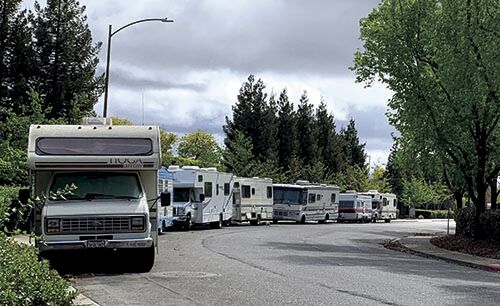
After coming to a settlement in the lawsuit over its RV-ban parking ordinance, the city of Mountain View began enforcing timed parking limits and oversized-vehicle limits on its public streets Saturday.
Enforced limits include the 72-hour rule, which significantly impacts vehicle dwellers, who are now at risk of being ticketed or towed if they remain parked in one place for more than three days.
The voter-approved Narrow Streets Ordinance and the Bike Lane Ordinance also took effect Saturday. The ordinances prohibit oversized vehicles from parking, respectively, on public streets narrower than 40 feet wide and streets with bike lanes.
Enforcement of the new ordinances comes on the heels of a tentative settlement in the Navarro v. City of Mountain View lawsuit, which has yet to be approved by the U.S. District Court.
The settlement resulted in a number of protections for RV-dwelling residents that were not guaranteed prior to the lawsuit, including the designation of at least three miles of streets that will allow oversized-vehicle parking without overnight restrictions. The city has been distributing maps in English, Spanish, Chinese and Russian over the past month to oversized-vehicle occupants that show where parking is available without restrictions throughout the city. The city also will provide a map with each parking ticket issued.
Most of the city’s streets are designated narrow or feature a bike lane, leaving approximately 50 of the city’s 525 streets or street portions for overnight oversized-vehicle parking. “Safe” streets include Ortega Avenue, Old Middlefield Way, Terra Bella Avenue and other smaller streets or street portions scattered around the city.
The city must issue a parking ticket at least once 72 hours prior to towing a violating vehicle but retains the right to tow immediately if it is blocking traffic or a driveway, or if the vehicle has previously received three or more parking tickets in violation of the ordinances. Residents with disabilities may request reasonable accommodations for their disability, which “the city will consider in good faith,” according to the settlement.
Pleas for empathy
Plaintiff Celerina Navarro said she was pleased with the outcome of the settlement, noting that Mountain View residents living in RVs no longer face the threat of displacement.
“Now people can feel more at ease knowing that they can remain in Mountain View without being displaced,” she said.
Local civil rights organizations also consider the lawsuit successful in protecting the most vulnerable people in the community against displacement, loss of support networks and further impoverishment by way of excessive fees.
“We’ve seen cities across California take a punitive approach to addressing the housing and affordability crisis our communities are facing,” said Bill Freeman, senior counsel of the ACLU of Northern California. “Rather than take up measures that serve the needs of all residents, regardless of income or housing type, many cities have chosen to target and harass people for their housing status. The tentative settlement agreement in Mountain View shows that it is possible for a city to take measures to respect unhoused residents.”
Despite the many important protections afforded to vehicle-dwelling residents as a result of the lawsuit, many people are still at risk of being ticketed or towed.
Local nonprofit Reach Potential Movement is raising funds for vehicle dwellers who need extra assistance to comply now that the restrictions have taken effect.
Mountain View resident Jarad Backlund, who has worked with groups like Reach Potential Movement that assist oversized- vehicle occupants, asked the Mountain View City Council in a public comment at the Sept. 27 council meeting for more time and understanding for residents who are still trying to figure out how they will comply with the new ordinances.
“There are a number of folks who are disabled or who have immobile RVs and are trying to figure it out, but need some more options on some places to park and also a little bit more time,” Backlund said.
Mountain View resident Kavita Aiyar, Los Altos Mountain View Community Foundation director of communications, echoed Backlund’s sentiment, urging the city to practice empathy as the ordinances take effect.
“I really think that if there was ever a time for compassion, it is now,” Aiyar said. “These are human beings, and these are their homes, so how can we all work together to support folks in finding a way forward?”