Four and a half hours of Los Altos City Council discussion last week led to yet another delay in adopting an ordinance regulating small wireless telecommunications facilities throughout the city. The approval process has been marked by vocal concerns from some residents over noise and health impacts.
In addition to the ordinance, the council considered a negative declaration of environmental impact under state law and adoption of a resolution outlining design guidelines. After a second public hearing and further edits to the ordinance wording, the council voted 4-1 to postpone adoption to its June 14 meeting.
The wireless telecommunications ordinance provides guidelines for regulating wireless installations at various locations. The need for set design guidelines and locational standards has increased as cellphone providers have moved from cellphone towers to smaller facilities carrying less powerful transmissions. That means more installations are needed to maintain coverage.
The council can regulate on aesthetics, such as positioning of facilities on utility poles, but cannot supersede federal law regulating environmental standards. Nonetheless, some residents stressed that the city consider the potential health impacts.
“We are all concerned about our health,” resident Terri Couture told council members. “Please do your homework, try to listen to us. None of you can confirm with us that we won’t get sick.”
The May 10 meeting, a continuation of discussion from an April 12 meeting, was marked by lengthy input from an out-of-town speaker claiming to be an expert in the field. Under city rules, residents who spoke ceded their three-minute speaking time to
accommodate the speaker. Concerns included fire risks, lack of Americans with Disabilities Act access and other risks from “strong electrical components.” The city’s experts agreed to research the fire-related concerns but not incorporate findings into this version of the ordinance.
Out-of-town input
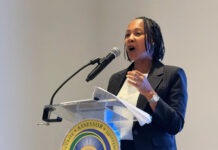
W. Scott McCollough, a Texas-based internet and communications lawyer, received nearly 10 minutes of time to caution the council and city staff about leaving the city exposed to a variety of factors, from electrical and fire hazards to lack of ADA access. He urged the city to add more protective language on such factors, while still complying with federal law.
“We believe … stronger protections are necessary,” he said. “There is a way to do that without violating federal law.”
McCollough offered to work with city staff to refine the ordinance.
After McCollough’s time expired, Councilmember Lynette Lee Eng asked him a series of questions that had him speaking an additional 10 minutes. That prompted resident Joe Beninato to wonder aloud whether McCollough’s combined 20 minutes of meeting time was “orchestrated.”
“I can’t believe what I just witnessed,” Beninato said. “Carpetbaggers from Texas are telling us what to do. … The general practice of the council is not to respond to public speakers, but it seems like Councilmember Lee Eng knew he was going to be calling in and had a series of questions for him so he could increase his time from 10 minutes to 20 minutes of our meeting.”
Lee Eng later questioned whether the city could regulate on any environmental factors. She raised a variety of them, from impacts on wildlife habitats to energy consumption and greenhouse gas emissions.
Lloyd Zola, the city’s lead consultant, repeatedly reminded council members that the city, in its ordinance, cannot address health concerns such as radio frequency emissions because the city is pre-empted by federal law. The Federal Telecommunications Act also forbids regulation of technologies such as 5G.
Zola added that the aim of the Los Altos ordinance is to “(address) impacts you as a city can in fact regulate, and not divert environmental analysis into what you cannot regulate. … There is a presumption that those standards are protective of the environment. You are not allowed to second-guess the feds and their standards.”
At their April 12 meeting, council members spent more than five hours discussing and editing the draft ordinance, which would allow for telecommunications facilities at 1,000-foot intervals, and would likely be installed in some residential neighborhoods. The council agreed to combine residentially zoned locations into a single “less preferred category” to provide equity among the locations. Within the category, it established preferences for locating cell facilities on sites set back 25 feet or more from residential homes.
Last week, the council reordered the preferences to emphasize nonresidential locations.
In the action to postpone adoption May 10, Vice Mayor Sally Meadows cast a “symbolic” “no” vote.
Pointing out that the ordinance had already been reviewed twice by both the council and the city’s Planning Commission, Meadows noted the council “has chosen to ignore legal advice in taking action, and I think this process has been ineffective.”
“We have already demonstrated that we are – at least a majority of this council – not going to follow the recommended approach of the consultant and that we are open to other changes and enhancements,” said Mayor Anita Enander.
The council adopted an urgency ordinance in 2019 that focused on prohibiting cellphone facilities based on mainly aesthetic concerns, triggering still-unresolved lawsuits by carriers Verizon and AT&T.