

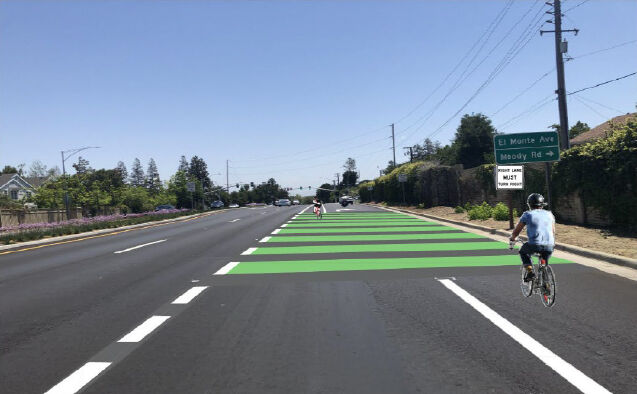
The recently completed Foothill Expressway improvement project through Los Altos was designed to address automobile traffic congestion. But it introduced safety concerns for local cyclists, particularly at the southbound intersection of Foothill and El Monte Avenue.
Now Santa Clara County road officials overseeing the project are finalizing improvements in response to those concerns.
Following a community workshop and further discussion at the Aug. 10 Los Altos Complete Streets Commission meeting, officials with the county’s Roads and Airports Department proposed creating a 250-foot-long “transition zone” for cyclists.
The idea is that horizontally placed green and white stripes would alert cars to cyclists preparing to go through the intersection. It’s intended to address the challenge for cyclists having to move left from the shoulder to a bike slot at the intersection that is to the left of two right-turn lanes onto El Monte. The conflict arises when cyclists are moving left in the same area as cars are moving right.
According to Ellen Talbo, county transportation planner, other proposed improvements include additional green paint on either side of the transition zone, additional lighting in the zone and work that would involve additional electrical uprgrades, removal of existing striping and microsurfacing.
Traffic signal phasing will remain unchanged, added Talbo, who said the work would take roughly eight weeks. The project has been approved by the state’s Traffic Control Devices Committee.
Rocelia Kmak, principal civil engineer with the county, could not yet offer a specific timeline for when work would begin. She said county officials are talking with a contractor about project costs and availability, and they are still in the negotiation stage.
“I will also be working on public noticing to let the community know our final design and timeline,” Kmak said.
Cyclists lobby for changes
Cyclists Jonathan Blum, Jim Fenton, Tom Shoup and Chris Hoeber (who writes the “Sharing the Road” column for the Town Crier) noted in an Aug. 16 presentation that they, along with Los Altos city officials, preferred a Class IV buffered bike lane along Foothill. Such lanes are physically separated from auto traffic with a vertical element.
They said the current design “requires bicycles to merge across a high-speed traffic lane in order to go straight with no clear indication that this is required – a potentially dangerous maneuver unlike any other intersection on the Foothill corridor.”
However, in acknowledging the county’s chosen alternative plan, the cyclists urged – and the county agreed – that the transition zone be longer than the 100 feet initially proposed. The cyclists also suggested road treatment before and after the zones, and that the design should address the entire expressway distance between the San Antonio Road and El Monte Avenue intersections.
In addition, they cited problems with the northbound El Monte-Foothill intersection that need adjusting.
The cyclists hoped improvements could be implemented as soon as early November.
At least two issues appear to be obstacles to the county agreeing to a Class IV bike lane on the expressway. The first: Current county policy does not recognize formal bike lanes, favoring instead a “delineate, not designate” approach. The reason is to discourage young and inexperienced cyclists from using the high-speed roadway.
The second speaks to the county’s focus on an expressway catering to high-speed automobile traffic.
“The county expressed concerns regarding presenting any alternatives that would reduce the capacity that was recently achieved as a part of the project,” Los Altos transportation services manager Marisa Lee wrote in an Aug. 10 report to the Complete Streets Commission. “They want to keep all the recently added project elements, including, for example, the dual right-turn lanes at El Monte, in order to preserve the operations improvements built by the project because of the 2016 Measure B funds used to build the project.”
Lee added that the city suggested to the county that it only present options to the community that the county “would feel comfortable implementing to avoid the perception of a disingenuous outreach process if the public expressed preferences toward alternatives that the county would not consider implementing. The county chose not to include city alternatives as a result.”





