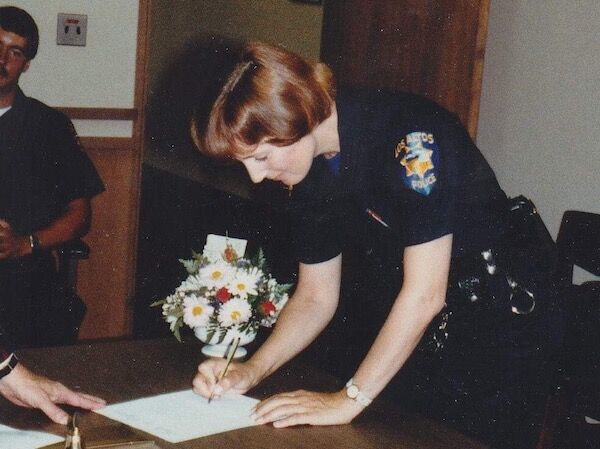
Reflecting on her 11-year career with the Los Altos Police Department, Sue Sinclair couldn’t decide whether it felt like four decades have passed since she became the city’s first female patrol officer or like no time has passed at all.
On one hand, she and her husband, Pat Langner, a retired Mountain View Police sergeant, occasionally run into people around Lake Oswego, Ore., who have also relocated from Los Altos – including former Los Altos Police Chief Don Johnson – and reminisce about how their lives have changed. On another, their lives remain immersed in the world in which they were once entrenched; Sinclair and Langner still communicate with police friends and acquaintances and have memorabilia from the careers in their home.
“We settled here because the cities are so similar,” Sinclair said. “Our top priority was a low crime rate – wonder why?”
Forty years ago this month, Sinclair was a deputy for the Santa Clara County Sheriff’s Office working for the women’s jail. She could only describe it as a violent place. At a time when she was breaking up physical altercations during bookings – having just fought for survival during police academy training – Sinclair heard the Los Altos Police Department was hiring.
There were two openings and more than 50 applicants, Sinclair recalled. However, she had the upper hand in one way: She had attended Los Altos schools and lived in the city for years. She knew the community well, knew the streets like the back of her hand.
“It was a dream come true,” she said.
Once on the Los Altos force, Sinclair learned there were two female reserve officers on the roster who were limited to part-time hours – with no pay. They were entry level and assisted regular officers but did not work independently.
“Generally speaking, my reception within the department was good but very watchful in the beginning,” Sinclair said. “Understandably, all officers want to know that they have a competent backup officer. We all thought of one another as fellow officers, not ‘female’ or ‘male’ officer.”
Anything they could do, she could do, too
The trailblazer admitted the job was more mentally and emotionally challenging than physically rigorous.
“For the first year or so, the public seemed to look upon me either as unique or as an oddity,” Sinclair said.
One extra X chromosome was just that while Sinclair patrolled, busting people for driving drunk or stealing from businesses when she worked her favorite shift: graveyard.
“It meant that most crimes were in progress, because of the cover of darkness,” she said. “All cops know that Friday and Saturday nights are very active on patrol.”
She recounted catching and arresting a “hot prowl burglar,” someone who breaks into a home “for theft or rape, knowing that the occupants are asleep inside.”
“I saw/heard the suspect first and chased him down and held him at gunpoint until other officers arrived,” Sinclair said. “Later, while I was booking the suspect, he told me he got really scared when he heard my voice and realized I was a female cop … because, ‘You never know what a woman might do.’”
Rewriting the narrative
Sinclair’s stories of her time as a patrol officer included one in which the driver she pulled over got quite a surprise. The young woman at the wheel hiked up her skirt and unbuttoned her blouse in hopes of getting out of a traffic ticket.
“When I approached the driver’s window … her expression was priceless,” Sinclair said.
On another occasion, a female resident asked Sinclair while she was on duty if “they” allowed her to carry any bullets in her gun.
“She assumed that only the men could do that,” Sinclair said. “Obviously, those were different times, when many women were still somewhat sheltered.”
Another of Sinclair’s favorite memories involved speaking at Los Altos High School’s Career Day, at which she “told the teenage girls that they were at the point in time where they could find a career in any occupation that interested them.”
Today Sinclair watches female officers in her own community and on TV – she and Langner are big fans of the A&E cable show “Live PD” – with a sense of pride.
“It has never surprised me that women have risen through the ranks,” she said. “It takes a special breed of woman to have a career in law enforcement. … It is exhilarating and rewarding beyond belief, especially for someone like me who has an overload of empathy for others.”
The Los Altos native has reflected on the changing political climate and how it has affected the way the public views law enforcement – she was a police officer “at a point in time when there was still respect for authority.”
“It is unbelievable to me to see how officers are mistreated or hated … which brings to my mind, would I do it again?” Sinclair said. “In a heartbeat.”