

Updated at 9:36 p.m. July 31:
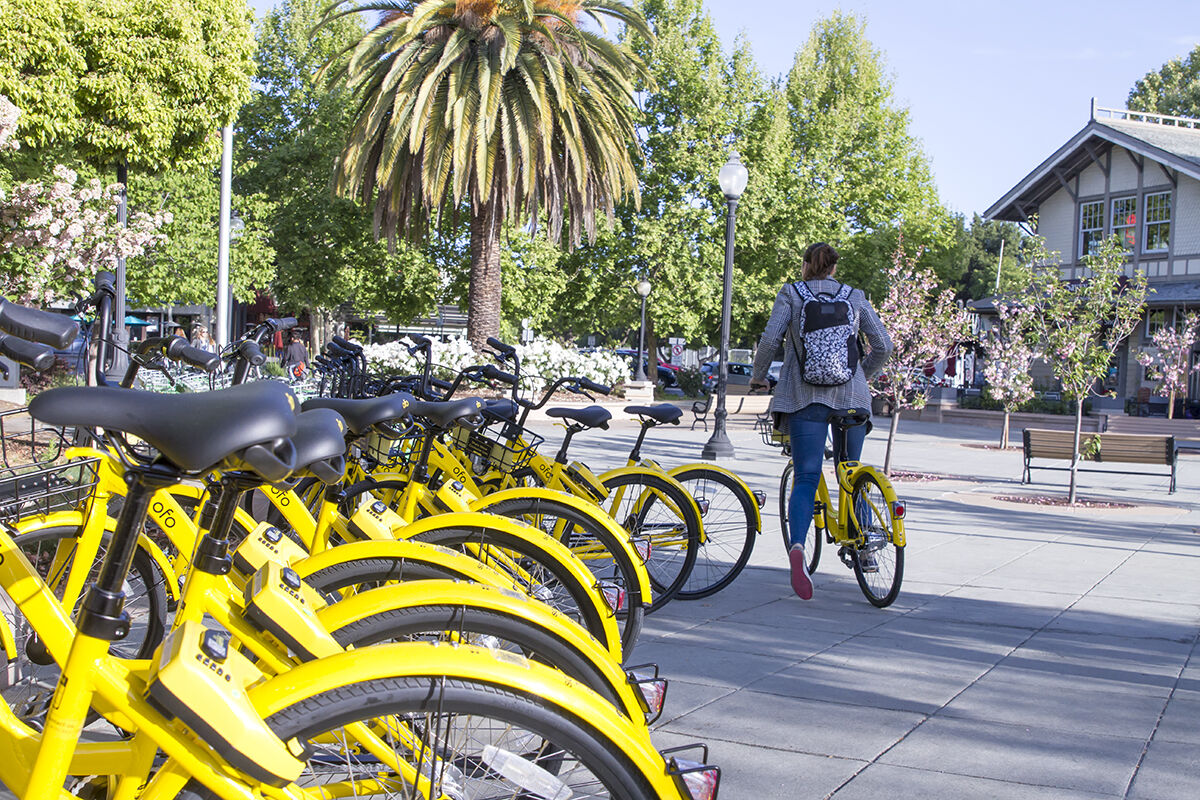
Less than three months after the rollout of a yearlong bike-share pilot program in Mountain View, one of the two participating companies has left the market.
“We’ve done some critical thinking about the markets we operate in, and how to deliver the best ofo experience possible to our riders. That’s why it’s with great sadness that we’ll be leaving your town over the next week,” the Beijing-based startup announced in an email sent to local customers Friday.
Representatives of ofo informed Mountain View officials July 20 of their intention to withdraw from the city, and the last ofo bikes were removed Friday, according to Ria Lo, Mountain View transportation manager.
“I don’t think it was any reflection on anything specific to Mountain View,” Lo said. “They’re pulling out of a number of countries, and they’re pulling out of most cities in the U.S. as they kind of figure out their business model and how to make it work for them.”
Eric Smith, ofo’s regional head of communications, emailed a written statement to the Town Crier.
“As we continue to bring bikeshare to communities across the globe, ofo has begun to re-evaluate markets that present obstacles to new, green transit solutions, and prioritize growth in viable markets that support alternative transportation and allow us to continue to serve our customers,” he wrote.
A map published on ofo’s website shows it operates in 25 U.S. cities, but the company in recent days has announced it is leaving markets including Atlanta, Chicago and Washington, D.C.
Mountain View will eventually open up permitting to other vendors, Lo said. The new participant or participants would join LimeBike, the San Mateo-based company providing electric-assist bikes to local riders.
To prevent any one vendor from saturating the city with too many bikes so as to gain a monopoly, the Mountain View City Council capped Lime and ofo to 400 each, according to Lo. Lime is close to meeting its limit, but ofo’s local fleet never reached beyond approximately 150-180 bikes.
Convenience or annoyance?
Mountain View launched its dockless bike-share program May 8. It features electric bikes rented through Lime, and traditional pedal bikes were rented through ofo. Riders establish free accounts and use smartphone apps to locate available bikes by map. They scan Quick Response codes on the bike frames to open the locking mechanism affixed to the rear wheels. Lime charges a $1 fee plus 15 cents per minute, and ofo charged $1 per 30-minute rental.
The pilot program is among several projects Mountain View officials are undertaking to make the city more bikeable, according to Nate Baird, city transportation planner.
“We definitely see it providing very helpful transportation to people getting from our transit center to the local campuses as an extension to transit and also just providing another way of getting around the downtown without using a car,” Baird said.
But some critics see the rental bikes as an annoyance. Because the bikes are self-locking, riders can park them anywhere, though they are instructed to keep them out of rights-of-way.
Feedback to city officials has been mixed, Lo said. Some people are excited to have a new transportation option, while others have complained about improperly parked ofo and Lime bikes blocking pedestrian and wheelchair access and failure by the vendors to relocate them in a timely manner.
To obtain a better understanding of the situation, city staffers in June conducted an informal survey of rental bikes parked in neighborhoods across the city. They noted how many bikes were parked correctly, how many were parked incorrectly and how many were parked incorrectly but weren’t necessarily causing problems.
Only a small fraction of the bicycles surveyed were parked in a problematic manner, Lo said.
Some of the complaints, she added, are from people who don’t realize it’s permissible for riders to park within what is referred to as the “furniture zone,” the section of a sidewalk between the curb and the primary, accessible pathway used by pedestrians. This area is where street “furniture” such as benches and newspaper kiosks is typically located.
As the program continues, city staffers will continue to educate both riders and residents about the rules, Lo said.
Bike share is “helpful to the city for multiple reasons in terms of traffic, reducing traffic congestion and reducing parking demand. But sometimes that’s not obvious to people when they’re just walking down the street and they see something that they haven’t seen before,” she said. “And so I think we’re in this process of adjusting to something that’s new and different.”
The city plans to hire a third-party contractor to formally evaluate the program in the next month or so.
For more information on Mountain View’s bike-share program – including rental pricing and how to contact vendors to report abandoned or improperly parked bicycles – visit mountainview.gov/depts/pw/transport/pilot_bike_share_program.asp.





