Duffy Price has lived on a hilltop vista in Los Altos Hills for more than three decades. With panoramic views of the Bay Area from San Francisco to Pacheco Pass from her backyard, it’s hard to complain.
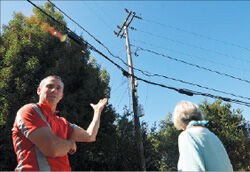
But there is one thing that’s irked her for as long as she can remember – that black power line streaking in front of the blue sky.
“It’s archaic, something that belongs in another generation,” she said. “It’s not something that belongs in our town.”
Aesthetics aside, Price also is certain the overhead utility lines and the poles that support them can pose threats to safety and service reliability. Along with several other residents and town officials, she is trying to spread awareness of a policy city councilmembers approved last year that allows neighbors to form special tax districts to independently finance undergrounding through voter-approved bonds and property-tax liens.
So far, no residents have started an undergrounding project.
An informational meeting on the process of forming tax districts and costs of undergrounding overhead lines, open to residents, is scheduled 7 p.m. Oct. 12 at Los Altos Hills Town Hall.
Officials estimate that it costs approximately $140 to bury one foot of utility line.
“We want and need to,” Price said of burying the lines.
Fellow resident Steve Schmidt, who said his electricity went out at least 15 times in 2010, has joined the push.
“We have these spectacular views, but we’ve got all these stupid poles,” he said, motioning toward a wooden monolith along Anacapa Drive.
But to bury every line in town is anything but cheap – or quick.
Former mayors Bob Fenwick and Dean Warshawsky, alongside Price, began championing the process of undergrounding all utility lines in town nearly a decade ago. Initial studies revealed that a townwide project would drain approximately $60 million from city coffers. Individual projects proved cost prohibitive.
In 2009 officials completed two test projects, partly funded by PG&E subsidies. For $645,000, 2,300 feet of power lines near the Purissima Little League fields and 700 feet on Altamont Road near Westwind Community Barn were undergrounded.
According to town documents, any undergrounding project must include at least 10 parcels because, Schmidt said, PG&E requires larger projects.
Once neighbors generate enough support among themselves, they can notify town officials to form a district and get rolling on the project.
Current estimates indicate it could take up to two years to complete a project.
“Even though we’ve been at it for nine years,” Price said, “we still have the enthusiasm and the stamina to make it happen.”