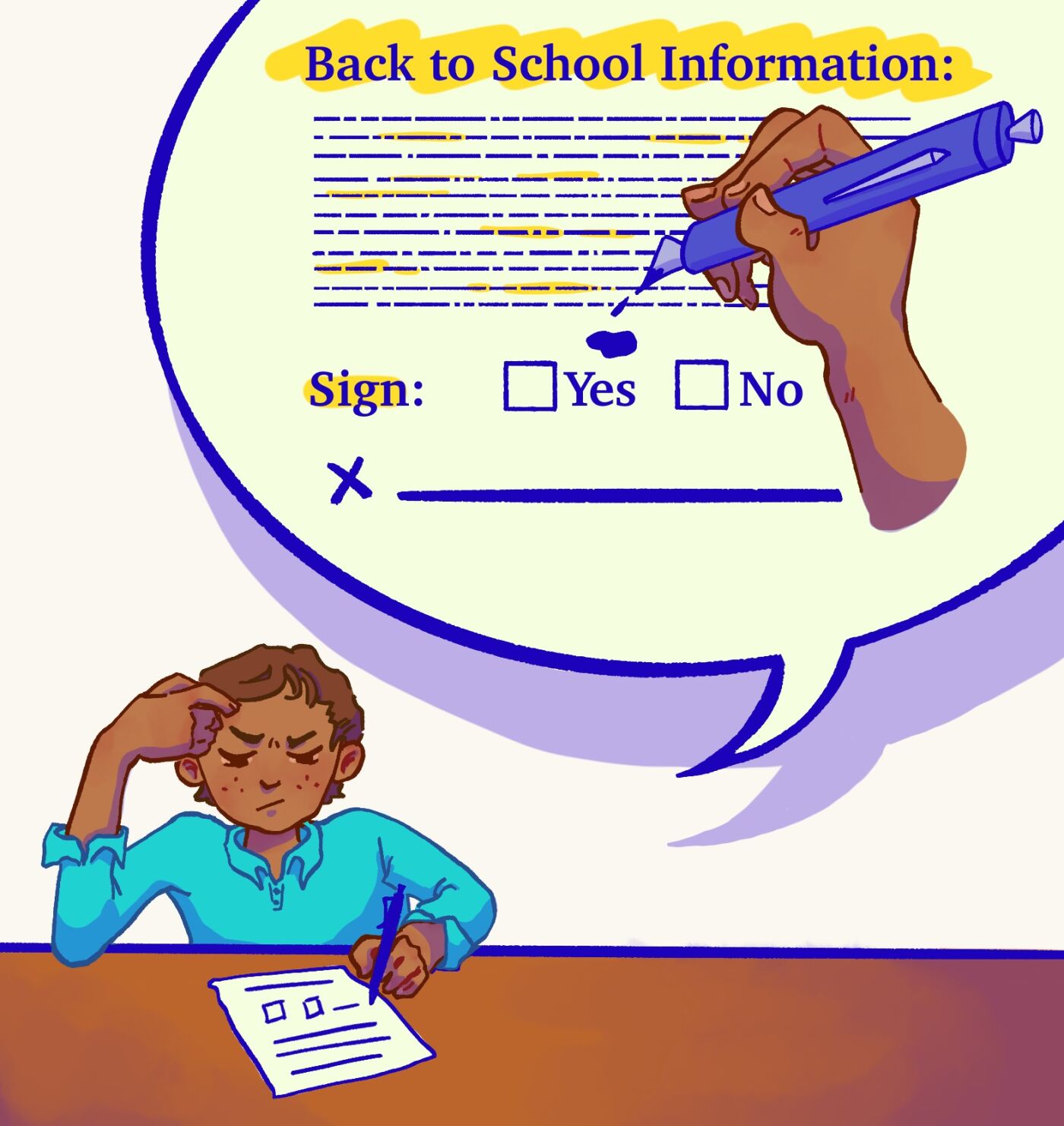
When students enter school, they trust teachers and administrators to keep their information safe. In an era of sharing too much, the information one provides their schools is a private matter. Students and families must provide schools with their personal data, but how much are they supposed to give to them and how should they be prepared if their rights feel violated?
According to Section 99.3 of the Family Educational Rights and Privacy Act (FERPA), information is disclosed to K-12 public schools to their school’s resource officers. Families or eligible students, who are students over 18 or who are emancipated from their parents/guardians, are required to provide the schools with directory information such as a home address, telephone listing, email or a photograph of the student. They also must release at least one biometric record such as fingerprints, voiceprints or handwriting. It is illegal for schools to ask for students’ social security number or their identification PIN.
FERPA states that the only time public schools are allowed to release private information without a person’s consent is when they “disclose personally identifiable information from an education record to appropriate parties, including parents of an eligible student, in connection with an emergency if knowledge of the information is necessary to protect the health or safety of the student or other individuals.” Families or eligible students also have the right to opt out of the various FERPA requirements by filing a complaint or reporting an alleged incident to the U.S. Department of Education.
David Sallay, the director at the Youth and Education Privacy Future of Privacy Forum, said families can also use the Protection of Pupil Rights Amendment, a federal law that offeres protected categories of information that schools can only gather with consent. This law allows parents to inspect teacher materials such as manuals, films or tests that could be considered explicit. It also gives them the right to look at sensitive information in advance.
The website of Student Privacy Compass, a resource for educators and policymakers that explains student data privacy laws, website said administrators use student information to keep attendance, course registration, counseling or enrolling in lunch programs. For instructors, it’s used for student support services, collaborative work online, learning applications or communication between peers and students.
A student’s data can also be broken down into Personally Identifiable Information (PII), de-identified data and aggregate data. PII helps teachers and parents learn about their children’s performance and how to support them in various subjects. It also allows teachers to identify a student’s academic record and adjust class instructions. De-identified data is the personal information of a student that is redacted to hide identities. This type of data protects a student when schools share their information with published reports on student achievements, external researchers and to help educational agencies with monitoring a school’s performance. Aggregate data is information on groups of students without any identifying information. This data helps find patterns in demographics, GPA performance, enrollment trends or district predictions.
To learn more about FERPA, visit ecfr.gov/current/title-34/subtitle-A/part-99.