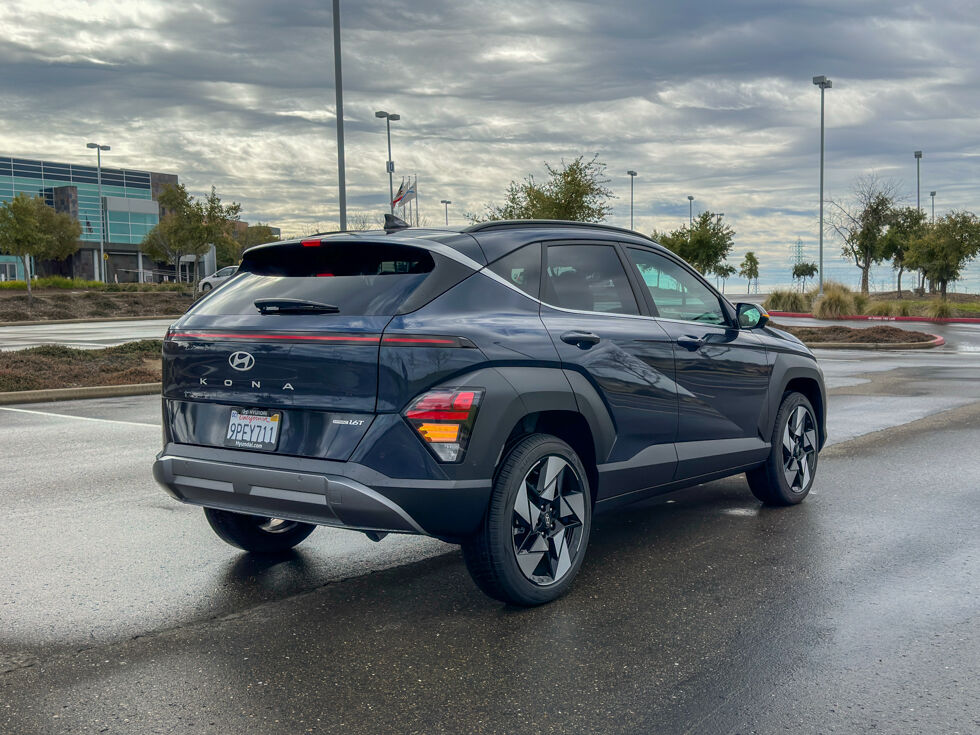
Hot on the heels of last month’s review of the Volkswagen Taos, we have another entrant in the very competitive subcompact SUV segment. The Hyundai Kona is a futuristic-looking (at least from the front) vehicle that can be had as both a gasoline-powered car and an electric vehicle.
It is a crowded niche of vehicles, including the Kia Niro (“On The Road,” February 2023), the Kia Soul (“On The Road,” October 2023) and the Honda HR-V (“On The Road,” September 2022).
Apart from the styling, what makes the Kona stand out is its spaciousness. The interior feels like it should be in a much larger vehicle. The instrument panel continues a theme begun in the IONIQ 5 EV (“On The Road,” May 2022), and in upper trim levels, the materials and feature content are way beyond what is typically found in the subcompact SUV class.
The Kona’s base engine is a 2.0-liter four-cylinder with 147 horsepower and 132 pound-feet of torque. But in certain upper trims (N Line S, N Line and Limited), it’s a 1.6-liter turbocharged four, making 190 horsepower and 195 pound-feet of torque. That keeps 0-60 times under eight seconds. Choosing one of those trim levels not only gives you a much better engine but the continuously variable transmission is replaced by an eight-speed automatic. It’s a much better driving experience.
Despite the extra power, the hotter engine delivers solid fuel economy – an EPA-estimated 24 mpg city/29 highway in the Limited AWD trim I drove.
That’s up front. In the back, 25.5 cubic feet of cargo space. Fold the rear seats down and it’s 63.7 cubic feet – very good cargo space for such a small vehicle.
The base price of the 2025 Hyundai Kona Limited AWD is $33,400 ($34,795 including destination charges), and it’s loaded like a luxury car from 20 years ago but with more modern tech. A comprehensive suite of active safety features is standard, as are 19-inch alloy wheels, heated side mirrors, automatic LED headlights, taillights and daytime running lights, high-beam assist, a power sunroof, roof side rails, a surround-view monitor, dual automatic climate control, rear air vents, an auto-dimming rearview mirror with HomeLink, interior ambient lighting, proximity key with pushbutton start, synthetic leather seating surfaces, a power driver’s seat, heated and ventilated front seats, a heated leather steering wheel, a hands-free liftgate, front and rear USB ports, a cargo cover, navigation, wireless Android Auto and Apple CarPlay, a 90-day trial subscription to SiriusXM satellite radio, a Bose premium audio system, wireless charging and a Wi-Fi hotspot that’s part of Hyundai’s Bluelink+ connected services.
The only extra-cost option on our test vehicle was carpeted floor mats for $210, so the as-tested price of the 2025 Hyundai Kona Limited AWD is $35,005. As of this writing, tariffs have been introduced and then paused. The Kona is assembled in Ulsan, Korea, and has only 2% domestic parts content. So, the price at your local dealer may be substantially higher.
Small cars show their strengths in heavy Peninsula traffic and tight parking spaces along Main Street. The Kona shines there and provides the interior room and amenities of some larger, much more expensive vehicles. If you’re in the market, it should absolutely be on your shortlist.
Mike Hagerty, past vice president of membership for Western Automotive Journalists (waj.org), has been writing about cars since 1997. Read more of his reviews at MikeHagertyCars.com.