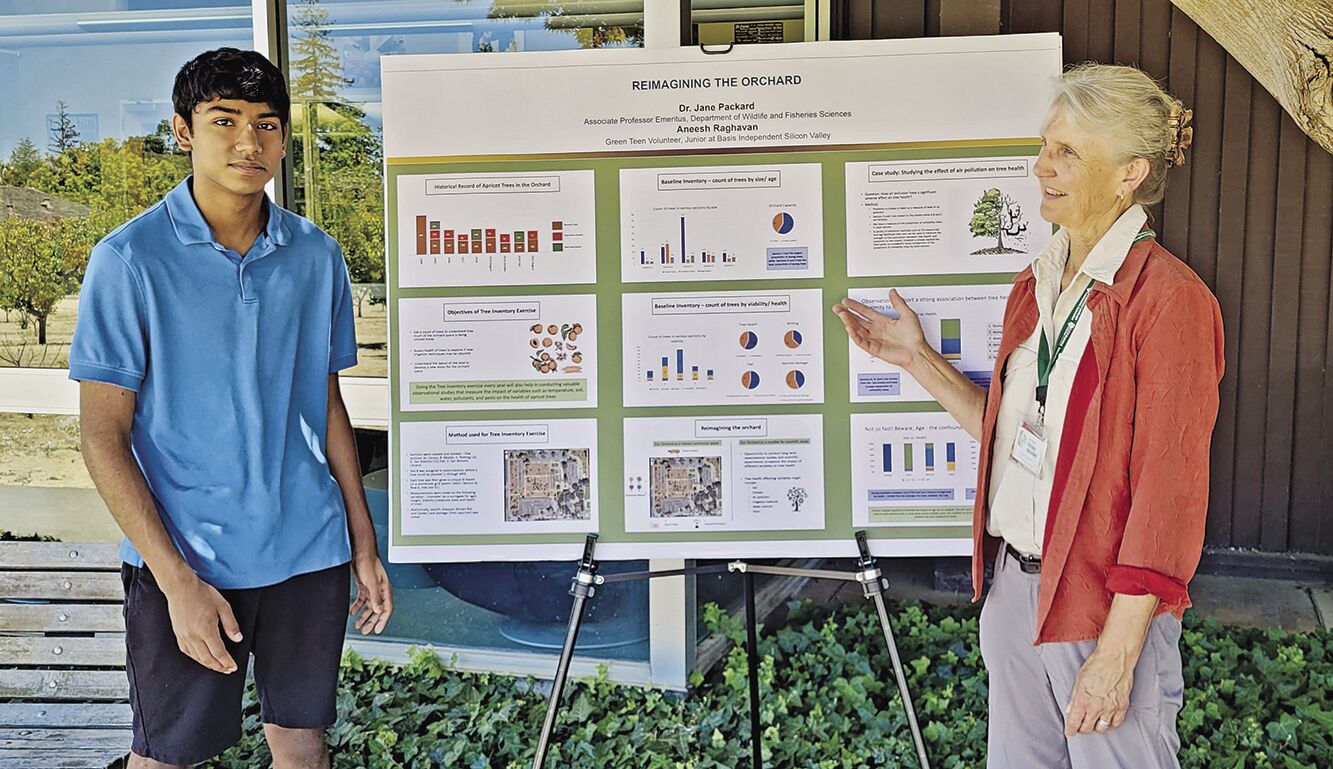
Aneesh Raghavan, a member of the Los Altos History Museum Teen Docent program, recently conducted a research project on whether air pollution from vehicle traffic along San Antonio Road has a negative impact on the apricot trees in the Los Altos Heritage Orchard.
The Los Altos resident worked with Jane Packard – chairperson of the museum’s Orchard Commons Committee – throughout the process, which involved taking inventory of the trees and measuring them.
Raghavan presented his findings to the public July 14 at the orchard. The results proved inconclusive, the teen said, because he was unable to concretely determine that the trees along San Antonio were not as healthy as the rest of the orchard.
“We need to do further analysis to eliminate age as a confounding variable,” said Raghavan, a senior at Basis Independent Silicon Valley in San Jose. “To do this, we’ll either have to look at more data points or do a longitudinal study and study these trees over many years, and the orchard can provide us the data to conduct such a longitudinal study.”
Nevertheless, Raghavan’s newfound belief in the cultural, scientific and community value of the orchard led him to petition the Los Altos City Council to provide additional funds for the orchard and to have the museum manage it – which has since happened.
Raghavan said he joined the museum as a docent due to his interest in environmental science and policy. He took an immediate interest in the orchard and reached out to Packard about his proposed research project.
Taking inventory
The first step in Raghavan’s research entailed working with Packard to take inventory of the trees in the orchard through surveying. They then gathered information about the trees’ characteristics.
“These inventories started in 1988 and have continued to this day at a pretty irregular rate,” he said. “We’ve taken these inventories and we’ve monitored the amount of trees that have died and have been removed and new trees that were planted (and track them for each successive cycle).”
Raghavan added that he had four main objectives for the inventories: to understand and gather detailed information about the orchard; to assess the health of the trees; to gain a better understanding of the orchard layout; and to conduct observational studies and experiments.
Raghavan and Packard then divided the orchard into different sections that served different purposes and helped with organizing the data. Afterward, they began the data collection and measuring process.
“We measured the diameter, which we use as a surrogate for age, so trees with a smaller diameter … we deemed those as younger, while trees with a larger diameter, a wider base, we deemed those as older,” Raghavan said. “We also measured the height and viability of the tree, which is just a measure of the health of these trees. We did that by looking for specific diseases like brown rot, which is the browning of the leaves’ canker, which is the presence of sap droppings or squirrel damage.”
Through measurements, Raghavan and Packard discovered that the section near the parking lot contained the greatest proportion of healthy trees, while the two sections near San Antonio Road had the greatest proportions of unhealthy or dying trees.
“Although streetside trees were statistically less healthy than trees farther away from the street, the age of the trees was a confounding variable,” Packard said. “Healthier, younger trees had been planted in the sections of the orchard farther from the street.”
Despite the inconclusive results, Raghavan said the time spent taking inventory and caring for the orchard helped him discover a new appreciation for it – along with a modern vision for the property.
“We can look at it as a lot more (than an orchard),” he said. “It can be used as a vibrant communal space that can bring the whole community together or as a place where more people can conduct such experiments and scientific experiments and studies to enhance not only ourselves, but the community in the orchard space as well.”
Future vision
Packard added that the orchard will become a place for further scientific and cultural study.
“Not only do we need to adapt to a changing social environment, we also need to become more climate resilient,” she said. “We are fortunate to work closely with city planners and administrators who recognize the need for multigenerational and multicultural activities that enhance public appreciation of this historical landmark.”
Raghavan and Packard’s vision for the orchard motivated them to submit a report to the city manager of Los Altos. The Los Altos City Council approved $75,000 in funding this year for the orchard.
“Part of the funding will go to developing new drip irrigation and the other will allow the museum to have full control over the orchard and not the government itself,” Raghavan said. “Our work had real value in that we were able to reach out to important people and actually get something done.”
Raghavan encouraged any students interested in research involving the orchard to reach out to the museum or Packard, or just stop by and ask questions.
“Something that I’m a part of is the Green Team, which is just a volunteering group, where we are trying to make the vision that we have of reimagining the orchard and redeveloping it into a reality,” he said. “We are now in the process of trying to conduct some observational studies and longitudinal studies and just continue to be more involved. Come by the orchard and learn more about it.”