Students are taking the lead in a push by the Los Altos School District to evaluate the role of artificial intelligence in classrooms.
Yash Maheshwari, one of a group of “tech interns” at Mountain View High School, said the development of a written artificial intelligence (AI) guidance for the TK through eighth grade district grew out of a project called the LASD Playlab – where sixth through eighth grade students experimented with using AI in a classroom format.
“Since then, we have shifted our focus into more AI – focusing on our community involving our school district and the LASD school district as well and talking a little bit more about how AI affects us,” he said.
The high school tech interns collaborated with a team of LASD stakeholders – 10 students, eight staff and six parents as part of a working group – to develop the “LASD Philosophy for Artificial Intelligence.” It was presented to the LASD Board of Trustees at a meeting on Nov. 17.
The philosophy was finalized as: “In Los Altos School District, our Philosophy for Artificial Intelligence is guided by our commitment to helping every student thrive academically, socially, emotionally and cognitively. We recognize that AI is not a substitute for human thought, judgment or creativity. Rather, it is a powerful and evolving tool that can support, not replace, the essential role of teachers and students in thinking, learning and creating. Our core principles ensure AI supports learning responsibly and ethically, extending human potential while protecting safety, equity, privacy and fairness.”
Grace Choi, curriculum and instruction coordinator, said the philosophy was intended to generate the beginnings of a conversation around AI – it was not intended for a vote by the district trustees as official policy. Not yet, anyway.
“Students, parents and staff were interested in exploring more ideas and developing guidance for AI use. We recognized that before we develop this, there was work that needed to be done in developing our key beliefs around AI,” she said.
AI tools have surged into the classroom in recent years – integrated in classroom technologies like Chromebooks and available to students online as Chat GPT, Grok or Google Gemini. Concerns about academic dishonesty, appropriate content and the veracity of AI information have all spurred interest about what AI use looks like in classrooms and what it can do.
Superintendent Sandra McGonagle said, “This was really meant to be, what do our kids need to know even before they start using AI. … We are teaching our kids to be responsible users of AI.”
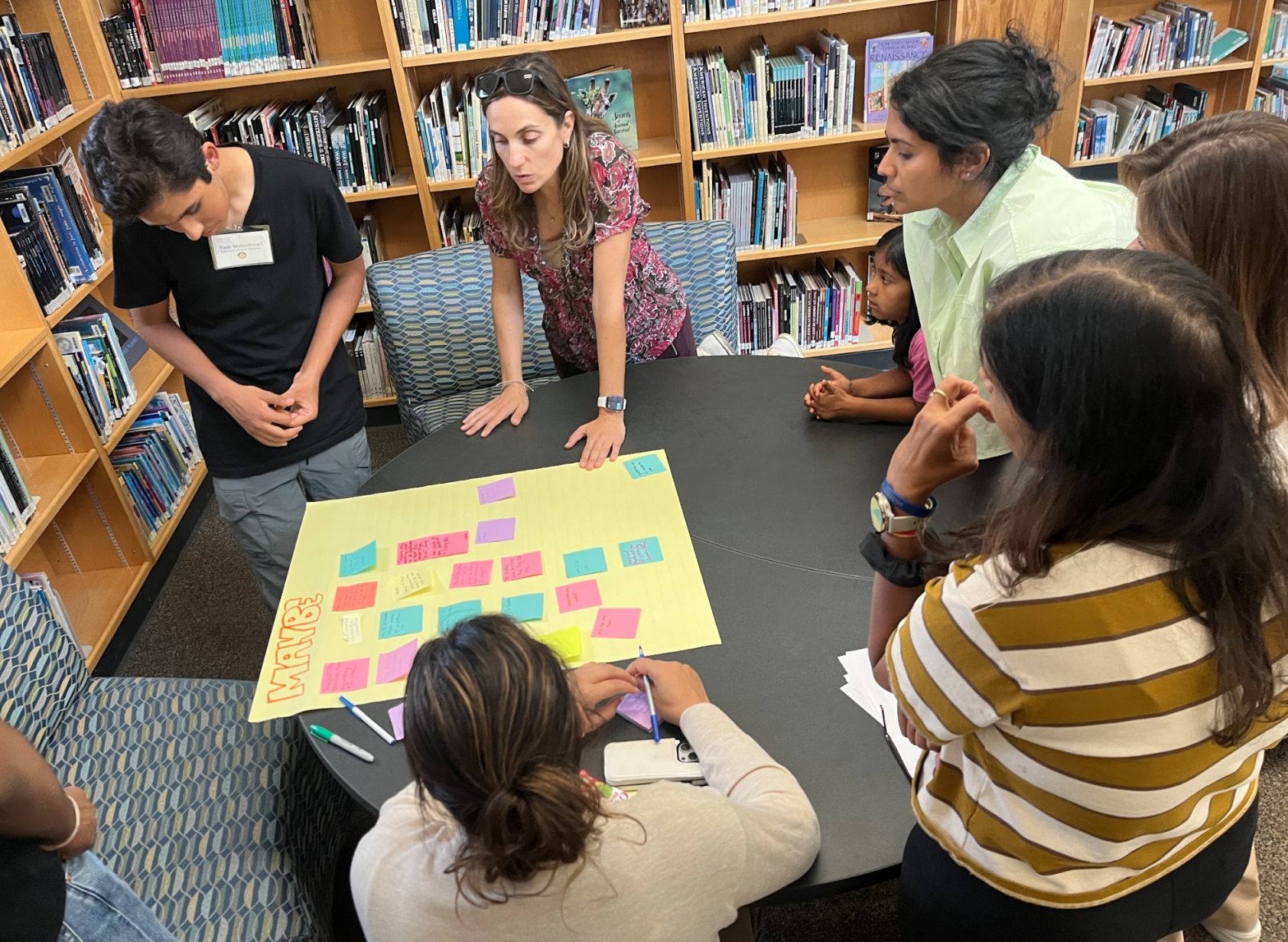
The tech interns hosted a series of workshops around AI in order to build the philosophy. Using the “Safe AI” card game, the interns posed potentially dubious questions around classroom AI use to the stakeholders in order to gauge what was important and what was necessary to include.
“The point of this game was to foster discussion. So we wanted to make sure that the little groups we were playing in were able to fully understand what they really wanted in this philosophy and what their priorities were,” said Nikita Narang, a Mountain View High School tech intern.
Trustee Bryan Johnson said new additions to the philosophy could include specific AI apps or tools that students were using.
“The landscape is changing fast,” he said. “It would be helpful for us to understand at TK through 8 to what extent are kids using specific apps that we are giving them that we have some control over, versus to what extent they are just using tools that we have very little control over or no control over.”
Trustee Vladimir Ivanovic said he would like to see the statement geared toward specific rules.
“I’m not quite sure the problem is solved yet. If I look at this statement, the top seems really broad and I think it would be helpful if it was much more specific,” he said.
Choi said the philosophy provided a functional starting point to develop further guidance on AI.
“It’s going to be ongoing and it’s going to be changing,” she said. “We want to have the ultimate care with our students, making sure they are protected while they utilize a tool that is in their reality.”