A well-diversified investment portfolio should include some investment in bonds issued by foreign governments or companies. The simplest way to buy them is through a mutual fund or exchange-traded fund (ETF) available here in the U.S., of which there are many.
One risk unique to foreign bond funds is currency risk. If the currency of the country in which the bonds are denominated drops in value relative to the U.S. dollar, any return from the bonds will be reduced by the same amount.
There are a number of foreign bond mutual funds and ETFs that eliminate this risk through the dollar-hedging process. But is it better to use a dollar-hedged foreign bond fund or select a fund that incorporates currency fluctuations as part of its return?
Dollar-hedging does not come free. A dollar-hedged foreign bond fund typically purchases forward contracts to execute the hedging, the cost of which reduces its overall return. And the return of an unhedged fund gets an added boost when the local currency strengthens against the dollar. Nonetheless, I believe that investors would be better served by sticking with dollar-hedged funds for the following reasons.
• When you buy an unhedged foreign bond fund, you are actually investing in two different asset classes at the same time: foreign bonds and foreign currencies. Because currency exchange rates behave in very different ways than do bond prices, it would make more sense to keep those investments separate.
• The biggest challenge with currency investments is the difficulty of determining the expected return. A bond’s expected return – based on its coupon and maturity – is well defined. An investment in stocks is an investment in productive, growing companies, with a consequent expectation of some positive return over time. But what is the expected return for currencies? Will the dollar grow by 5 percent per year versus the pound long term? Or the yen? Over time, currency investments have yielded close to a 0 percent average return. That’s not much basis for a growth-oriented investment.
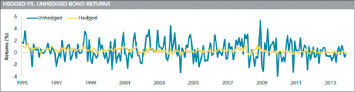
• The primary purpose of currency hedging is to reduce the risk and volatility of your foreign bond holdings. Because currency fluctuations are so much greater than bond price fluctuations, the returns of unhedged bonds demonstrate significantly more volatility than those that are hedged.
Because the primary role of bond investments in a portfolio is to provide stability, it doesn’t make sense to me to leave all that currency risk embedded. The next time you are evaluating a foreign bond fund, I recommend considering one that uses dollar-hedging.
Los Altos resident Artie Green is a Certified Financial Planner and principal at Cognizant Wealth Advisors. For more information, call 209-4062 or email [email protected].