Although recalls seem to dominate the headlines, we never cease to be amazed at the quality, safety and practicality that manufacturers are building into reasonably priced family-sized sedans.
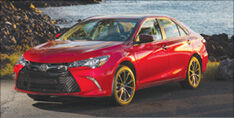
Cases in point: the top-of-the-line Toyota Camry XSE V6 and the straightforward-with-a-bonus Subaru Legacy 2.5i Premium we drove last month.
First things first. We’re talking full-sized here: comfortable front seats and capacious rear seats with good room for up to five adults and excellent visibility in all directions.
The Camry, completely restyled for 2015, is priced at $35,169 with a long list of entertainment/communications and safety options, while the Legacy is priced at $25,984, but with the same interior space and an equally impressive list of options.
Better interior materials and a slightly more comfortable ride justify the extra cost for the Camry, but neither car will make owners feel as if they’re making a great sacrifice.
The Camry has a big six-cylinder engine, producing 268 horsepower and 248 pound-feet of torque that provide slightly quicker acceleration on the freeway onramp. The Legacy makes do with the standard Subaru opposed-four-cylinder engine producing an adequate 175 horsepower and 174 pound-feet of torque.
There is a trade-off in that the smaller engine has an amazing fuel efficiency rating of 26 mpg city, 36 highway and 30 combined. Nevertheless, the Camry still checks in with a respectable 21 city, 31 highway and combined mpg of 25.
In addition, the Subaru comes with all-wheel drive – a feature the brand pioneered – contributing to safety on wet pavement, while the Camry has the front-wheel drive that is standard on most Toyotas.
Safety options
What is amazing is the list of safety options available on both cars. These electronically enabled features couldn’t be found at any price on any car only a few years ago, and now they are being built into midline family cars for a price that makes their choice the only reasonable decision. Blind-spot warning, precollision throttle and brake adjustment, lane-departure alerts and active cruise control with distance maintenance are inexpensive options on both of these cars.
The Subaru, however, trumps the Toyota and pretty much every other mid-priced family sedan with its EyeSight Driver Assist System. Not only does the two-camera system adjust speeds to match the car ahead as with any active cruise control, but it also alerts the driver if he or she is drifting across the lane markers without the turn signal activated, or if the driver starts to drift back and forth within the lane – a typical sign of potential drowsiness.
The system can even disengage the throttle, then activate the brakes to bring the vehicle to a complete stop if a vehicle ahead slows or stops abruptly, dramatically reducing the most typical source of urban collisions. The alert warning also sounds if the driver doesn’t start up when the stoplight turns green and the vehicle ahead moves off, reducing the likelihood that the driver behind has to beep the horn to get the Subaru’s driver to pay attention.
On the less desirable side of the ledger, neither car is going to be confused with a sport sedan; handling on corners at higher speeds feels a bit awkward. Nevertheless, the buyer of either of these practical family sedans isn’t likely to be pushing the vehicle beyond the limits of its stability control.
Overall, we were impressed with both of these automobiles, great choices for families that want a standard four-door sedan, and vastly improved from the sedans they are likely to be replacing.
Los Altos residents Gary and Genie Anderson are co-owners of Enthusiast Publications LLC, which edits several car club magazines and contributes articles and columns to automotive magazines and online services.