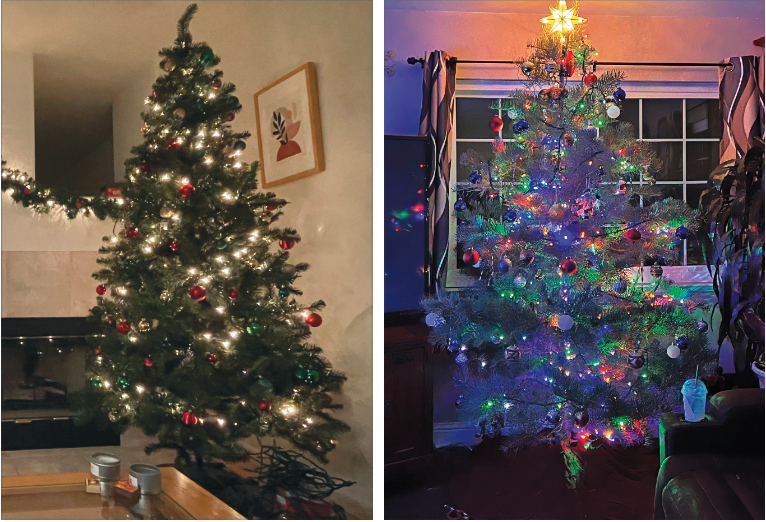
Decorating an evergreen tree is one of the oldest Christmas traditions that has survived into the modern era. The practice came from humble beginnings in 16th-century central Europe, where Protestants began to adorn trees with apples, colored paper and candles, which people have since traded for ornaments, tinsel and strings of electric lights.
It’s not just the decor that has changed over the past half-millennium – it’s the trees themselves. Not only can consumers choose among several varieties of evergreen trees at a local lot, they can also peruse thousands of artificial trees available online (or at big-box stores) to fit their exact needs. And while you will not be hard-pressed to find people who scoff at the idea of putting up 6 feet of plastic in their living rooms for the holiday, more Americans than ever are going the artificial route. Of the trees displayed in 2021, 84% were artificial and 16% were farm-grown, according to a survey by the American Christmas Tree Association (ACTA).
But which one should you choose? Is it more environmentally friendly to cut a tree down or to buy a nonbiodegradable but reusable one? Which one looks prettier? Is the tradition of heading to the farm worth the hassle, or does the convenience of just taking the fake one out of storage outweigh the benefits of a real one?
Here are the facts to help you make the best choice for your home this year.
Sustainability
There is fierce debate among the scientific community about whether using a real tree each year or reusing an artificial tree is better for the environment in the long run. In addition to measuring greenhouse gas emissions, water use and energy use, factors include land use, use of pesticides, the effect on local wildlife and disposal methods.
A life-cycle assessment of the environmental impacts of real and artificial trees commissioned by the pro-artificial-tree ACTA in 2021 concluded that though a real tree produced less emissions than an artificial tree on a one-to-one basis, reusing a plastic tree for five years would make a break-even point, after which an artificial tree would be less wasteful.
However, a previous study conducted by Ellipsos, an environmental consulting firm in Montreal, found that an artificial tree had to be kept for 20 years before it would have a lesser impact than 20 real trees. It is unclear how long consumers typically keep their reusable trees before getting rid of them, but with 10 million to 20 million artificial trees sold each year, according to consumer reports by the National Christmas Tree Association, it is safe to assume that these plastic trees might be overconsumed or replaced too often.
There is also the question of waste. Most artificial trees are made of PVC plastic and will not biodegrade. However, that doesn’t mean you can dispose of your real tree in any way you want. Properly recycling or composting your tree will guarantee the least amount of emissions, as opposed to just throwing it in a landfill.
So, if you already have an artificial tree, definitely keep using it and keep it in good condition so that you can use it for as long as possible, which will reduce the environmental impact the most. If you don’t think you will use an artificial tree that long, you’re most likely better off getting a real tree each year if sustainability is your top concern.
Aesthetics and convenience
Unlike other fake plants, I’m convinced that very few people will notice whether or not your tree is authentic. With garlands, lights and ornaments covering a majority of the tree’s surface area, few are going to take note of whether or not your tree was ever in the ground.
In terms of convenience, it would be ridiculous to argue that the personal labor involved in erecting an artificial tree compares to that of a real one. If you go for a fake tree, it is most often delivered to your home in a box, and once you construct it, you don’t have to worry about watering it or cleaning up falling needles. This hardly compares to the process of driving to a tree lot, picking one out, getting it trimmed, hauling it home, installing it into your tree stand and maintaining the water and mess.
But is convenience what the holiday is about? What is Christmas (in the modern, secular sense) about if not carrying out traditions with loved ones? Dedicating an evening to picking out the tree alongside my parents and brother was a highlight of the season, even if it was sometimes a headache. Sure, the holiday season is busy and maybe this tradition isn’t important to your family, but I wouldn’t forgo the experience if you do enjoy it just because it would be easier to get a fake one.
If you decide to get a real tree this year, check out tree lots that benefit local organizations, such as the Los Altos Kiwanis Christmas Tree Lot (kiwanistrees.org), the Los Altos High Athletic Boosters Tree Lot (lahsathleticboosters.org/tree-lot) or the Mountain View Spartans Tree Lot (spartanstreelot.com).