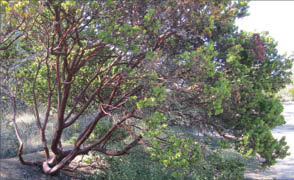
Arboriculture instructor Jocelyn Cohen summarized her pointers for pruning some common native shrubs – manzanita, ceanothus and toyon – during a presentation at the San Francisco Flower & Garden Show last month.
“Be respectful and have fun,” she advised. “Look to nature, mimic nature.”
But you can’t always do what nature does itself, she said.
Timing is important. For drought-tolerant shrubs adapted to a summer-dry climate, the dormant season is summer. Cool fall nights trigger dormant buds, so the best time to prune is before buds are set. For best results, prune from late summer to early fall. If you prune after the plant has already put energy into new leaves and buds, it may not have the energy reserves to set new buds, Cohen noted.
Marvelous manzanita
The essence of manzanitas is their “gorgeous mahogany bark” 12 months of the year, Cohen said. To show the elegant trunk to best advantage, it’s important to keep the trunk flare – the place where the trunk is a little wider at the base of the plant – clear of duff, weeds and herbaceous plants.
Cohen showed before-and-after photos of a well-pruned Sentinel manzanita. Before, it looked like a big shrub covered with leaves. After, the sinuous trunk was visible.
“Keep plenty of interior foliage” when you prune, she suggested, and make sure that light can reach the interior foliage so that it stays alive.
When a manzanita has lots of dead leaves, you can shake it to clean it out. Not only does it look neater, but this “tickling” also promotes more vigorous growth, Cohen added.
Spectacular ceanothus
The essence of ceanothus is its flowers. One of the most common cultivars, Yankee Point, tends to “grow and roll” in a cascading form, Cohen said. She recommended playing with the layers to keep the lower layers open to light. Without any pruning, eventually you could end up with an 8-foot-high plant that has leaves only on the outside layers.
“Anything shaded out will die,” she said. “You always want to open it up.”
Likewise, if a ceanothus (or an oak or a garrya) is sheared into a hedge, it won’t be able to sustain any inner growth. It may be possible, however, to renovate a sheared plant. Cohen showed an example of a Coast Live Oak that had been shaped like a lollipop on a stick. Over five years, she was able to prune it into a more natural form by gradually opening it up. Most of her work as an aesthetic pruner is “cleaning up people’s bad work,” she said.
Terrific toyon
Toyon’s natural tendency is to form multiple trunks. To avoid tons of annual maintenance, remove some extra stems at the base when the plant is young. It’s “three times harder” to remove stems when an overgrown plant is older, Cohen noted.
“Don’t leave a stub,” she said. “It doesn’t take any longer to cut it right than to cut it wrong.”
If you can’t make a proper cut with a regular pruning saw in tight areas, you’re not using the correct tool, she said.
“Get a keyhole saw,” Cohen added.
If you prefer a single-trunked toyon, you can choose a single trunk when the plant is young. Although toyon usually has a rounded form, you can also train it against a wall or fence as an espalier.
Tanya Kucak gardens organically. Email her at [email protected]. N