Staring up at the Milky Way on a clear night, with its billions of stars, it would be easy to believe that we’re not alone in the galaxy. A local planetary scientist is confident that aliens won’t be contacting us anytime soon.
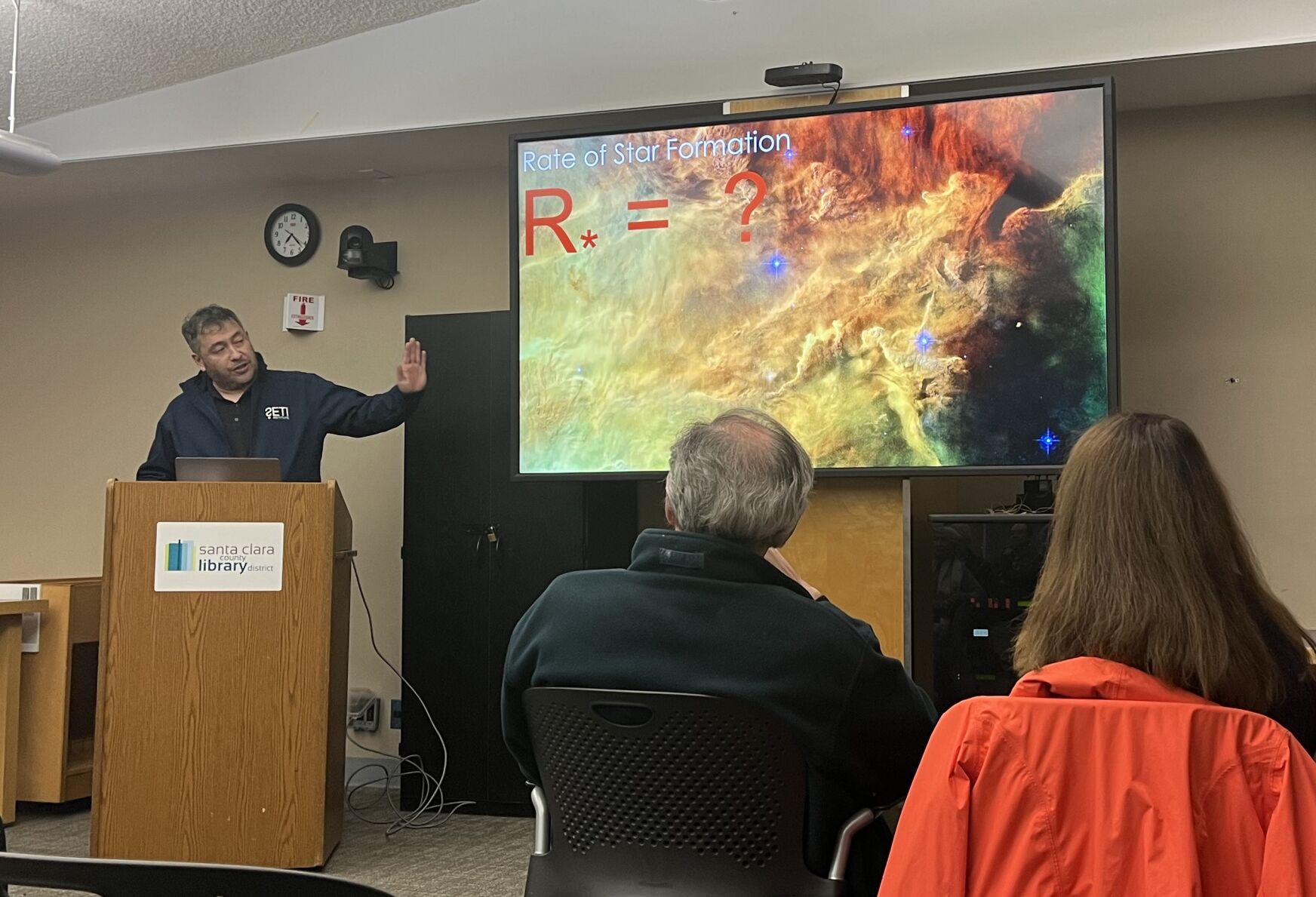
Speaking in front of an audience last week at the Los Altos Library, Pascal Lee said he believes we are likely alone in the galaxy.
“The bottom line is that we’re not living in a galaxy that’s teeming with intelligent societies,” said Lee, affiliated with the SETI Institute, the Mars Institute and the NASA Ames Research Center. “Nobody’s going to show up at our doorstep to show us how the warp drive works. We don’t live in a galactic club where different civilizations hang out at some music joint.”
The few dozen people who braved the pouring rain Feb. 4 to attend the Silicon Valley Reads program ranged from a gray-mustached man diligently scribbling notes to young children in brightly colored rain boots. The program, titled “Are We Alone in the Universe?,” was the second of five talks Lee is leading for Silicon Valley Reads at libraries throughout the Santa Clara County Library District. Two of the talks will focus on exploration of the Moon and Mars.
Count Santa Clara County Library Services Manager Cheryl Lee (not related to the scientist) among those intrigued by both subjects.
“You always think about, is there going to be life in other galaxies? Can we inhabit another planet?” said Lee, organizer of Silicon Valley Reads. “We’re obviously running out of resources here, so I think it’s kind of the age-old question.”
For Mingkai Guo, a 12-year-old who attended last week’s talk with his mother and younger sister, the existence of aliens is a frequent topic of conversation around the dinner table.
“Me and my parents were actually just having a discussion about interstellar travel and extraterrestrial life,” the Los Altos resident said. “I feel like if we do find extraterrestrial life, it’s probably gonna be life changing for both them and us.”
Like the other attendees, Mingkai appeared eager to hear Lee’s answer to the titular question: Are we alone in the universe?
Lee took the audience through one of the fundamental tools for estimating the likelihood of intelligent extraterrestrial life: the Drake Equation.
“The formula gives you the number of advanced civilizations that are likely to exist in our galaxy today,” Lee said. “… this number is simply written in terms. It’s a multiplication of terms, and each term expresses the likelihood, if you will, of some factor that is going to determine, … how many advanced civilizations that might be out there.”
Lee added that for decades, people have argued that intelligent life must be plentiful in the galaxy, calculating the number of advanced civilizations to be in the tens of thousands, even millions – results that would suggest we live in some sort of Star Trekkian galaxy. But despite his childhood obsession with Star Trek, Lee has taken a different approach.
“I did the numbers not so long ago, using an approach that, in my view, is pragmatic,” he said. “I tried to neither be optimistic nor too pessimistic, and walk the line of what is really supported by science.”
Guided by the terms of the Drake Equation, Lee walked the attentive audience through a series of questions. How many stars form each year that are suitable for intelligent life? How many of those stars host a planetary system? Within those solar systems, how many planets are habitable for life?
“We figure that one thing that ought to really help (life develop) is the persistence of liquid water,” said Lee, who served as a teaching assistant to Carl Sagan at Cornell University while earning his PhD on space sciences and astronomy. “Water is very common in the galaxy, in the universe, and in our own solar system.”
But here’s where Lee’s calculations become more conservative than many others. While life may be plentiful in the galaxy, thanks to water’s ubiquity, he argued intelligent life capable of interstellar communication is quite rare.
Look at Earth as an example. Although life emerged relatively early in Earth’s history, intelligence – defined by Lee as the ability to create technologies that continuously evolve and improve a species’ chances at survival – took much longer to develop.
“Homo erectus took four and a half billion years to show up,” Lee said. “And it wasn’t even some sort of a directed, inevitable path. It was really happenstance.”
With these pragmatic adjustments plugged into the Drake Equation, Lee estimated the number of intelligent, communicating societies in our galaxy is around one. While this sobering thought might cause some interstellar loneliness, Lee urged those in the room to look on the bright side.
“We obviously should take care of our own planet even if we were not alone,” Lee said. “But us being alone and this being such a special place should really make us understand how unique what we have is.”
For those who missed Lee’s talk last week, he plans to repeat it at 2 p.m. Feb. 16 at the Saratoga Library. Like the other Silicon Valley Reads programs, the event is free to attend.
For more information, visit siliconvalleyreads.org.