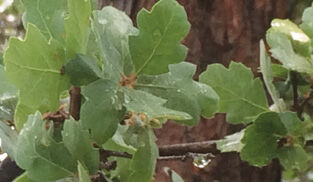
If you love oak trees but are wary of planting one because of Sudden Oak Death, you’ll be glad to know that not all native oaks are susceptible to the pathogen.
SOD is a problem for home gardeners mostly on the edges of wildlands, where acres of trees, in places, have been lost. It is also prudent to avoid planting known carriers, or host plants, of the pathogen if you live near wild oaks, and to avoid importing mulch from areas where the infection has been found.
The iconic oak of California hillsides, coast live oak, is susceptible. So are the other native red/black oaks, including California black oak, interior live oak and Shreve oak. Non-native oaks in this group include red, scarlet and pin oaks. In addition, the oaks classified as intermediate oaks are also susceptible. This taxonomic group includes canyon live oak and island oak, as well as three shrub oaks: huckleberry oak, Cedros Island oak and Palmer’s oak.
White oaks
So what’s left?
In fact, the pathogen has not infected the largest group of native oaks – white oaks – nor are they thought to be hosts of the pathogen. Furthermore, no hybrids have been found between white and red/black oaks, though “promiscuous hybridization” is found among the shrubby white oaks, according to Matt Ritter, a Cal Poly San Luis Obispo biology professor who hosted a recent workshop on tree identification.
The names of the groups refer to the color of the wood: red/black oaks feature reddish-brown wood, intermediate oaks have light-brown wood and white oaks have light-brown or yellowish wood. Other characteristics define the groups as well.
The white oak group boasts four trees – including California’s largest oak, the valley oak – and eight shrub oaks that are not often seen in gardens. Notably, the acorns of white oaks are usually less bitter than the acorns of red/black oaks. Native white oak trees include:
• Valley oak. It grows relatively fast in gardens, up to 40 feet tall and wide in 25 years, eventually reaching 100 feet, with deeply lobed deciduous leaves.
• Blue oak. It grows relatively slowly to 15-30 feet high, with gnarled branches, but in time can reach 60 feet, with deciduous blue-green leaves.
• Oregon white oak, or Garry oak. It grows 25 feet in 20 years, eventually reaching 90 feet, with deciduous dark green lobed leaves.
• Engelmann oak. Grown mainly in Southern California, it can reach 40 feet, with semievergreen blue-green leaves.
Shrubby white oaks include scrub oak, Muller oak, Nuttall’s scrub oak, leather oak, Tucker’s oak, island scrub oak, deer oak and desert scrub oak.
Valley oaks
Valley oaks once covered the Central Valley, but most of these magnificent trees were cut down to convert the fertile soils to agricultural use. They thrive in rich soils and where their roots can find groundwater, such as near a watercourse or in areas with a high water table, so they are more adaptable to gardens than other oaks.
Young trees are more upright, with age developing a rounded profile, the craggy branches swooping to touch the ground. Like other native oaks, they support a diverse and abundant population of beneficial bugs and birds.
Tanya Kucak gardens organically. Email her at [email protected]. r