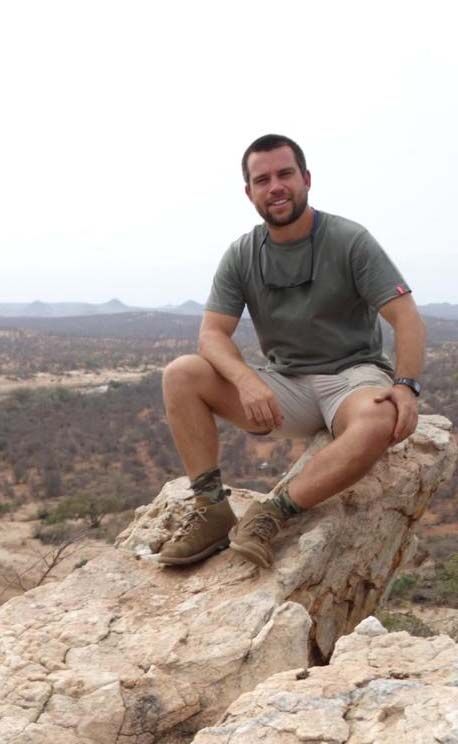
For many, watching National Geographic shows is simply entertainment enjoyed on the couch. Los Altos native Camille Fritsch’s devotion to the channel led him to South Africa, where he now conducts research in the KwaZulu-Natal province.
“When I was able to watch Nat Geo … I got really inspired by the rawness of nature and the apparent close relationship some people in Africa still had with nature and the land they depended on,” Fristch said. “I wanted that skill set and I wanted that lifestyle.”
A graduate of Los Altos High School and UC Santa Barbara, Fritsch is now working at the University of KwaZulu-Natal as a postdoctoral fellow after earning his doctorate in ecological sciences.
His research involves the study of wildlife – specifically hippo populations at Ndumo Game Reserve, Kruger National Park, iSimangaliso Wetland Park and Phongolo Nature Reserve in South Africa. Fritsch said he works with wildlife management authorities, and his research informs them on how hippo populations respond to current climate trends. This in turn helps the authorities devise ways to protect the hippo populations, because “fence-protected areas (like the game reserve and the wildlife inhabiting it) cannot be moved in response to climate change, or changes in resource availability,” he said.
To monitor the wildlife, Fritsch and his colleagues designed a census method with drones, which he said have proven to be accurate and affordable. The affordability aspect, according to Fritsch, was important because “impoverished countries don’t always have the budget to monitor and manage wildlife.” He hopes the technology can extend to monitoring other species in the future.
Fristch also mentioned the importance of conservation, which he called a “global issue.”
“Conservation is an industry that has been overlooked because we haven’t yet found a way to profit from it in our capitalistic society,” he said. “Los Altans – especially students coming through now – can have a serious impact as data analysts, scientists, managers and people with marketing skills.”
Although Fritsch said he arrived in South Africa intending to learn about animals, he eventually noticed his research’s connection to humans – revealing to him South Africa’s “massive poverty.”
Due to widespread poverty in the country (the unemployment rate was 34.9% in the third quarter of 2021, according to government statistics), Fritsch said many South Africans still depend on natural resources to get by. Consequently, they are drawn to protected areas like Ndumo Game Reserve to find wood, water, grass and meat. This ultimately causes competition for resources between the “impoverished communities” and the government protection agency responsible for maintaining the natural reserves, he added.
“It’s a very difficult problem to solve, and it’s not one that can be solved from far away,” Fritsch said. “It has to be solved on the ground, dealing with people and understanding their needs, accommodating those people first, and then managing wildlife and protected areas in light of knowing the needs of those people.”
Immersed in nature
Fritsch’s passion for ecology came not only from watching National Geographic, but also from childhood experiences that included adventures in
France’s wilderness with his grandfathers during the summer and observing wildlife at home in Los Altos Hills.
“We had deer in the yard. We had coyotes in the yard. My parents recently had bobcats in the yard,” Fritsch said.
Fritsch recalled that he always enjoyed his time outdoors and “finding creatures” – and “had a knack for it.”
Those factors led him to pursue environmental studies at UCSB and ecological sciences at the University of KwaZulu-Natal.
Fritsch has been in South Africa for seven years – an experience he called “completely boggling and amazing.” He said finds solace in the time spent in the protected areas, because he gets to feel “immersed in nature, really getting knocked down to size, and feeling really vulnerable – but then at the same time, very excited.”
Fritsch also enjoys learning about the people around him, noting that South Africa is a “diverse culture” with 11 official languages.
“I encourage you to check out the world and get immersed in these different cultures,” he said. “It makes you smarter and it gives you a depth of understanding of everyone’s issues – global issues.”
Traveling, along with researching and supporting research in other places around the world, “will help us all form a global plan for managing these resources in the future,” he added. “I think that’s really important, especially in the current context.”
For more information on Fritsch’s work, visit researchgate.net/profile/