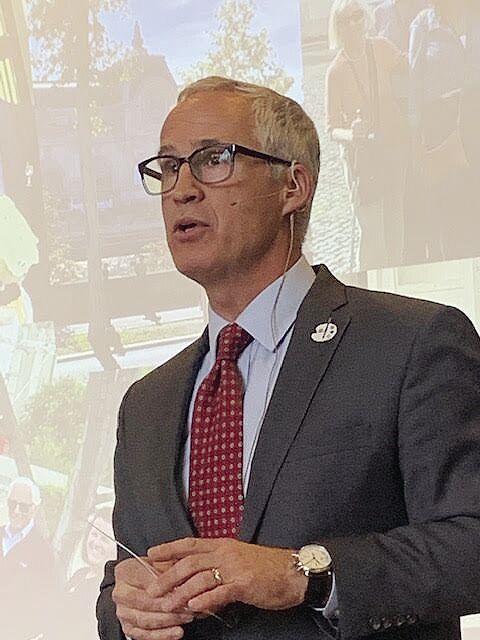
The Morning Forum of Los Altos audience was transported to Paris for “A Day at the Musée d’Orsay” Nov. 7 by art historian Michael Stehr, whose interest in art history began during his undergraduate years at Stanford University.
Stehr, a fine artist and decorative painter, gives tours of museums in Paris and Rome for small groups.
“When you get to the main opening of the museum, and that vast open space opens up before you, it is a ‘wow’ moment,” he said.
The Musée d’Orsay was constructed as a train station in 1900, but by 1939 the platforms were too short for the longer trains and the station was closed. In the 1970s, the Beaux-Arts structure became the chronological museum bridge between the Louvre (works up to 1848) and the Pompidou Center (works after 1914).
Impressionist artists challenged the status quo and engaged in a war with tradition. Many art historians regard the Impressionist period as the most important period in western art since the Renaissance.
Stehr showed slides of famous Impressionist paintings, offering the following details.
• Camille Corot’s work serves as the bridge between the traditional and the modern impressionistic paintings. Corot was a great source of inspiration for his uncanny ability to depict genuine, authentic, realistic outdoor light.
• Jean-Francois Millet challenged what the judges of the state salons thought was worthy of being subject matter. He painted peasants, such as in “The Gleaners,” doing their back-breaking work. He insisted that the work of these women was what put food on the tables of the upper class, so they were worthy of being celebrated.
• Édouard Manet painted “Olympia,” a portrait of a nude prostitute. His mantra was “Be of the day.” He painted in a new style, of a current subject.
• Claude Monet was one of the great titans of the Impressionist movement. His works were the clearest embodiment of the ideals of the movement, focusing on blurred lines, animated brush strokes and outdoor light.
• Edgar Degas painted scenes of recreational activities that were enjoyed by the upper class, such as horse racing, orchestra pits and ballet dancers at rehearsal. He was enthralled by movement.
Stehr also showed slides of the art of Auguste Renoir, Camille Pissarro, Paul Cézanne and Vincent Van Gogh.
He concluded his presentation with, “The journey to modern art is now complete.”
The next Morning Forum lecture, scheduled 10 a.m. Dec. 5, will feature Ignacio Ornelas Rodriguez speaking on “Bracero and Guestworker Programs: A Look at Farm Labor.”
Morning Forum lectures are held at Los Altos Methodist Church, 655 Magdalena Ave. Presentations are also available to members via Zoom. Morning Forum receives member donations and grants from Los Altos Mountain View Community Foundation and the Farrington Historical Foundation.
For more information, visit morningforum.org.