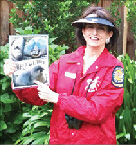
Los Altos resident Ginny Strock volunteers as a naturalist at Año Nuevo State Park, on the Pacific Coast south of Half Moon Bay. Docents lead guided walks during breeding season for elephant seals and serve as roving naturalists in the spring, summer and fall.
Q: How did you become involved with Año Nuevo State Park?
A: I grew up as a vocally reluctant member of a camping family. Even though I protested loudly, I did develop a love of nature and of just being outside walking and exploring. Two years ago, my husband and I took a tour and a fabulous guide lit a spark for me. Driving home, I said, “I could do that,” but my husband’s response was, “No way, you’ll never do it.” I do have a tendency to put a bit too much on my plate. That was all it took.
Q: What are the responsibilities of a naturalist-docent?
A: During the breeding season, from mid-December through the end of March, I give guided tours to groups of 20 people. It is great fun to arrive before the park opens and look for animal tracks, see which birds are around and gather with other docents in a little cabin we call the “roost.”
The volunteer coordinator assigns the docent tours, usually two or three for 90-minute tours each day. Weekdays, we conduct field trips for school groups. Our job is to guide visitors through the lowlands and over the sand dunes to observation points. During the “roving” season, April to November, visitors walk through the reserve on their own, and docents are stationed at designated observation points to answer questions and give information.
Q: What skills and training are required, and what is the time commitment?
A: My training class included people of all ages: a 9-year-old with his mom, college students, middle-aged people with full-time jobs and retirees. There are docents out there in their 80s who have done it for 25 years.
The training is like the most rigorous and fascinating college class I have ever taken – and, it’s free. The group in training usually meets twice a week for three or four hours at the reserve. Experts from around California give lectures on marine mammals, birds, other flora and fauna, archaeology, history, geology and how to guide. There are field walks, readings and homework. Each new docent is assigned a mentor and must meet twice a month during the training process to learn how to guide and to get a feel for the lay of the land. Once trained, the usual commitment is two shifts per month.
Q: What is your favorite part of volunteering?
A: I have so many favorite parts. I love the docents themselves and the rangers and other park personnel, as they are such an interesting group of people. My favorite experiences are watching reluctant campers, especially teenage ones, light up with excitement when they see a 5,000-pound alpha male elephant seal raise up and let out an awe-evoking bellow that sends all other males in his vicinity scrambling away. There is nothing quite like watching a teenager take off his sweatshirt hood, come close to the ledge and say, “Awesome!”
There is also nothing quite like watching a tour group observe a pup birth or watching a school group run down the sand dune and beg to do it again and again. At the end of my first year of guiding groups, my docent class got together for a potluck and evaluation of the year, and we were asked to sum up our first year’s experience with one word. Mine was “exhaustilating.”
Q: Who might succeed in this volunteer position?
A: Really, the only elements required are good physical condition, a desire to work with and speak to groups (both children and adults), the ability to get out to the coast on a regular basis, especially for the training, and a genuine love of nature.
To volunteer at Año Nuevo State Reserve, call the docent coordinator at 879-2032 or e-mail [email protected].
Carol Crites is a Los Altos resident and longtime volunteer. Send suggestions for this column to [email protected].