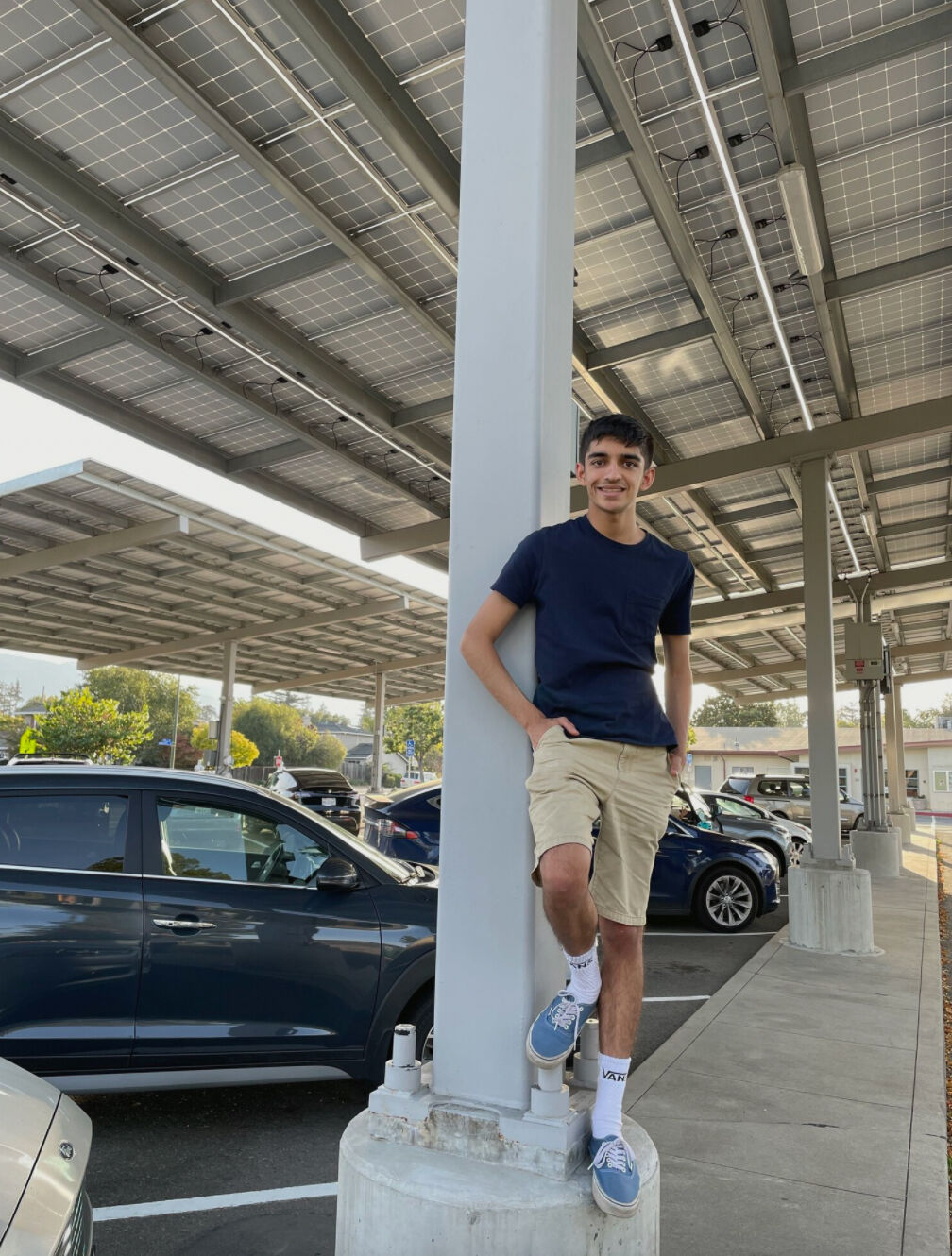
Kahaan Gandhi, a senior at Menlo School, wants to make implementing solar power more accessible for schools across the country.
At only 17 years old, the Los Altos resident founded an independent project, Schools for Solar, that measures the potential solar efficiency of 124,000 K-12 schools across the United States with the goal of demonstrating the economic and environmental value of using solar panels.
Schools for Solar doesn’t stop at measuring efficiency – it provides further analysis based on several different metrics. While Gandhi’s research is extensive and documented, Schools for Solar goes a step further to encourage stakeholders at the regional and state level to implement policies that drive solar installations, especially among states with ideal solar conditions. According to his research, California, Texas and Florida rank as the top three states with ideal solar potential, but potential does not necessarily match up with the rate of installations.
Gandhi hopes Schools for Solar can be a tool for school districts or local government agencies to use when assessing whether solar panel installation would be the right move for their buildings.
“You can install the same solar panel in different places and generate totally different amounts of electricity,” he said. “And right now, we are only looking at whether or not a region can afford it. But the problem is that we’re not concerned with the logical questions like, ‘Is this place sunny? Is it actually a good place to install it?” he said. “So, Schools for Solar gauges how much electricity you would actually be making. Will it be a good idea? Or should we maybe look at wind or thermal energy instead?”
Inspiration
Gandhi first became familiar with the potential for solar energy as a student at Blach Intermediate School, where he witnessed solar panels being installed on his daily walk to school. Just one month into the pandemic, Gandhi noticed the construction of new solar panels at his alma mater, Springer School, on his daily run, inspiring him to dig a little deeper into the study of solar energy.
He noticed that not only did solar roofs generate electricity, but they also provided shade and a convenient place to charge electric vehicles after hours, serving both the school and the community at large.
A sense of community is also what drew him to the environmental studies field. He said he has found environmental studies to be much less restrictive than other fields of science.
“I found the environmental field to be very welcoming,” Gandhi said. “With other types of research, you have to be on the breaking edge to make an impact. But here, in the environmental field, everyone is so supportive. It’s about protecting the Earth, so we’re all kind of on the same side.”
Schools for Solar represents the communal commitment. While Gandhi learned data visualization skills necessary for the project, he also received support from various experts in the field, including his mentor, Nazanin Rezaei, a doctoral candidate in environmental studies at UC Santa Cruz. Gandhi said he connected with her because they shared a similar interest in responding to philosophical problems with concrete data. Along with some guidance from Rezaei and other local experts, he pulled a comprehensive project together that provides information for schools across the country and advocates for solar energy as a means to combat climate change.
Next steps
A high school senior, Kahaan is currently waiting to hear back about his college applications for next year, but he plans to keep improving Schools for Solar. He recently partnered with the nonprofit Generation180 to compare his calculations to the current solar conditions at resource schools. Comparing the two data points of calculation and reality at the schools will improve the accuracy of his findings. He also plans to take coding classes in college, regardless of the major he chooses, to help expand the reach of Schools for Solar.
“There are a lot of things I could be finding that I haven’t considered yet, like the size of parking lots and how different schools might have different available surface area to work with,” Gandhi said. “Eventually, I could code that in and it would be even more refined. The more work I can do to help these schools, the more incentivized they will be.”
Despite being undecided on a specific major, Gandhi expressed excitement about pursuing environmental studies in college.
“There are so many angles you can approach the environmental field from. There’s a data science angle, the economic or policy angle, the math angle, the physics angle – I could go on because there are so many ways you can contribute,” he said. “I think I just want to experiment.”
For more information, visit schoolsforsolar.org.