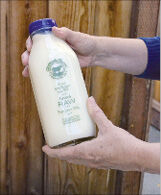
Raw milk has become a precious – and sometimes illicit – commodity among American eaters drawn to less processed, more primal foods. It’s banned in some states or permitted only to those who own their own cows. Even in California, a bastion of alternative eating, only four dairies have received licenses to sell raw milk.
But local residents have unusual access these days, due to a service that picks up milk at two raw dairies each week and delivers to Los Altos and Mountain View, in addition to other Bay Area locations.
Palo Alto resident Christina Hildebrand founded Real Food Bay Area as a Community Supported Agriculture (CSA) business after becoming a customer of Claravale Farm, which nurtured a small herd of cows and dropped off raw milk each week for a few dozen Bay Area customers. Hildebrand found them as she sought solutions for her young daughter’s milk intolerance – she believes that unpasteurized milk preserves delicate enzymes, improving digestibility.
“Those enzymes allow the lactose in raw milk to be broken down much more easily by a human body,” Hildebrand said.
When the opportunity to work directly with the dairy came up, Hildebrand said she “just couldn’t pass it up, and she expanded the delivery to a larger constellation of local foods that celebrate a similarly direct field-to-table ethos.
“Fruits, vegetables – food is just abundant in California,” she said.
Local eaters shared her values – demand for raw milk outpaced production, and Real Food Bay Area this month added a new line of milk, from the fourth licensed Grade A raw dairy in California.
“We’re lucky in the state to have it available legally,” she said. “The California Department of Food and Agriculture tests the milk regularly and it truly is clean milk. These are small dairies and it’s their livelihood – they can’t afford not to have clean milk, they can’t afford not to feed their animals properly and look after them.”
Risks vs. rewards
Unpasteurized milk is an intriguing liquid – it doesn’t go “bad” like the milk most of us know. Because benign bacteria survive in it, over time the milk sours rather than spoils, changing state to something more like buttermilk or yogurt, and remains wholesome to consume, if not sweet. Real Food Bay Area’s milk travels from udder to glass within 24 hours, in contrast to the ultra-pasteurized store products that can linger on shelves for weeks or months.
Historically, raw milk has spread infections ranging from E. coli to typhoid. Risk remains in modern milk, which dangerous bacteria can contaminate while it is still inside the cow or during and after the milking process.
U.S. health authorities are unambiguous: Raw milk presents substantial food-safety risks, particularly for children and pregnant women. Raw-milk advocates believe that meticulous cow-raising and milking practices mitigate those risks. Pasteurization, the process that transforms raw milk into the liquid on standard store shelves, rapidly heats, then cools the milk, killing both pathogens and benign bacteria and – according to raw-milk lovers – fundamentally changes the milk for the worse in terms of taste, digestion and health effects.
Cleveland dentist Weston A. Price traveled the world in the 1930s to study groups beginning to eat mass-produced and pasteurized food. He documented the physical defects he associated with eating refined sugar, white flour and pasteurized skim milk in “Nutrition and Physical Degeneration” (Price Pottenger Nutrition, 2009). In the Los Altos area, advocates of a Price-inspired diet often seek out raw milk because they believe that it preserves enzymes and bacteria that promote digestion and a healthy immune system.
There’s more to the diet than raw milk – it celebrates organic, sustainable farming practices and pasture-raised, humanely treated livestock. Real Food Bay Area caters to those preferences.
The CSA enables customers to handpick their orders each week on the Real Food website rather than offering everyone the same seasonal box. It operates somewhat like a co-op, inviting consumers to buy from farmers at a lower price than they’d pay in the supermarket. Hildebrand vets new vendors based on farm visits and criteria such as organic practices and humane animal treatment.
You can buy quarts of milk for approximately $4.50 plus a bottle deposit and eggs at $7 a dozen as well as fermented foods like kefir and kvass and sustainable and/or organic seafood, chicken, beef, honey and cheese. Berkeley-based Three Stone Hearth offers a rotating menu of prepared dishes (such as ragu, soup or stew) that CSA members can now preorder off a menu as well.
For more information on Real Food Bay Area, visit realfoodbayarea.com.
For the U.S. Centers for Disease Control and Prevention warnings about raw milk, visit cdc.gov/foodsafety/rawmilk/raw-milk-index.html.
To explore The Weston A. Price Foundation’s pro-raw-milk project, visit realmilk.com.