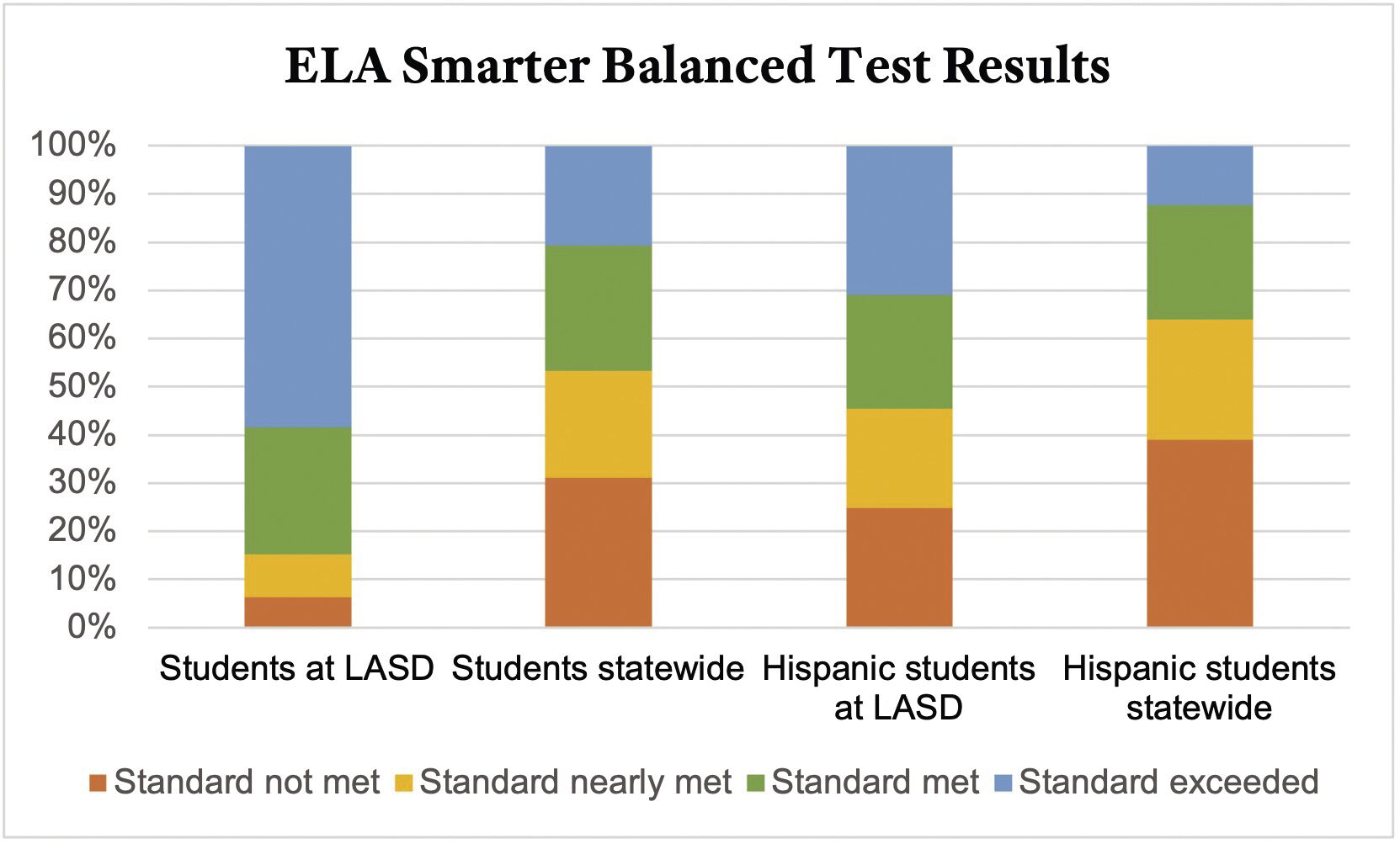
While the Los Altos School District consistently performs well above the vast majority of the state in standardized tests, it continues to suffer from a significant achievement gap along racialized lines.
The district’s Latino students are only meeting or exceeding grade-level standards in English and math at a rate of about half of their white and Asian peers, who pass around 85-90% of the time.
The findings are based on the results of the Smarter Balanced Assessment System, a standardized test administered to all students in grades 3-8 (excluding new English language learners), aligned with Common Core State Standards for English language arts (ELA) and mathematics.
Data going back to the mid-2010s indicates that performance of Latino students in LASD has been declining – even before the pandemic. Where Latino students met ELA and math standards at a rate of 59.9% and 54.8% respectively in the 2017-2018 school year, this school year those numbers dipped to 54.5% and 50.2%.
However, the number of Latino students taking the assessment (233 students this school year) is a relatively small pool of the total district population, which can mean a higher amount of variability within any given year of test results. It’s also important to note that Hispanic students in the district are meeting standards at 1.5-2 times the rate of the same demographic statewide, but that the gap between Hispanic and white/Asian students is wider in LASD than it is throughout the rest of California.
“I believe very strongly that this is a big issue, regardless of the number of students, even one student is a big issue – but a small number does present a challenge of really understanding the trends,” LASD director of teaching and learning Greg Drummond told the Town Crier. “We have found a lot more success by examining students on a case by case basis and understanding what their real individual needs are.”
Drummond said the achievement gap cannot just be chalked up to language differences, socioeconomic status or pandemic-related learning loss, but that it is a multifaceted issue that can shift based on each group of students in a given year. He acknowledged that Hispanic students and their families are not monolithic and that there is “obviously nothing about being Hispanic that makes you less likely to learn.”
This is why the district is pursuing a more individualized approach where students’ learning is routinely monitored by teachers in the classroom and through routine assessments that evaluate literacy skills, according to Drummond. Students who need help often receive intervention through group or individual sessions with their teacher. When a student isn’t making enough progress through classroom intervention, they will be pulled out of class several days of the week to work individually with a staff member that follows a “research based, nationally produced” intervention curriculum,” he added.
In addition to academic intervention, Drummond said there is more of an effort at the district level to get to know children as individuals to help identify things they can do within a larger system that will improve outcomes for more students.
“What we found is that our best bet is personal connection,” he said. “We believe so strongly in the power of developing positive developmental relationships with kids and in creating environments that are safe where they truly have a sense of belonging as prerequisites to learning. And so, we’re working really hard to do that.”