Excitement for the curtain-raiser of San Francisco’s cultural season poured in with the crowd at the War Memorial Opera House, decorated with red and burgundy flowers arranged as cynical clown faces across the balcony rails and in the lobby. Guiseppe Verdi’s “Rigoletto” opened San Francisco Opera’s 103rd season on Sept. 5.
With a prominent place in the canon, Verdi is well regarded as a composer and storyteller who dramatized power, morality and the human condition. Operas serve as cultural touchstones with enhanced storytelling through drama and music. As one of the most celebrated pieces in history, the 1851 opera “Rigoletto” is no exception.
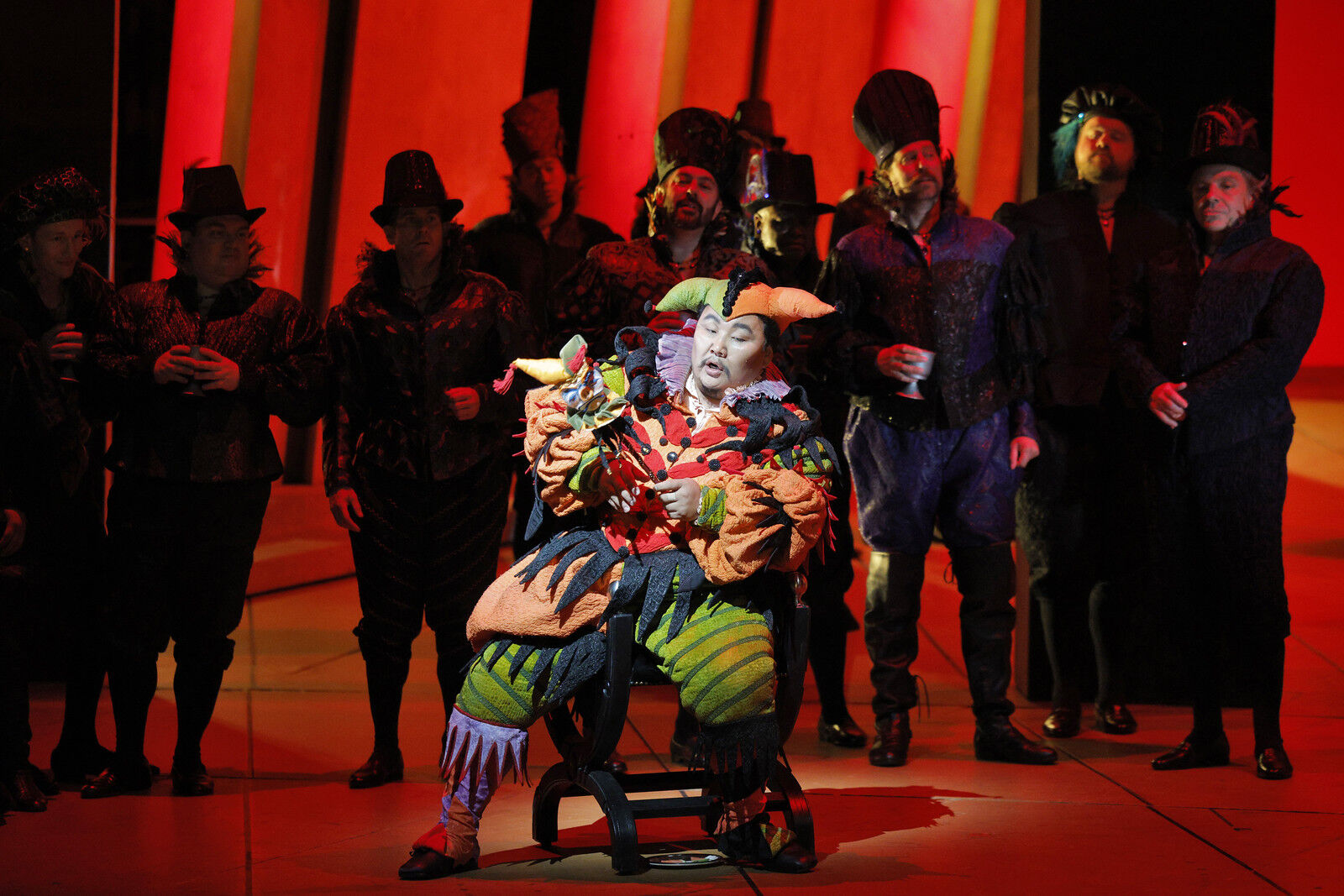
The story of “Rigoletto” is centered in the 16th century on a morally complex anti-hero, Rigoletto – a deformed, hunchbacked court jester – whose daughter’s tragic death exposes the corruption of the powerful. Rigoletto often gets carried away as he amuses the Duke of Mantua by hurling insults at courtiers and mocking their suffering, sometimes, with cruelty, even though he knows the duke is a careless and merciless womanizer. Rigoletto’s cruelty causes a curse to be laid on him by Count Monterone, whose daughter is dishonored by the duke. Rigoletto’s beautiful and innocent daughter, Gilda, fell victim to the seductive ruler, who abuses women with his charm and lies. Rigoletto’s attempted revenge on the duke ends with the ultimate tragedy, as Gilda’s blind love for the duke makes her willingly sacrifice her life to save him from being killed by Rigoletto’s hired assassin Sparafucile.
There are several famous arias from this opera; the most universally recognizable has to be “La donna è mobile” (“Woman is fickle”). Rapid and energetic, “La donna è mobile” is an impossibly catchy tune with irresistible buoyancy. Ironically, as a celebrated entertainment in the 19th century, it carries blatant confidence without conscience, provoking reflection in the 21st century as it collides with our cultural debate over gender-based power plays and inequality masked by charisma and charm. Music director Eun Sun Kim leaned into the bright and breezy cynicism with sinistry simmering beneath; contrasted with the looming weight of the curse, such beauty in music carries a striking darkness.
The international cast includes Amartuvshin Enkhbat, the Mongolian baritone who will have played the title role more than 120 times after the conclusion of the current production. Enkhbat possesses musical and dramatic power in portraying an aggressive jester, yet a deeply loving and protective father tormented by hatred and revenge. Adela Zaharia is the Romanian soprano, whose supple and shimmering voice grows Gilda’s character from girlish innocence to heart-wrenching agony and sacrifice.
Stage and lighting designs frame the storytelling in a dramatic, uncanny and melancholic setting with high contrasts. Michael Yeargan’s staging, inspired by Italian surreal artist Giorgio de Chirico’s cityscape painting, consists of towering arcades, empty alleyways and flat buildings with hollow windows, etched in ominous elongated shadows under Justin Partier-designed stark red, green, blue, purple and yellow lighting, creating visual echoes of the curse, drama and tragedy. The contrast between light and shadow mirrors the opera’s moral polarity: charisma and cruelty intertwined, beauty sacrificed for brutality.
Through “La donna è mobile” and the curse, Verdi wraps cynicism in gleaming musical charm, tying together mockery, hubris, fate and tragedy in “Rigoletto.”
The opera runs through Sept. 27 at the War Memorial Opera House, San Francisco. For more information and tickets, visit sfopera.com.