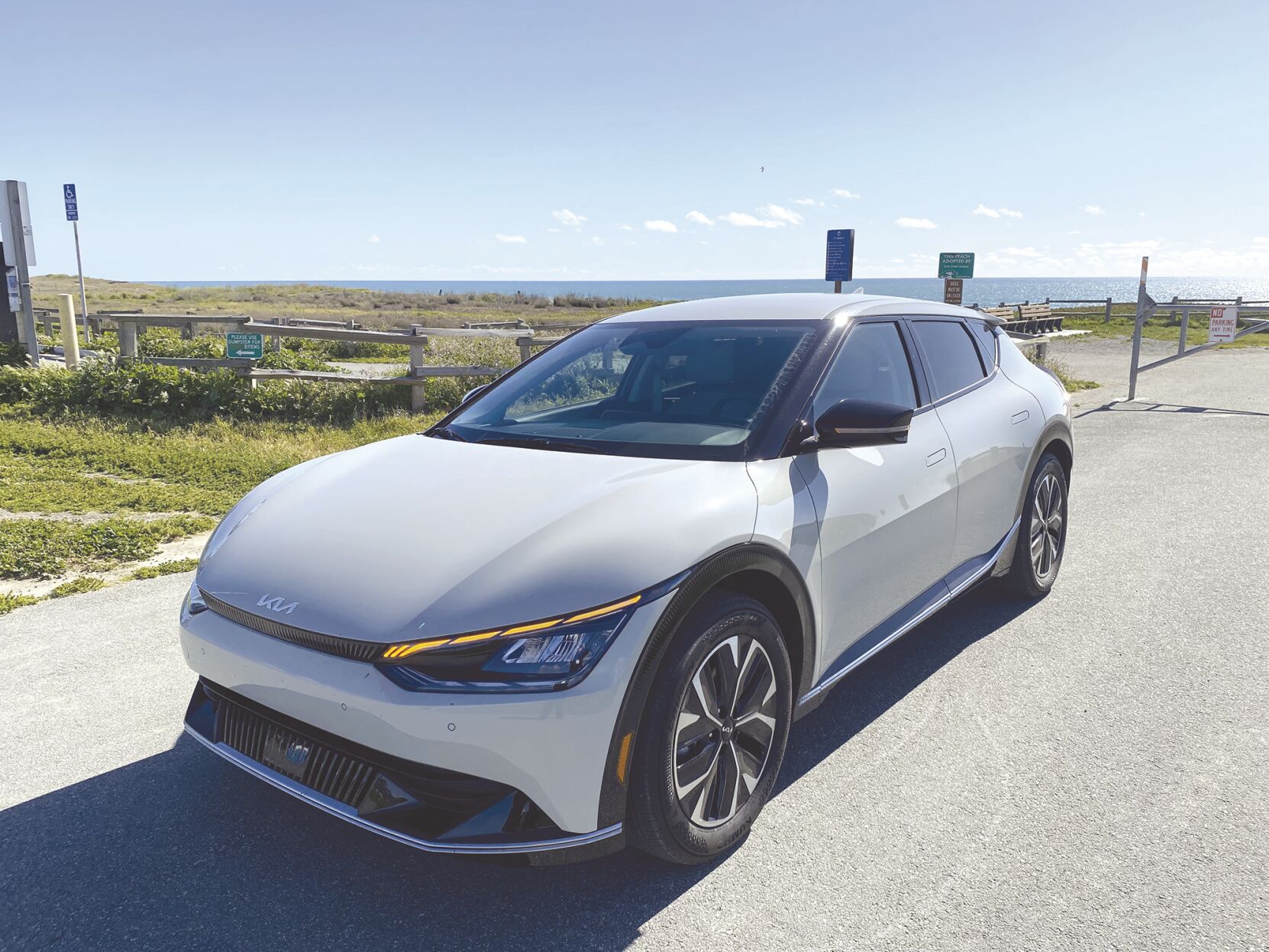
A mere four months after our road trip in the 2022 Hyundai IONIQ5 AWD (On the Road, May), here comes a road trip in its sibling beneath the skin, the 2022 Kia EV6 Wind.
I write “sibling beneath the skin” because Hyundai and Kia are corporate cousins that based the two cars on the same architecture and then let their own designers run when it came to the body. The IONIQ 5 is a 15/10ths-scale VW Golf. The Kia EV6 is otherworldly – but in a good way.
There’s more going on aerodynamically in the EV6 and, though I can’t prove it, I think it contributes to what seems to be less wind noise than in the IONIQ 5.
There are two ways to spec these, mechanically: The AWD has 320 horsepower and a range of 250 miles per charge; the RWD comes with 225 horsepower and a range of 310 miles per charge.
The AWD EV6 can go from 0 to 60 mph in just under 5 seconds. The RWD model, like our tester, is no slouch, either, reaching 60 mph from a standing start in 7.2 seconds.
With EVs, the vehicle governs the charger, telling it how much of its capability (if available) to send to the battery. The EV6 and IONIQ 5 are two of only five EVs available today with 800-volt charging (the others are the Porsche Taycan, Audi e-tron GT and Lucid Air). That enables the quickest charging times currently possible, from 10% to 80% charge in just 18 minutes.
Scenic route with range
Our trip this time was from Folsom to Half Moon Bay for Western Automotive Journalists’ Media Days 2022. We spent the weekend on the Peninsula and set out on Monday for Half Moon Bay from Burlingame with 98% charge.
As usual, my wife and I took the long way, along Crystal Springs Reservoir, up onto Skyline Drive, detouring to Woodside for lunch, then through Portola Valley and La Honda to the coast and up to Half Moon Bay. Those 53.8 miles could have been cut to 13.3 the most direct way, but where’s the fun in that?
The advantage to the route we took, besides astonishing beauty, is that the hills and curves play to the EV6’s regenerative braking. As we did in the IONIQ 5, we added miles to our range, what worked out to being 15-20 miles per every 100 miles driven (we took the scenic route on the way home, too). There’s no need for as exhaustive a review of range and charging here as I wrote in the Hyundai’s review. The Kia EV6 proves that wasn’t a fluke. This is what these cars do.
As with the IONIQ 5, there’s plenty of room for people and their things. There’s also great visibility, thanks to slim A-pillars. But again, Kia gets to make the EV6 its own car; there’s a different dashboard with a similar instrument display and a different center console.
The Wind is the mid-line EV6 trim. Base price for an RWD model like our tester is $47,000. At that price, the standard equipment includes Android Auto and Apple CarPlay, Meridian premium audio system, navigation-based smart cruise control, dual-zone automatic climate control, wireless phone charger, seats covered in a combination of recycled fabric and vegan leather that are heated and ventilated, 19-inch alloy wheels and smart-power tailgate.
And that’s it. Apart from the $495 paint (a shade called Glacier), there are no extra-cost options. So, with $1,215 inland freight and handling, the as-tested price of the Kia EV6 Wind RWD is $48,710.
However, that’s not the bottom line.
Kia still qualifies for tax credits with its EVs, so knock $7,500 off that price. That drops the price to $41,210. Wait, what’s that? California adds another $2,000 in tax credits. That makes the net price $39,210.
The Kia EV6 is a remarkable car at any price. At that price, it’s a steal.
Mike Hagerty, vice president of membership for Western Automotive Journalists (waj.org), has been writing about cars since 1997. To read more of his reviews, visit his website (MikeHagertyCars.com) and follow him on Twitter (twitter.com/mikehagertycars).