The bad news: Lawns and conventional landscaping can account for up to 70 percent of your water bill, mowers and blowers contribute to air pollution and fertilizers drain into our water systems. The good news: There are beautiful, drought-tolerant alternatives to lawns and the Santa Clara Valley Water District offers rebates up to $2,000 to encourage removal of thirsty lawns.
Once you decide to replace your lawn with something more eco-friendly, what should you put in? Following are some ideas.
Synthetic turf
While synthetic turf initially sounds like a great idea, I have several beefs with it. Unlike true lawns, synthetic lawns do not respire and cool the area. They are notoriously hot, and children have been burned playing on them. They give nothing back to the earth, they don’t decompose and enrich the soil. Worst of all, they are not recyclable when you are finished with them – a large plastic mass goes into the landfill. Have I dissuaded you yet? Also, the rebate does not apply to plastic lawns.
Herbal lawns
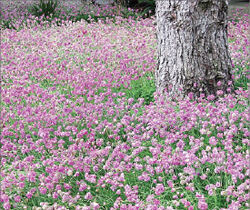
Although an herbal lawn made of Yarrow (for sun) or Yerba Buena (for shade) has the same downsides as any monoculture, it is more drought-tolerant than turfgrass, and doesn’t require weekly mowing. You can occasionally walk on these plants, but regular foot traffic should be diverted to a path or stepping-stones. Yarrow should be cut back after blooming. Sea Pink can make a showy and unusual lawn as well.
Ground covers
Here’s a way to cover a large expanse without a large expense, I think this is the least-expensive strategy. Fast-growing plants like Carmel Creeper or Bee’s Bliss Sage can cover an 8-foot-wide area within two years. This chokes out weeds and creates a large, uniform planted area that contrasts beautifully with taller accent plants.
Hardscape
Hardscape is the landscaping term for all the areas that aren’t soil and plants – the patios, decks, paths, walls, etc. May I put in a pitch for permeable hardscaping? Your drought-tolerant garden will benefit if you can keep all of the water that falls on your property on-site. Instead of concrete, consider pervious concrete and pavers, decomposed granite, gravel and mulch.
Meadows
A meadow conjures images of a grassy field filled with wildflowers, and you can create that at home. Meadows require a different mindset than a lawn, as they don’t look the same all year long. The seed heads sway in the breeze, flowers come and go and there may be a dormant period.
To establish a meadow, you must control the competing weeds, including invasive European annuals like foxtail and wild oats and perennials like oxalis and Bermuda Grass. You should start by pre-germinating and then killing the weed sprouts and controlling them as they come back.
Decide whether you want a bunch grass like Leafy Reed Grass or California Fescue, which would allow some flowers to be interplanted, or a mildly running grass like Red Fescue or Dune Sedge, which eventually chokes out the flowers and creates a more uniform appearance. Some grasses are available to plant from seed, others are only available by plugs or larger plants.
Recently, several mixtures of native meadow grasses have become available in sod form. Many of the valleys we currently inhabit were once meadows of deep-rooted perennial grasses. It takes a bit of time to bring them back, so be patient and persistent.
To apply for the rebate, contact the Santa Clara Valley Water District at (800) 548-1882 or www.valleywater.org to schedule a Water Wise House Call and have your lawn measured. Then you have three months to replace the lawn with drought-tolerant plants from an approved list. San Jose Water Company customers should contact (408) 279-7900 to schedule a Water Watcher Report.
Deva Luna works for a sustainable landscape contractor, EarthCare Landscaping, in Cupertino. For more information, e-mail [email protected] or visit www.earthcareland.com.