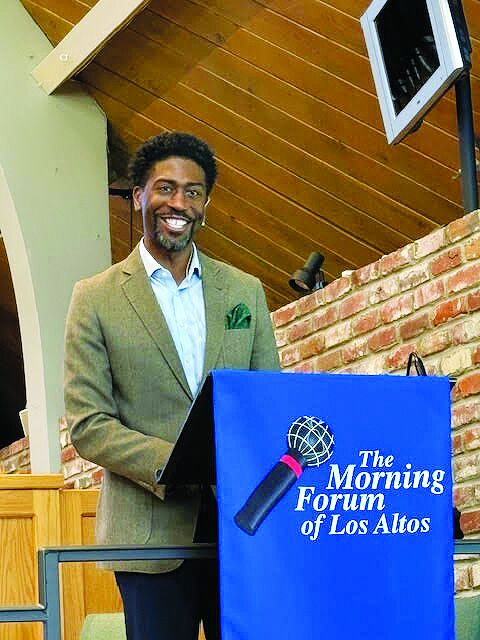
Morning Forum members were rewarded for braving the rain on Feb. 4 to hear Dr. Lerone Martin’s informative talk “Martin Luther King’s Process of Change Through Non-Violence.”
Since 2022, Martin has served as the director of the Martin Luther King, Jr. Research and Education Institute at Stanford University. His talk focused on how the King Institute uses research, education and public outreach to keep Dr. King’s legacy alive.
Martin is also the Martin Luther King, Jr. Centennial Professor of Religious Studies and of African and African American Studies. He has received numerous awards for his research, writing and teaching and has served as a commentator for major media outlets including The History Channel, PBS and the New York Times.
After the establishment of Martin Luther King Jr. Day as a national holiday in 1983, Dr. King’s widow Loretta King decided she wanted an institute established to publish all of King’s sermons, photographs, speeches, papers and even private correspondences.
A good friend suggested that she entrust the King Papers Project to Claybourn Carson, a young history professor at Stanford.
The goal of the project was to publish 14 volumes, chronicling every aspect of King’s 36 years. By the time Martin replaced Carson as the second director of the project, seven volumes covering MLK’s life from his birth in 1929 to 1962 had been completed.
Martin said that King first became aware of racism when he was 6 years old and the mother of his best friends told him they could no longer play with him because he was a “N word.”
In tears, young Martin went home and crawled into his mother’s lap. His mother assured him that despite the cruelty and ignorance of the woman, “You are somebody and don’t ever let anyone take your ‘somebodiness’ away from you.” Martin explained that King went on to use those words many times in his sermons and speeches.
Determined to become an attorney so he could fight against injustice, King entered Morehouse College in 1944. But by the time he graduated, King had decided he could do the most good by becoming a minister. And so he headed to divinity school and then went on to earn a Ph.D. in theology at Boston University.
To explain King’s belief in nonviolent direct action, Martin described what the reverend viewed as “the evil triplets: racism, poverty and violence.”
King believed that inaction merely leads to acceptance of evil while violent reaction leads to more violence and is no more effective than using fire to fight fire. In either case, King believed “nothing is accomplished.”
The project is now working on Volume 8, which covers the events of 1963, including the famous March on Washington for Jobs and Freedom.
As the official title of the march indicates, King’s goal was to eliminate both racism and poverty by getting fair pay for all workers.
Martin then proceeded to describe the many ways the King Institute uses education to ensure King’s legacy. Martin teaches a number of classes at Stanford on the Civil Rights Movement. But he is proudest of the outreach the Institute has made to 250 students in 10 Title 1 high schools across the country by allowing them to take a hybrid class similar to one he teaches Stanford students on King and Malcom X. When they pass, they earn a Stanford credit.
In a four-minute videotape, Martin showed the impact the class has had on the students. One student said that completing the class “has made me more motivated because I now know I can succeed in a college course.”
The Institute also sponsors public events and conferences to generate support for issues like health equity and poverty which greatly concerned Dr. King.
Annually, the institute joins with Stanford’s Medical School to sponsor a Health Equity Symposium.
Scholars from departments throughout the campus exchange ideas and work together to address what King referred to as “the most inhumane” form of inequality.
In discussing the future of the Institute, Martin described his excitement at recently moving to a new building in the center of the campus, which gives it and its mission more exposure.
He also explained that through a generous donation from a Stanford alumni, “We will now be digitizing the final seven volumes, which will make the material less expensive to produce and more accessible than the heavy tomes of the first seven volumes.”
Martin is also excited about finding sponsors to bring low-income students to the Stanford campus for two weeks every summer, an experience that will certainly increase their confidence that they can meet the challenges of college life.
Given how many audience members expressed their concern for the survival of King’s legacy and democracy itself under the current administration, Martin offered some comfort in King’s observation decades ago: “U.S. history has always experienced backlash against change.”
Acknowledging that social media has greatly changed the way people communicate, Martin still believes that we must follow King’s legacy and continue to hope, organize and speak truth to power.
He added that King urged everyone who wanted to support his movement but couldn’t demonstrate, to do what they could do, to use their “time, talent and treasure to push the needle toward justice.”
Morning Forum of Los Altos is a membership lecture series held Tuesdays at the Los Altos United Methodist Church. For more information, visit morningforum.org.